
Bluebell wood: spring carpets of Hyacinthoides in ancient woodland
A bluebell wood is a deciduous woodland that in spring produces a dense carpet of bluebells (Hyacinthoides non-scripta). This article explains their ecology, history, cultural role, and conservation issues.
A bluebell wood is a stand of trees in which, for a few weeks each spring, the ground beneath the young leaf canopy becomes carpeted with flowering bluebells. Often associated with temperate deciduous forest, these displays depend on a seasonal cycle: bulbs send up leaves and bell-shaped flowers in early spring, then die back as the tree canopy closes and shades the forest floor. The term is used broadly to describe the habitat and the spectacle, and it appears across regions of Europe where the native bluebell thrives.
Image gallery
5 Images

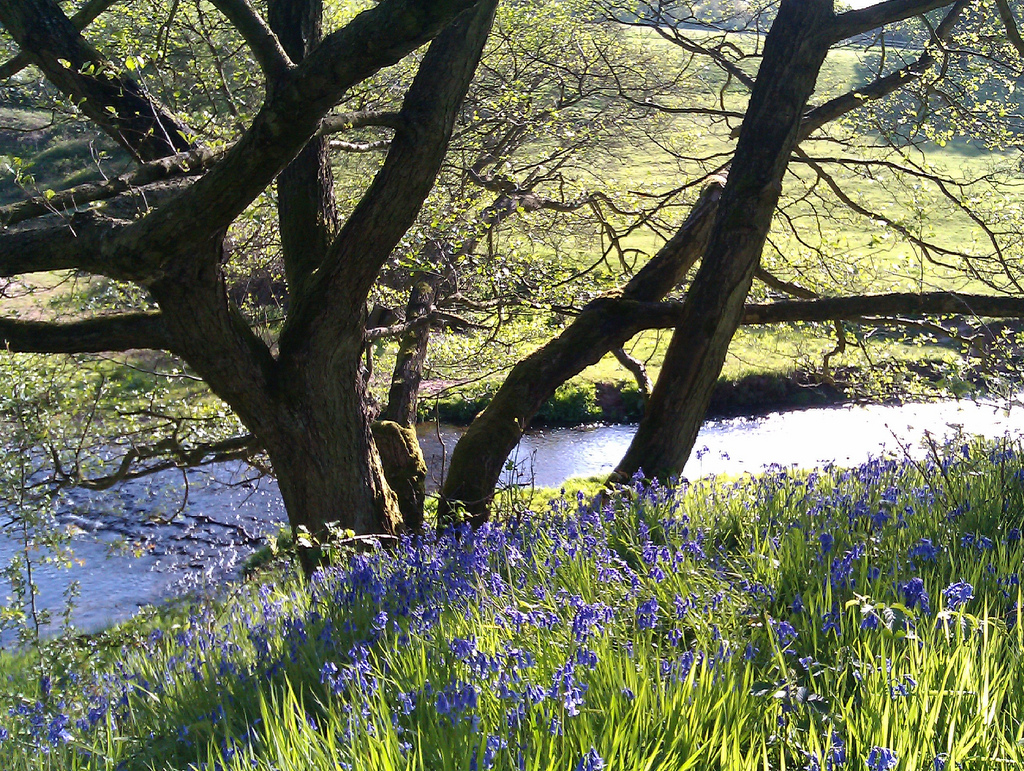


Where and how they form
Native bluebells (primarily Hyacinthoides non-scripta) favour cool, moist soils and dappled light. They are most conspicuous in places where the overstorey is deciduous and opens in spring before leaf cover becomes dense. Such woodland often supports a flush of early herbs and bulbs that complete their growth cycle in the narrow window of high light availability. Because the ground flora is suppressed once the canopy thickens, a dense and continuous canopy in summer can encourage an especially vivid bluebell carpet the following spring, as competing plants are reduced.
Ecology and significance
Bluebell woods are ecologically important. As spring ephemerals they provide nectar and pollen to early insects and help structure the seasonal succession of woodland plants. The presence of abundant native bluebells is also widely used as an indicator that a patch of woodland is long-established. In Britain and Ireland, for example, dense bluebell populations are commonly interpreted as a sign of ancient woodland, often meaning the site has been continuously wooded for several centuries. Conservationists therefore treat bluebell-rich woods as habitats of high biodiversity value and historical continuity.
History, culture and literature
Bluebell woods have held a special place in the cultural imagination of regions where they occur. Writers and poets have long celebrated the sudden transformation of the forest floor each spring; one well-known example is the English poet Gerard Manley Hopkins, who described the visual and sensory richness of bluebells in his notes and verse. Public enjoyment of bluebell displays helps to promote woodland protection and seasonal visitation, though increased footfall must be managed to avoid trampling sensitive ground flora.
Identification and notable distinctions
- Native vs non-native: The native Hyacinthoides non-scripta bears nodding, one-sided racemes of deep blue, often with a sweet scent. Non-native species such as Hyacinthoides hispanica and hybrids can differ in colour range, flower orientation and robustness.
- Ancient woodland indicator: Thick carpets of native bluebells are regarded as evidence of long-established woodland; surveys and ecological assessments frequently cite them when identifying ancient woodland.
- Seasonality: Leaves and flowers appear in spring and typically die down by early summer as the tree leaves develop.
Threats and conservation
Bluebell woods face multiple pressures: habitat loss and fragmentation, trampling by visitors, illegal collection of bulbs, and genetic dilution through hybridisation with introduced species. In some countries there are legal protections and guidance for managing wild bluebells; for example, in parts of the UK and Ireland authorities warn against removing wild bulbs and recommend measures to limit disturbance. Practical conservation actions include protecting woodland boundaries, controlling non-native species that hybridise with the native bluebell, and encouraging responsible public access.
Where to learn more
Bluebell woods occur widely across Great Britain and Ireland and in other parts of north‑west Europe: many nature reserves and public woodlands advertise bluebell displays in spring. For further reading see local woodland guides and botanical resources such as general pages on bluebells, the structure of a leaf canopy, and regional information for Great Britain and Ireland. Specialist conservation pages also discuss why the presence of bluebells is used as a marker for ancient woodland and how sites can be protected from disturbance.
Questions and answers
Q: What is a bluebell wood?
A: A bluebell wood is a woodland that in springtime has a carpet of flowering bluebells (Hyacinthoides non-scripta) underneath a newly forming leaf canopy.
Q: Where can bluebell woods be found?
A: Bluebell woods may be found in all parts of Great Britain and Ireland, as well as elsewhere in Europe.
Q: How old are bluebell woods likely to date back to?
A: Bluebells are a common indicator species for ancient woodlands, so bluebell woods are likely to date back to at least 1600.
Q: Who was keen on bluebells?
A: Gerard Manley Hopkins, one of the romantic poets, was very keen on bluebells.
Q: What did Hopkins say about the sight of the bluebells?
A: In his journal entry for 9 May 1871 Hopkins said it was "a lovely sight" and that the "bluebells in your hand baffle you with their inscape, made to every sense".
Q: How does Hopkins describe the sound of the bluebell stalks when rubbed together?
A: Hopkins describes it as making "a brittle rub and jostle like the noise of a hurdle strained by leaning against".
Q: What does biting into a blue bell taste like according to Hopkins?
A: According to Hopkins there is a faint honey smell and in the mouth there is a sweet gum when you bite them.
Related articles
Author
AlegsaOnline.com Bluebell wood: spring carpets of Hyacinthoides in ancient woodland Leandro Alegsa
URL: https://en.alegsaonline.com/art/12390
Sources
- commons.wikimedia.org : Hyacinthoides non-scripta
- timesonline.co.uk : Bluebell woods of Britain
- treeforall.org.uk : The Woodland Trust
- woodlandtrust.org.uk : What is an ancient wood?
- poetsgraves.co.uk : May Magnificat