
Klemens Wenzel von Metternich
Austrian statesman and diplomat (1773–1859) who shaped post‑Napoleonic Europe through the Congress of Vienna, the Concert of Europe and conservative continental diplomacy.
Klemens Wenzel von Metternich (1773–1859) was a leading Austrian statesman and a prominent diplomat of the early 19th century. Serving as Austria's principal foreign minister from 1809 and later as chancellor, he guided imperial policy through the collapse of Napoleon's empire and the settlement that followed. Metternich is best known for promoting a diplomatic framework intended to prevent large‑scale war in Europe by preserving a balance among major powers and by resisting revolutionary and nationalist movements.
Image gallery
10 Images


Career and rise to influence
Born into the German‑speaking aristocracy of the Holy Roman Empire, Metternich rose through the Austrian diplomatic service at a time when the French Revolutionary and Napoleonic wars were transforming Europe. He became Austria's foreign minister in 1809 at a moment when Napoleon's France dominated much of the continent. Metternich combined cautious pragmatism with a strong commitment to the preservation of the multi‑ethnic Habsburg state. He sought to keep Austria intact and influential by making careful alignments, withdrawing from disadvantageous obligations imposed by France when opportunities arose, and by repairing relations with other great powers.
The Congress of Vienna and the European order
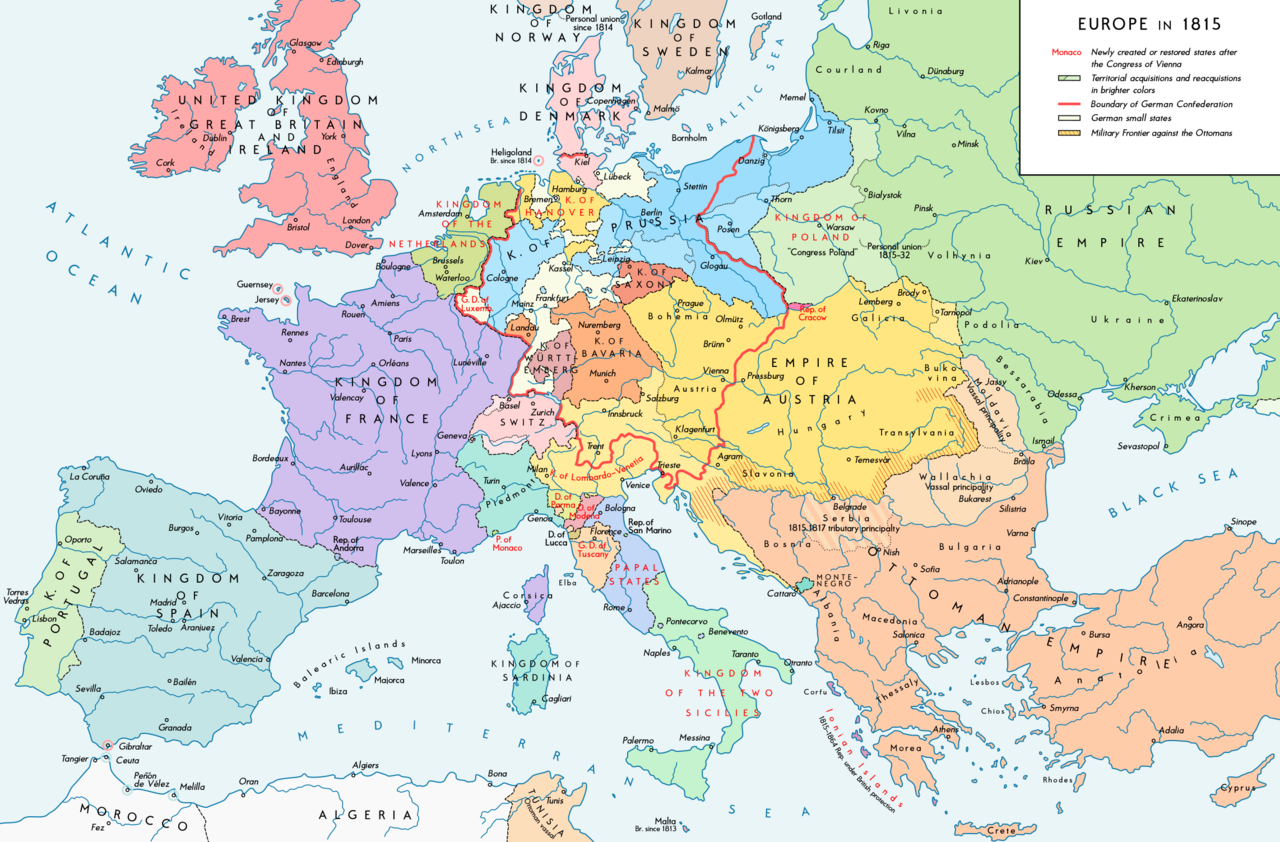
After Napoleon's first abdication, leading statesmen gathered at the Congress of Vienna (1814–1815) to redraw borders and create a durable settlement. Metternich played a central role in that process, advocating a system—often called the European order or Concert of Europe—designed to prevent any single state from dominating the continent. Practical elements of this settlement included strengthening certain states to act as buffers: combining the Southern Netherlands with the Northern provinces to create a stronger polity that included Belgium and Luxembourg under a reorganized Netherlands; consolidating hundreds of small principalities into larger units within the German-speaking lands; and recognizing a set of principalities and kingdoms in the Italian peninsula rather than a single unified Italy. Those arrangements aimed to check the power of France and to reduce the chance of future European-wide conflict.
Diplomatic practice and crisis management
Metternich favored negotiated settlements, secret diplomacy and a network of personal contacts among rulers. He worked within the alliances formed against Napoleon—most notably the coalition sometimes identified with the Quadruple Alliance—to translate wartime cooperation into peacetime guarantees. He also attempted to manage expansion and succession crises. For example, when Alexander I of Russia considered intervening forcibly in the Balkans or sending troops to support uprisings, Metternich argued against moves that might provoke a wider competition over territories of the Ottoman Empire. He feared that the implosion of Ottoman rule would invite rival claims and disrupt the delicate balance; this perspective shaped Austrian policy toward intervention in the Greek War of Independence and other eastern Mediterranean crises, including the question of whether to send troops to Greece in support of Orthodox Christians.
Conservatism, internal order and the German question
Domestically Metternich was a conservative who believed that revolutionary and nationalist movements threatened stability. His policies emphasized censorship, surveillance of political societies and coordination with other governments to suppress subversive activity. He supported the maintenance of the German Confederation as a loose framework of sovereign states rather than a single nation‑state, because a unified Germany could upset the continental balance and weaken Austria's position. That stance put him at odds with later proponents of national unification.
- Key actions: negotiating settlements at Vienna, building the Concert of Europe, arranging territorial adjustments to create buffer states, and coordinating conservative reaction to revolutionary movements.
- Methods: coalition diplomacy, secret treaties, diplomatic congresses and pressure on domestic opponents through censorship and police measures.
Revolution, exile and legacy
The revolutionary wave of 1848 reached Vienna and other Habsburg territories; mass unrest forced Metternich from office and into temporary exile. The revolutions marked a decisive blow to the system he had defended, and in subsequent decades European politics moved in directions he had tried to prevent. The emergence of strong, unified states—most notably under the leadership of Otto von Bismarck in Prussia—reconfigured the balance of power. The creation of a unified Germany and other developments in the late 19th and early 20th centuries changed the diplomatic landscape in ways that made Metternich's approach seem both prescient and limited: prescient in its attention to balance and restraint, limited in its inability to accommodate nationalism and liberal reform, which later contributed to tensions culminating in World War I.
Assessment
Historians view Metternich as one of the most influential statesmen of his era. Supporters credit him with creating decades of relative stability after the Napoleonic wars; critics argue that his repression delayed necessary political change and national integration. Whatever one's judgment, his career illustrates the strengths and limits of conservative diplomacy in an age of rapid social and political transformation.
For further reading and archival material, consult specialist histories of the Congress of Vienna, studies of the Concert of Europe, and biographies that trace Metternich's letters and negotiations in detail. Contemporary summaries and source collections are available through many academic and public resources.
Austrian statesman • diplomat • Napoleon • France • European order • foreign minister • Prussia • invasion of Russia • Quadruple Alliance • Congress of Vienna • Belgium • Luxembourg • Netherlands • Germany • Italy • Alexander I • send troops to Greece • Greek War of Independence • Ottoman Empire • Otto von Bismarck • German Confederation • World War I
Questions and answers
Q: Who was Klemens Wenzel, Prince von Metternich?
A: Klemens Wenzel, Prince von Metternich was an Austrian politician and diplomat.
Q: What was his role as Foreign Minister for Austria?
A: Metternich served as Foreign Minister for Austria from 1809 to 1848.
Q: What treaty did Metternich get Austria out of?
A: Metternich got Austria out of a treaty with Napoleon which forced Austria to fight for France.
Q: What did Metternich do to build a system that kept the peace in Europe for most of the next 100 years?
A: Metternich helped create a balance of power in Europe, with no country being strong enough to beat all the other countries. He made some countries stronger and put together some countries, to make sure France wouldn't think twice about going to war.
Q: What was Metternich's fear about Alexander I of Russia sending troops to Greece to protect Orthodox Christians?
A: Metternich was afraid that if the Ottoman Empire fell apart, powerful countries in Europe would start fighting to get its land. Russia might get too big and powerful, which would upset Metternich's balance and start a huge war.
Q: What was the outcome of Metternich's removal from office?
A: After Metternich was removed from office due to the 1848 revolts, Otto von Bismarck in Prussia managed to become powerful, take over the German Confederation and start a big German country, which still exists.
Q: How did the creation of one big Germany affect Metternich's balance and contribute to the start of World War I?
A: The creation of one big Germany upset Metternich's balance and helped to cause World War I.
Related articles
Author
AlegsaOnline.com Klemens Wenzel von Metternich Leandro Alegsa
URL: https://en.alegsaonline.com/art/123806