
Blue Nile
Major tributary of the Nile, rising at Lake Tana in Ethiopia and joining the White Nile at Khartoum; key source of water, sediment, hydropower and regional geopolitics.
Overview
The Blue Nile is one of the two principal tributaries that join to form the River Nile at Khartoum. Rising in the Ethiopian Highlands, the river is noted for its seasonal floods, high sediment load and dominant contribution to the Nile's annual flow. It has shaped landscapes, agriculture and human settlement along its banks for centuries.
Image gallery
8 Images



Source, course and physical characteristics
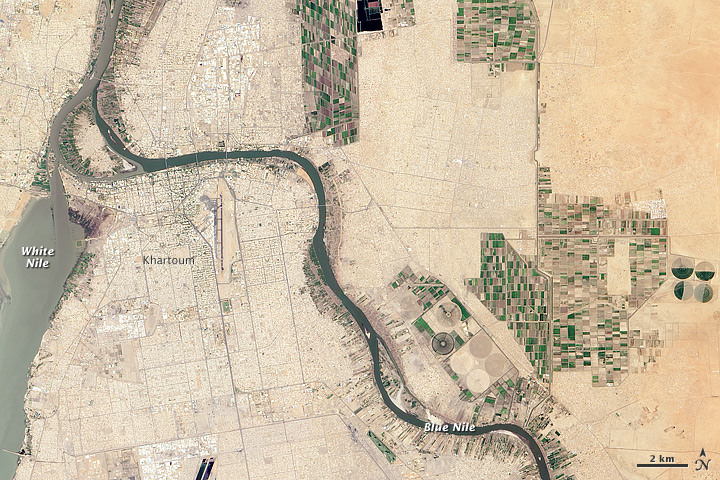
The Blue Nile originates from Lake Tana in the Ethiopian plateau, a widely recognized source of the river Lake Tana. From there it descends through steep gorges and a series of cataracts as it travels northwest into Sudan, passing through diverse highland and lowland environments Ethiopia and Sudan. The confluence with the White Nile occurs at the Sudanese capital region near Khartoum, where the two rivers become the Nile proper Khartoum.
Hydrology and importance
Compared with the White Nile, the Blue Nile contributes the greater share of the Nile's water and fertile silt during and shortly after the rainy season; commonly cited estimates attribute roughly 60 percent of the Nile's water to the Blue Nile water contribution. Its flow varies strongly with seasonal rains on the Ethiopian plateau, producing high flows and large sediment loads in the wet months and much lower discharge in the dry season.
Uses, development and modern issues
Communities along the Blue Nile rely on its floods and silt for flood-recession agriculture, fisheries and freshwater. In recent decades the river has been the focus of major hydropower and irrigation projects intended to increase energy production and food security. Such projects have regional implications, creating both development opportunities and political debates among upstream and downstream countries over water allocation and management.
Notable facts and distinctions
- The river is often described as the Nile's principal tributary because of its larger seasonal discharge and sediment contribution biggest tributary.
- The characteristic "blue" name contrasts with the paler, more stable flow of the White Nile; the Blue Nile's color and turbidity reflect heavy suspended sediment from upland erosion.
- Its floodwaters historically influenced agriculture and settlement patterns across northeastern Africa and continue to be central to contemporary development planning.
Together, these features make the Blue Nile a river of major hydrological, environmental and political importance in the Nile basin. Ongoing efforts to balance energy, irrigation and ecological needs underscore its continuing relevance to the region.
Questions and answers
Q: What is the Blue Nile?
A: The Blue Nile is one of the main tributaries of the River Nile.
Q: What do the Blue Nile and White Nile form?
A: The Blue Nile and White Nile form what is known as Nile near Khartoum.
Q: Where does the Blue Nile start and flow through?
A: The Blue Nile starts at Lake Tana in Ethiopia and flows through Ethiopia and Sudan.
Q: How much water does the Blue Nile supply to the Nile?
A: The Blue Nile supplies about 60 percent of the water of the Nile.
Q: How is the Blue Nile seen in relation to the White Nile?
A: Even though it has more water than the White Nile, the Blue Nile is seen as the biggest tributary of the Nile.
Q: What is the significance of the Blue Nile to the Nile river system?
A: The Blue Nile is a major contributor of water to the Nile river system.
Q: How does the Blue Nile compare to the White Nile in terms of water volume?
A: The Blue Nile has more water than the White Nile.
Tags
Related articles
Author
AlegsaOnline.com Blue Nile Leandro Alegsa
URL: https://en.alegsaonline.com/art/12362