
John William Waterhouse: life, style, and legacy of the late Pre‑Raphaelite painter
Overview of John William Waterhouse (1849–1917), his artistic style, major works, themes from mythology and literature, career milestones, and lasting influence in British art.
Overview
John William Waterhouse (6 April 1849 – 10 February 1917) was an English painter associated with the later phase of the Pre‑Raphaelite manner. Working after the original Brotherhood had dispersed, he combined a reverence for narrative detail with a modern sensibility that sometimes echoed the Impressionists in handling light and color. He became best known for evocative portrayals of women drawn from ancient Greek myths and from Arthurian and other medieval legends, creating large, theatrical canvases that blend atmosphere, psychology and meticulous costume.

Image gallery
10 Images



Style, subjects and characteristics
Waterhouse returned to and refreshed Pre‑Raphaelite concerns—clarity of form, jewel‑like tones, and careful attention to nature—while also favouring looser brushwork in backgrounds and subtle effects of light. His compositions typically center on a solitary heroine or thinker, captured in a decisive, often melancholic moment. He habitually used rich textiles, architectural ruins, pools of water and expressive gestures to suggest narrative tension. Critics and viewers note his focus on visual storytelling: each painting implies a before and after, drawing the spectator into a moral, romantic or mythic drama.
Life and career
Born in Rome to English parents who were both artists, Waterhouse moved to London as a young man and trained at the Royal Academy Schools. He began exhibiting at the annual Academy exhibitions and steadily built a reputation for ambitious canvases portraying scenes from classical antiquity, Shakespeare and later medieval romance. Over his career he adapted source material rather than faithfully reproduce ancient costume or setting; his aim was emotional truth rather than archaeological accuracy. In later decades he was sometimes called "the modern Pre‑Raphaelite" because he kept the movement's visual language alive into the twentieth century.
Major works and examples
His oeuvre includes memorable depictions that remain familiar through prints and gallery displays. Representative paintings include:
- Ophelia (an interpretation of Shakespeare's tragic heroine) — Juliet and other Shakespearean figures also recur in his work.
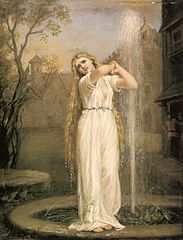
- Undine and other water‑spirits, showing his interest in elemental myth.
- Diogenes — a philosophical subject rendered with classical restraint and human immediacy (Diogenes).
- Circe offering the cup to Odysseus — a dramatic moment from Homeric legend that he treated in 1891 (Circe and Odysseus).

Reception, exhibitions and legacy
During his lifetime Waterhouse enjoyed steady popular success though academic critics sometimes dismissed his work as anachronistic. In the late twentieth and early twenty‑first centuries his reputation revived as museums and the public rediscovered the emotional power and craftsmanship of his paintings. Major British institutions now hold examples of his art, and the Royal Academy organised a retrospective that reintroduced his range to a wider audience. He is often compared with earlier Pre‑Raphaelites such as Rossetti, Millais and Hunt, but his blend of mythic subject matter and painterly modernity gives him a distinctive place in the transition from Victorian to modern British painting.

Distinctive facts and continued interest
Collectors and scholars value Waterhouse for his narrative clarity, sumptuous palette and sympathetic portrayal of female figures who are at once enigmatic and emotionally persuasive. His paintings continue to appear in exhibitions, books and popular media, where their theatrical immediacy and symbolic resonance make them accessible to general audiences as well as specialists.

Questions and answers
Q: Who was John William Waterhouse?
A: John William Waterhouse was an English painter in the Pre-Raphaelite style. He worked after the breakup of the Pre-Raphaelite Brotherhood, and so was called "the modern Pre-Raphaelite".
Q: Where did he come from?
A: He was born in Italy to English parents who were both painters. Later on, he moved to London and enrolled in the Royal Academy of Art.
Q: What type of artworks did he create?
A: His artworks were known for their depictions of women from both ancient Greek mythology and Arthurian legend. He focused on creating large canvas works depicting scenes from the daily life and mythology of ancient Greece.
Q: How popular is his work today?
A: Although not as well known as earlier Pre-Raphaelite artists such as Dante Rossetti, John Millais and William Holman Hunt, Waterhouse's work is currently displayed at several major British art galleries, and the Royal Academy of Art organised a major retrospective of his work in 2009.
Q: What influence did other artists have on him?
A: He was influenced by his contemporaries, the Impressionists.
Q: When did he embrace the Pre-Raphaelite style?
A: Despite it having gone out of fashion in British art scene several decades before, later on in his career he came to embrace the Pre-Raphaelite style of painting.
Related articles
Author
AlegsaOnline.com John William Waterhouse: life, style, and legacy of the late Pre‑Raphaelite painter Leandro Alegsa
URL: https://en.alegsaonline.com/art/122707