
John Flamsteed: First Astronomer Royal and Pioneer of Stellar Positions
English astronomer John Flamsteed (1646–1719), first Astronomer Royal, established precise positional astronomy at Greenwich, produced a monumental star catalogue and made the earliest recorded observations of Uranus.
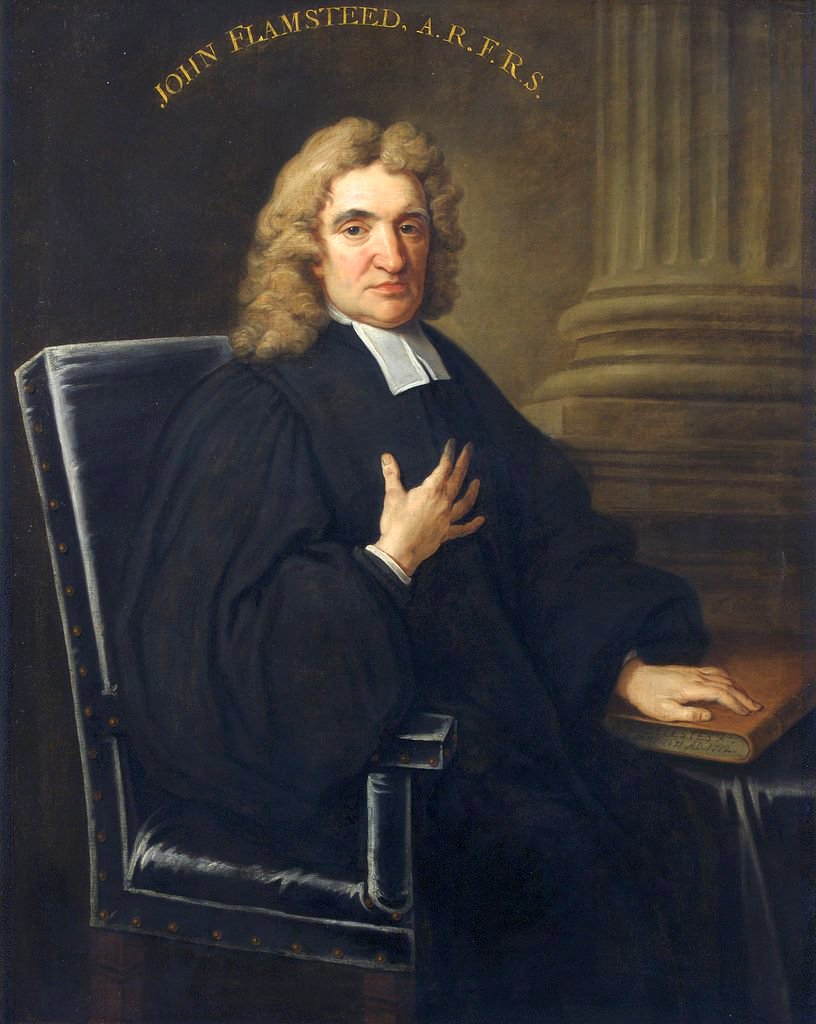
John Flamsteed (19 August 1646 – 31 December 1719) was an English astronomer appointed the first Astronomer Royal in 1675. Stationed at the newly founded Royal Observatory, Greenwich, he established systematic methods of positional observation that raised the standard of star positions and timekeeping in Britain. Flamsteed combined disciplined nightly records with careful reductions to produce work that remained influential for generations.
Image gallery
4 Images


Work, instruments and methods
Flamsteed favored rigorous observation and exhaustive logging. He used the precision instruments available in the late 17th century and recorded thousands of measurements of stars, planets and comets. His approach emphasized repeated observations to reduce random errors and careful comparison with earlier catalogues. Flamsteed also calculated phenomena such as the solar eclipses of 1666 and 1668.
Catalogue and mapping the sky
His lifetime work produced a comprehensive catalogue of stellar positions and a detailed star map. Material from his observations later formed a major published star catalogue and accompanying atlas; the numerical designations assigned to stars in that work are still known as Flamsteed numbers and continue to appear in modern star listings. Flamsteed’s cataloguing helped standardize constellation boundaries and coordinates used in practical astronomy.
Notable observations
Among his recorded sightings are some of the earliest telescopic observations of bodies later reclassified by astronomers. He documented objects that were catalogued as stars at the time; notably, Flamsteed made what is now recognised as the earliest known observation of the planet Uranus, recording it under the designation 34 Tauri. That object was not identified as a planet until decades later, after repeated observations by others.
Controversies and legacy
Flamsteed was protective of his material and engaged in prolonged disputes with contemporaries over the editing and publication of his observations, an episode that shaped how scientific data were handled and credited. Despite personal conflicts, his meticulous records advanced practical navigation and celestial mapping. His work provided a foundation for later astronomers and for timekeeping at Greenwich.
Why Flamsteed matters
- Established Greenwich as a centre for systematic observational astronomy and time measurement.
- Produced a star catalogue whose numbering system (Flamsteed numbers) remains in use.
- Made early recorded observations of objects—including the future planet planet Uranus—that were important to later discoveries.
Today Flamsteed is remembered both for his exacting observational practice and for the lasting reference works derived from his life’s records. For further detailed study consult primary sources and modern treatments of 17th‑ and 18th‑century positional astronomy: see specialized biographies and archival editions of his catalogue and correspondence (observations). Additional background and reproductions of plates and lists are available in observatory histories and catalog studies (eclipse records, star entries).
Questions and answers
Q: Who was John Flamsteed?
A: John Flamsteed was an English astronomer and the first Astronomer Royal appointed in 1675.
Q: What were some of Flamsteed's achievements?
A: Flamsteed calculated the solar eclipses of 1666 and 1668. He also recorded the earliest known sightings of the planet Uranus and catalogued it as '34 Tauri'.
Q: When was Flamsteed appointed as the first Astronomer Royal?
A: Flamsteed was appointed as the first Astronomer Royal in 1675.
Q: What did Flamsteed mistake for a star and catalogue as '34 Tauri'?
A: Flamsteed mistook the planet Uranus for a star and catalogued it as '34 Tauri'.
Q: When did Flamsteed make his earliest known sighting of Uranus?
A: Flamsteed made his earliest known sighting of Uranus in December 1690.
Q: What were some of Flamsteed's contributions to astronomy?
A: Flamsteed made important contributions to astronomy, including his calculations of solar eclipses and his cataloguing of several celestial objects.
Q: When did John Flamsteed pass away?
A: John Flamsteed passed away on December 31st, 1719.
Related articles
Author
AlegsaOnline.com John Flamsteed: First Astronomer Royal and Pioneer of Stellar Positions Leandro Alegsa
URL: https://en.alegsaonline.com/art/122450