
Johann Heinrich Pestalozzi: Swiss Educational Reformer and Advocate of Head, Hand, and Heart
Swiss pedagogue Johann Heinrich Pestalozzi (1746–1827) developed child-centered education stressing hands-on learning, moral development, and social reform; his methods influenced schools and later thinkers.
Overview
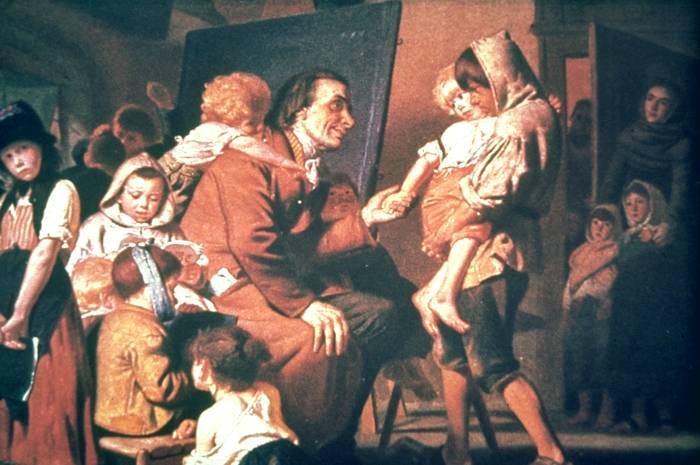
Johann Heinrich Pestalozzi (12 January 1746 – 17 February 1827) was a Swiss educator and social reformer whose ideas shaped modern primary education. Widely regarded as a practical humanist, he emphasized the dignity of every child and the importance of education that combines intellectual, manual and moral development. Pestalozzi sought to make schooling accessible and meaningful for ordinary families rather than to train elites alone.
Image gallery
5 Images


Core principles and classroom practice
Pestalozzi rejected rote instruction and harsh discipline in favor of teaching that follows the child’s natural development. His well-known motto—translated as "learning by head, hand and heart"—summarizes his tripartite aim: intellectual understanding, practical skill, and moral feeling. He believed that lessons should begin with concrete, sensory experience and proceed to general ideas, so that knowledge grows from what a child can directly perceive and do.
- Child-centered progression: instruction arranged in a psychologically ordered sequence rather than arbitrary lectures.
- Integration of work and thought: combining manual activities with reading and arithmetic to link knowing and doing.
- Moral education: fostering empathy, responsibility and domestic virtues alongside academic skills.
- Individual attention: adapting teaching to each pupil’s pace and talents rather than uniform methods.
Experiments, schools and major writings
Across German- and French-speaking Switzerland, Pestalozzi established several experimental schools and institutions aimed at poor and orphaned children. He wrote extensively to explain his methods and to defend his experiments in practice. Among his early publications were a set of reflective maxims issued anonymously as The Evening Hours of a Hermit, which outlined the ethical and educational ideas that later became associated with his name.
One of his best-known literary projects was the four-volume novel "Leonard and Gertrude," a didactic narrative that illustrates how domestic care, competent teaching and supportive civic action can produce social harmony and educated citizens. Another important work, often translated as Enquiries into the Course of Nature in the Development of the Human Race, elaborates his theory that human understanding unfolds according to natural stages and must be respected in schooling.
Influence, diffusion and legacy
Pestalozzi’s ideas fed into nineteenth-century teacher education and the formation of public schooling across Europe and beyond. His methods influenced later educational reformers and were adapted to different national contexts. Cantonal and municipal schools experimented with his techniques, and teacher-training institutions used his principles as a foundation for a kinder, more practical pedagogy.
His approach left traces in unexpected places: for example, the canton school in Aarau (Aarau) that the young Albert Einstein attended is often cited as an environment that encouraged independent thinking. Historians and commentators have suggested that the emphasis on visualization and self-directed inquiry helped cultivate the habits Einstein later used in his famous thought experiments (thought experiments).
Context, distinctions and notable facts
Pestalozzi is typically described as both a pedagogue and an educational reformer, and his outlook blended Enlightenment humanism with elements of the early Romantic stress on feeling and individuality—an approach sometimes characterized simply as humanist or romantic in style. His work sits between philosophy, social action and classroom technique: he insisted that education must be rooted in everyday life, sustained by public support, and guided by sympathetic teachers.
Although not all of Pestalozzi’s institutional experiments succeeded and some of his theoretical writings were difficult for contemporaries to follow, his legacy endures in the widespread acceptance of developmental sequencing, learning by doing, and the moral dimension of schooling. His life combined practical school work with written advocacy, and his influence continued through the teachers and institutions that carried elements of his practice into the broader systems of modern education.
For further reading on his life and principles, see accounts of his practice and the schools he founded, which remain a point of reference in histories of pedagogy and in discussions about child-centered instruction.
Questions and answers
Q: Who was Johann Heinrich Pestalozzi?
A: Johann Heinrich Pestalozzi was a Swiss pedagogue and educational reformer who had a humanist and romantic approach to education.
Q: What was his motto?
A: His motto was "Learning by head, hand and heart".
Q: What did he write about in The Evening Hours of a Hermit?
A: In The Evening Hours of a Hermit, Pestalozzi wrote aphorisms outlining ideas that would later be known as Pestalozzian.
Q: What is the story Leonard and Gertrude about?
A: Leonard and Gertrude is a four-volume story about the lives of four characters - Gertrude, Glüphi, an unnamed parish clergyman, and Arner - who work together to achieve harmony through comprehensive education for all people.
Q: What did Pestalozzi believe could be achieved through learning?
A: Pestalozzi believed that all understanding can be achieved through a psychologically ordered sequence of learning.
Aarau school attended by Albert Einstein used his method.
Q: How did Albert Einstein feel about the education he received at Aarau school?
A: Albert Einstein said that his education at Aarau made him realize how much better an education based on free action and personal responsibility is than one relying on outward authority.
Related articles
Author
AlegsaOnline.com Johann Heinrich Pestalozzi: Swiss Educational Reformer and Advocate of Head, Hand, and Heart Leandro Alegsa
URL: https://en.alegsaonline.com/art/122286