
Johannes Peter Müller (1801–1858): German physiologist and comparative anatomist
Overview of Johannes Peter Müller, his work in physiology, comparative anatomy, marine biology and sensory science, his travels, students, honors and lasting influence.
Johannes Peter Müller (14 July 1801 – 28 April 1858) was a prominent German scientist whose work bridged experimental physiology, comparative anatomy and natural history. Trained and active during a period when laboratory methods were becoming central to biological inquiry, Müller combined careful observation with experimental investigation. He is remembered for clarifying how nerves and sensory organs function, for detailed comparative studies of animals—especially fishes, amphibians and marine life—and for training a generation of influential scientists.
Image gallery
1 Image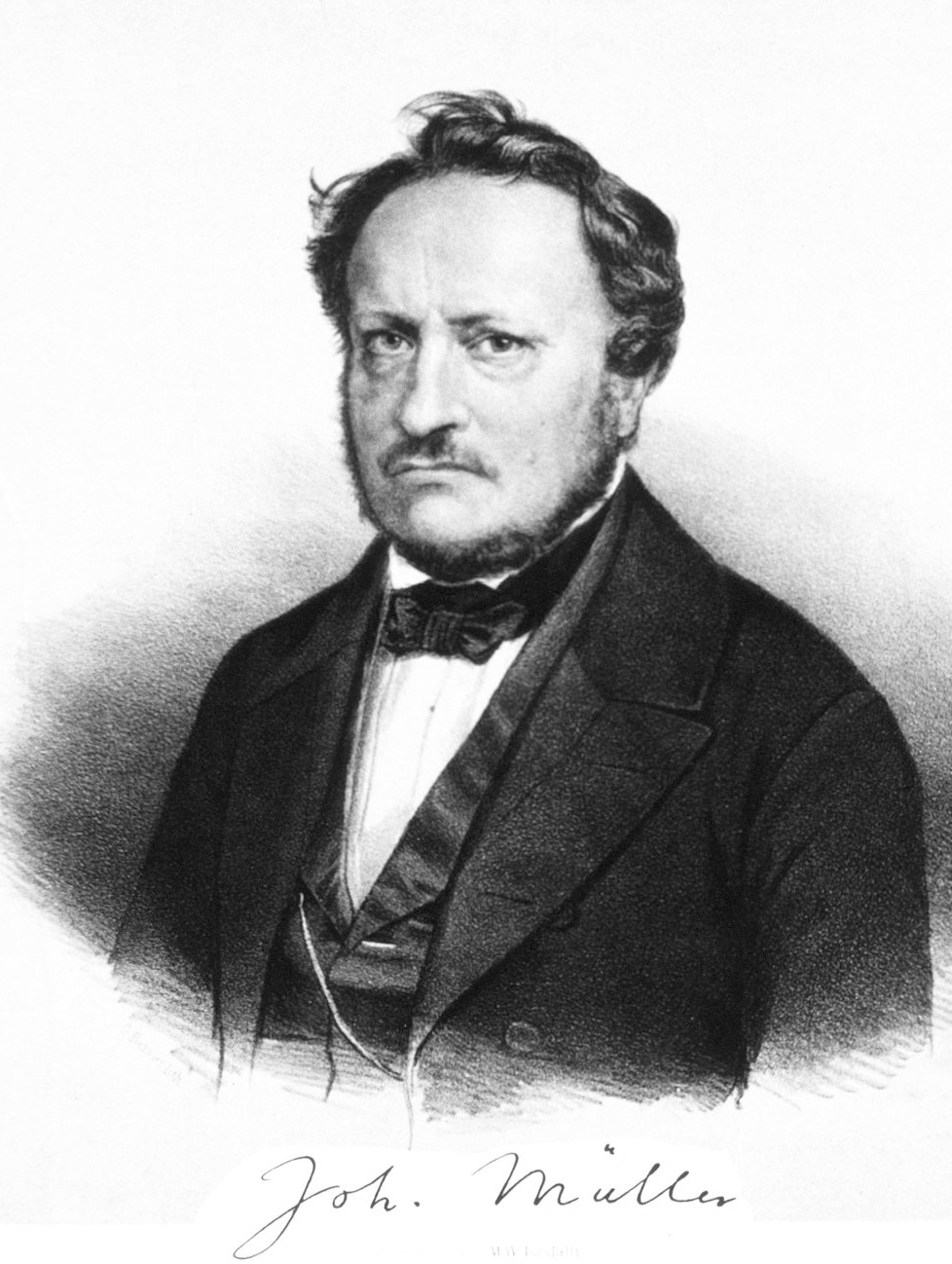
Major contributions and methods
Müller established a laboratory-based approach to physiology and emphasized experimental evidence over speculation. He formulated the principle now known as the law of specific nerve energies, arguing that different sensory nerves produce distinct sensations regardless of how they are stimulated. That idea shaped later work on vision, hearing and neural function. His lectures and writings presented physiology as a mechanistic and testable science, and he investigated muscle action, circulation, and sensory organs using dissection combined with physiological tests.
Comparative anatomy, taxonomy and marine studies
Later in his career Müller devoted increasing attention to comparative anatomy. He published extensive anatomical studies of amphibians (a term then often applied to reptiles as well) and described the anatomy and classification of fishes and other groups. His fieldwork included many voyages to study coastal fauna: he collected and examined marine organisms from the Baltic, the North Sea, the Adriatic and the Mediterranean, and took repeated trips to shorelines and ports to study live specimens. He favored fishes and marine animals in general and had a particular interest in marine invertebrates. He also made taxonomic descriptions, including new species of snakes and other reptiles.
Teaching and intellectual legacy
Müller held the chair of physiology at the University of Berlin, where his courses and laboratory instruction influenced many students who became leaders in 19th‑century biology and medicine. Among those trained by him were Hermann von Helmholtz, Emil du Bois‑Reymond, Theodor Schwann, Friedrich Gustav Jakob Henle, Carl Ludwig and Ernst Haeckel. His insistence on rigorous observation and measurement helped shape developments such as experimental physiology and aspects of cell theory indirectly through his pupils.
Selected achievements and honors
- Introduced experimental methods into physiological teaching and research (physiology).
- Produced influential comparative anatomical monographs and manuals used by students of natural history (comparative anatomy).
- Contributed to ichthyology and herpetology with descriptions and collections (ichthyologist, herpetologist).
- Recognized internationally: elected to the Royal Swedish Academy of Sciences and awarded the Copley Medal of the Royal Society.
Importance and notable facts
Müller stands as a transitional figure who helped move biology toward laboratory experimentation and comparative, systematic study. His teaching created a network of researchers who advanced physiology, embryology, and evolutionary ideas. While some specific concepts were refined or replaced by later discoveries, his methodological insistence on measurable, reproducible evidence and his wide-ranging anatomical descriptions remain important milestones in 19th‑century science.
Selected students and associates as examples of his influence include figures such as Helmholtz, Schwann, and Haeckel. Biographical and bibliographical surveys of Müller’s work and expeditions remain useful for historians of physiology and natural history and for understanding the institutional growth of the modern biological sciences.
Questions and answers
Q: Who was Johannes Peter Müller?
A: Johannes Peter Müller was a German physiologist, comparative anatomist, ichthyologist, and herpetologist. He became Professor of physiology at the University of Berlin in 1833.
Q: What were his favorite subjects?
A: Fishes and marine invertebrates were his favorite subjects.
Q: How did he investigate salt-water life?
A: He took 19 trips to the Baltic and North Sea, the Adriatic and the Mediterranean to investigate salt-water life.
Q: What work did he author on amphibians?
A: He authored a comprehensive work on the anatomy of amphibians, which in his era including reptiles.
Q: Who did he mentor during his career?
A: During his career he mentored some distinguished physiologists and biologists, including Hermann von Helmholtz, Emil du Bois-Reymond, Theodor Schwann, Friedrich Gustav Jakob Henle, Carl Ludwig and Ernst Haeckel.
Q: When was he elected a foreign member of the Royal Swedish Academy of Sciences?
A: In 1834 he was elected a foreign member of the Royal Swedish Academy of Sciences.
Q: What award did he receive from the Royal Society in 1854?
A:He was awarded the Copley Medal of the Royal Society in 1854.
Related articles
Author
AlegsaOnline.com Johannes Peter Müller (1801–1858): German physiologist and comparative anatomist Leandro Alegsa
URL: https://en.alegsaonline.com/art/122277