
Joan Miró — Catalan painter, sculptor and pioneer of surrealist abstraction
Joan Miró (1893–1983) was a Catalan painter, sculptor and ceramicist whose playful, pictographic imagery and experimental techniques helped reshape 20th‑century modern art.
Overview
Joan Miró (20 April 1893 – 25 December 1983) was a Spanish artist best known for work that spans painting, sculpture and ceramics. Born in Barcelona, he developed a visual language of bold color, spare line and biomorphic signs that bridged Surrealism, abstraction and a distinctively Catalan sensibility. A foundation in Barcelona, the Fundació Joan Miró, preserves much of his work and archives. Miró died in Palma, Majorca, reportedly of heart disease, leaving a legacy of paintings, public commissions and experimental objects.
Image gallery
10 Images


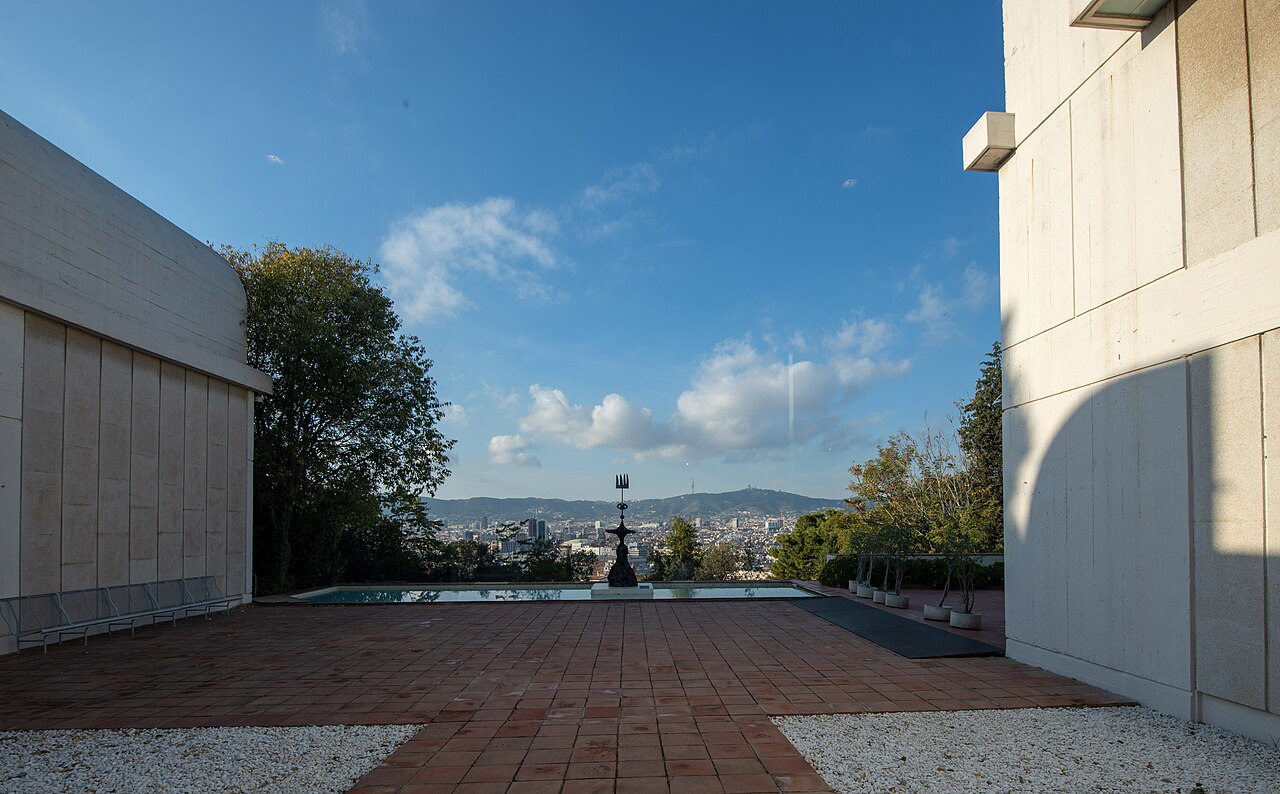


Artistic characteristics and materials
Miró favored simple graphic elements — stars, eyes, birds, ladders, and moons — organized into dynamic pictorial fields. His vocabulary mixes playful symbols with rhythmic, often improvisatory composition. Across mediums he explored texture and scale: delicate gouaches and oil paintings, large canvases, engraved prints, ceramics decorated with spontaneous brushwork, and welded or cast sculptures intended for public spaces. Miró’s work often reads as a visual alphabet: repeated motifs that function as signs rather than literal depictions.
Development and major phases
After training in Barcelona and brief study in Madrid, Miró absorbed currents of early 20th‑century modernism before aligning with the Surrealist movement. During the 1920s and 1930s he moved from detailed, symbolic scenes toward freer, more automatic methods — a practice associated with Surrealist ideas of the unconscious. Notable early and mid‑career paintings include The Farm and Harlequin’s Carnival, while his acclaimed Constellations series (created during the turmoil of World War II) exemplifies his tiny, star‑filled compositions that combine lyricism with meticulous draftsmanship.
Selected works and public projects
- The Farm (early 1920s) — a richly observed, transitional work combining realism and symbolic detail.
- Harlequin’s Carnival (mid‑1920s) — a busy, playful tableau of biomorphic figures.
- Constellations (late 1930s–1940s) — small, jewel‑like paintings characterized by constellation‑like marks.
Later in life Miró produced large murals, tapestries and ceramic murals for public buildings and collaborated with architects and craftsmen to bring his imagery into urban contexts.
Impact and legacy
Miró influenced generations of artists. His emphasis on gesture, scale and spontaneous mark‑making resonated strongly with mid‑20th‑century movements; in particular, scholars and artists cite his effect on American abstract expressionists and on later minimalist and lyrical abstract practices. He is often discussed alongside contemporaries such as Pablo Picasso, yet Miró’s aesthetic — less focused on formal Cubist experiment and more on playful sign systems — marks a distinct contribution to modernism.
Notable facts
- Miró worked across media: painting, printmaking, ceramics and sculpture, continually experimenting with materials and scale.
- He established a major foundation in Barcelona to promote modern art and preserve his work (Fundació Joan Miró).
- He remained rooted in Catalonia throughout his life, and his cultural identity is often considered integral to his imagery.
- Miró is widely regarded as a bridge between European Surrealism and later 20th‑century abstract movements, influencing both peers and younger artists.
For further reading and museum collections, consult major modern art institutions and specialized catalogs that document Miró’s extensive output and experimental techniques. His career exemplifies a modern artist who combined regional roots with an international, iconographic imagination.
Painter, sculptor and ceramicist • Barcelona • heart disease • Palma • Fundació Joan Miró • Pablo Picasso • American influence
Questions and answers
Q: Who was Joan Miró?
A: Joan Miró was a Spanish painter, sculptor, and ceramicist.
Q: When was Joan Miró born?
A: Joan Miró was born on 20 April 1893.
Q: Where was Joan Miró born?
A: Joan Miró was born in Barcelona.
Q: When did Joan Miró start painting?
A: Joan Miró started painting when he was fourteen and attended an art school.
Q: What influenced Joan Miró's style of painting?
A: Joan Miró's style of painting was influenced by Pablo Picasso.
Q: What changes did Joan Miró make to his style of painting in around the 1930s?
A: In around the 1930s, Joan Miró started to make rapid changes to his style of painting, developing more surrealist works.
Q: Was Joan Miró a significant influence on late 20th-century art?
A: Yes, Joan Miró was a significant influence on late 20th-century art, in particular the American abstract expressionist artists.
Related articles
Author
AlegsaOnline.com Joan Miró — Catalan painter, sculptor and pioneer of surrealist abstraction Leandro Alegsa
URL: https://en.alegsaonline.com/art/122140
Sources
- guardian.co.uk : "Guardian, April, 2011, ''Joan Miró Retrospective Reunites Triptychs"
- books.google.com : NY Magazine, Sept. 11, 1972, Vol. 5, #37
- ndoylefineart.com : "Artist Profile of Joan Miro"