
Jean Chrétien
Canadian politician who served as the 20th Prime Minister (1993–2003); long-time Liberal MP known for federalism, fiscal reform, and plain-spoken style.
Overview
Joseph Jacques Jean Chrétien (born January 11, 1934) is a Canadian politician best known for serving as the 20th Prime Minister of Canada from 1993 to 2003 and as leader of the Liberal Party from 1990 to 2003. A Member of Parliament for more than three decades, Chrétien rose from a small industrial town in Quebec to become a dominant figure in late 20th-century Canadian politics. His premiership is remembered for efforts to restore federal finances, defend Canadian unity, and pursue a pragmatic, low‑key leadership style.
Image gallery
10 Images
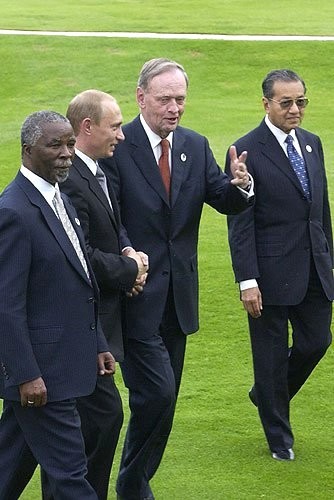


Early life and legal career
Chrétien was born and raised in Shawinigan, Quebec, where his upbringing in a francophone, working‑class environment shaped his politics and rhetoric. He studied law at Université Laval and practised as a lawyer before entering federal politics. His background as a bilingual, federalist Quebecer became a recurring theme of his public image and informed his approach to national unity and intergovernmental relations.
Political rise and cabinet experience
First elected to the House of Commons in the 1960s, Chrétien served in several senior roles in Pierre Trudeau’s Liberal governments and later in John Turner’s administration. He held important portfolios and was regarded as an experienced cabinet minister and strategist. Readers can consult an official biography or a detailed party profile for timelines and records of his various cabinet responsibilities. Biographical summaries and analyses are also available at general reference pages such as political directories and historical overviews like national archives.
Prime Ministership: policies and record
As prime minister, Chrétien led three consecutive majority governments. His administration focused on eliminating the federal deficit, achieving budgetary surpluses in the late 1990s, and reducing national debt relative to GDP. On constitutional matters he opposed unilateral separation by Quebec and sponsored parliamentary measures aimed at clarifying the conditions for secession. In foreign affairs he pursued traditional alliances while declining to commit combat troops to the 2003 invasion of Iraq. More on his economic and constitutional initiatives can be found in policy summaries and academic profiles (fiscal reports, constitutional studies).
Major initiatives and notable moments
- Fiscal restraint and deficit reduction efforts, including spending controls and program reviews.
- Legislative responses to the 1995 Quebec referendum and measures clarifying federal stance on secession.
- Domestic programs and ministerial appointments that shaped Canadian social and economic policy.
- International posture marked by participation in multilateral forums and reluctance to support the 2003 Iraq invasion.
Contemporary coverage, government documents and commentary on these points are accessible via specialized repositories and analyses (economic analyses, unity debates, foreign policy reviews).
Controversies and legacy
Chrétien’s tenure was not without criticism. Internal party tensions toward the end of his leadership and later scandals connected to federal programs affected public perceptions of the governing party. He was a polarizing figure in some respects — admired by supporters for his plain‑spoken, resilient image and criticized by opponents for perceived centralization of power in the PMO and for patronage practices. Retrospectives, commission reports and journalistic accounts provide multiple perspectives on these debates (inquiries, journalistic reviews, academic critiques).
After politics and recognition
After stepping down in 2003 and handing party leadership to his long‑time rival, Chrétien remained active in public life through speaking, memoirs and international work. He has received various honours and remains a frequent subject of study for his role in shaping modern Canadian governance. For further reading, consult collections of speeches, memoir excerpts and scholarly evaluations (speech archives, memoir excerpts, scholarly reviews, honours lists).
Questions and answers
Q: Who was the 20th Prime Minister of Canada?
A: Joseph Jacques Jean Chrétien was the 20th Prime Minister of Canada from 1993 to 2003.
Q: Where was Chrétien born?
A: Chrétien was born in Shawinigan, Quebec.
Q: What did he study at Université Laval?
A: He studied law at Université Laval.
Q: When did he become a politician?
A: He became a politician in 1963 when he was first elected to the House of Commons.
Q: What positions did he hold while Pierre Trudeau was Prime Minister?
A: While Pierre Trudeau was Prime Minister, Chrétien held the positions of Minister of Justice, Minister of Finance, and the Minister of Indian Affairs and Northern Development. He also served as Deputy Prime Minister when John Turner was Prime Minister.
Q: How many seats did the Liberals win in the 1993 election?
A: The Liberals won 177 seats in the House of Commons in the 1993 election.
Q: Who replaced him as Prime Minster and leader of the Liberal Party after his retirement in 2003?
A: Paul Martin replaced him as both Prime Minster and leader of the Liberal Party after his retirement in 2003.
Related articles
Author
AlegsaOnline.com Jean Chrétien Leandro Alegsa
URL: https://en.alegsaonline.com/art/121683
Sources
- cbc.ca : "The Life and Times of Jean Chrétien" · web.archive.org
- fd.ulaval.ca : "Le très honorable Jean Chrétien reçoit un doctorat honoris causa d'université"
- cbc.ca : "When Jean Chrétien wouldn't 'pass the torch' 20 years ago"
- lop.parl.ca : "The Right Hon. Joseph Jacques Jean Chrétien, P.C., Q.C., C.C., O.M., M.P."
- collectionscanada.gc.ca : "The Right Honourable Joseph Jacques Jean Chrétien"
- thecanadianencyclopedia.ca : "Elections of 1979 and 1980"
- cbc.ca : "Kim Campbell becomes Canada's first woman prime minister"
- archive.macleans.ca : "Promises, promises"
- theglobeandmail.com : "The GST, hated by many, stands the test of time"
- cbc.ca : 1993: Tories trampled in Liberal landslide
- reviewcanada.ca : "Jean Chrétien: Fox or snake"
- ottawacitizen.com : "Plamondon: Canada's most conservative prime minister? It's not who you think"
- macleans.ca : "This is what's wrong with Canada's Left"
- thecanadaguide.com : "Canadian Political Parties"