
Henry Moore (1898–1986) — English sculptor
Henry Moore was a leading 20th‑century English sculptor, known for large abstract bronzes and carved works that reimagined the human figure and transformed public sculpture internationally.
Overview
Henry Spencer Moore was an English sculptor and draughtsman whose work helped define modern British sculpture in the twentieth century. He became widely known for large, often monumental abstracted figures—many cast in bronze or carved in stone—and for a persistent exploration of mass, void and the relationship between the human body and landscape. Short biographical outlines and curated timelines can be consulted via a general biographical summary or overviews of his role as a sculptor within modern art.
Image gallery
10 Images


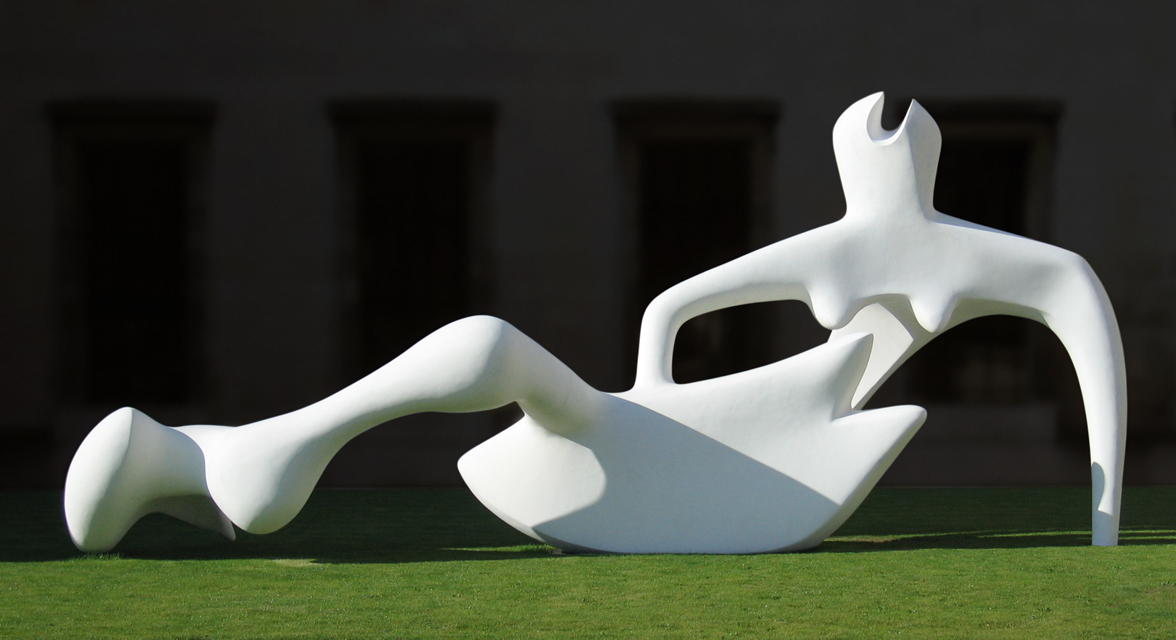
Life and career
Born in Castleford, Yorkshire, Moore came from a working-class background and developed an early interest in drawing and carving. He served in the First World War and later trained at local art schools before continuing formal studies at national institutions. Across his career he combined studio practice with teaching and public commissions; wartime drawings of shelter scenes and evacuees increased his public profile during the 1940s. He lived and worked mainly in England and used proceeds from sales to establish an institutional legacy devoted to art education and conservation.
Themes and stylistic concerns
Moore’s imagery repeatedly returned to certain human themes: the reclining figure, mother-and-child groups and, at times, family ensembles. Rather than literal portraiture, his works are abstractions that compress human relationships into simplified, often monumental forms. A distinguishing device is the use of apertures—holes or hollows that pierce the mass of a form—so that empty space becomes as important as solid volume. Critics and viewers have read these forms both as body fragments and as landscape analogues: for some, the rolling contours reflect a connection to the Yorkshire countryside where he grew up, while others emphasise the sculptural autonomy of his shapes. For discussion of his place in the wider artistic genre and regional influences such as Yorkshire, see the linked resources.
Materials, methods and collaborations
Moore worked in a range of media. Bronze casting allowed him to realise large-scale editions for public settings; carved stone and direct-carving techniques produced unique, tactile objects. He maintained a practice of modelling smaller maquettes and drawings as studies before translation to larger works. Moore also engaged with architects and planners to integrate sculpture into buildings and civic spaces, treating site and setting as part of a work’s meaning. Technical and material discussions are available in resources on bronze casting and stone carving, and his built collaborations are treated in accounts of architecture and urban design.
Major commissions and notable projects
Throughout his career Moore accepted significant public commissions that placed abstract forms in parks, university campuses and city plazas. One uncommon project was a large carved brick relief completed under his supervision in 1955 at the Bouwcentrum in Rotterdam; it was executed in brickwork by local craftsmen and is frequently cited as an unusual example of his architectural collaboration (Rotterdam project). Many of his bronzes, executed as editions, are installed in outdoor settings across Europe, North America and elsewhere.
Reception, influence and legacy
Moore’s reputation has been mixed in critical detail but overwhelmingly influential: admirers praise his synthesis of organic form, monumentality and a modern sensibility for public space; critics have occasionally argued that repetition of certain motifs limited formal novelty. His considerable commercial success allowed him to endow the Henry Moore Foundation, intended to support research, conservation and public engagement with sculpture. The foundation and major museums maintain collections, archives and educational programmes that continue to shape scholarship and public appreciation.
Study points and further reading
- Compare the ways Moore uses voids and apertures to alter perceptions of mass.
- Examine how scale and site—garden, plaza, or interior—change a work’s social and visual impact.
- Consider material choice: why bronze editions expanded public reach while carved stone works remained unique.
- Investigate Moore’s wartime drawings and how they informed his subsequent public commissions.
For introductions, teaching resources and curated collections consult the linked pages above and institutional pages that host catalogues and images; these provide accessible entry points to Moore’s varied practice and his continuing role in twentieth‑century sculpture studies. Further curated and technical material is available through foundation and museum pages that address casting, carving, exhibition history and conservation: see linked entries on sculpture resources, technique pages on bronze methods and stone technique, and architectural case studies via architecture references.
Questions and answers
Q: Who was Henry Spencer Moore?
A: Henry Spencer Moore was an English sculptor and artist.
Q: What was Henry Spencer Moore best known for?
A: Henry Spencer Moore was best known for his abstract monumental sculptures.
Q: What are Henry Spencer Moore's forms usually abstractions of?
A: Henry Spencer Moore's forms are usually abstractions of the human figure.
Q: Where was Henry Spencer Moore born?
A: Henry Spencer Moore was born in Castleford.
Q: What is the Henry Moore Foundation?
A: The Henry Moore Foundation supports education and promotion of the arts.
Q: What was Henry Spencer Moore's only work in carved brick?
A: Henry Spencer Moore's only work in carved brick was "Wall Relief" at the Bouwcentrum in Rotterdam.
Q: How was the brick relief at the Bouwcentrum in Rotterdam sculpted?
A: The brick relief at the Bouwcentrum in Rotterdam was sculpted with 16,000 bricks by two Dutch bricklayers under Moore's supervision.
Related articles
Author
AlegsaOnline.com Henry Moore (1898–1986) — English sculptor Leandro Alegsa
URL: https://en.alegsaonline.com/art/120550
Sources
- findmypast.com : Deaths England and Wales 1984-2006
- henry-moore-fdn.co.uk : Chronology