
Henry Fairfield Osborn: paleontologist, museum leader, and controversial figure
Overview of Henry Fairfield Osborn (1857–1935): his education, work at the American Museum of Natural History, dinosaur discoveries, expeditions, administrative legacy, and controversies.
Overview
Henry Fairfield Osborn (August 8, 1857 – November 6, 1935) was an American paleontologist and influential museum administrator who served as president of the American Museum of Natural History for more than two decades. He became one of the most visible figures in early twentieth‑century vertebrate paleontology, noted for organizing large field expeditions, describing new dinosaur taxa and for promoting public displays of prehistoric life built around fossil material.
Image gallery
7 Images


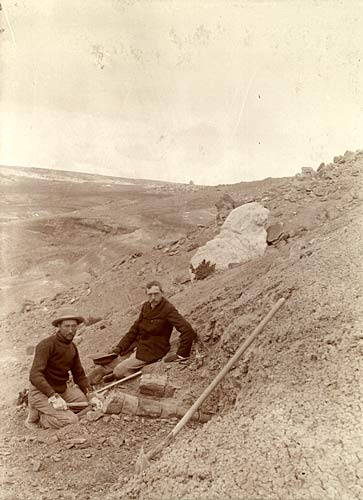
Education and early career
Osborn earned a Sc.D. in paleontology from Princeton and served there as a professor of comparative anatomy from 1883 to 1890 (Professor). He later accepted a faculty post at Columbia University as a professor of zoology and took on a concurrent appointment at the American Museum of Natural History in New York, where he became curator of the newly formed Department of Vertebrate Paleontology (curator). During these years he combined teaching, fieldwork and museum responsibilities while building collections of fossils for study and exhibition.
Museum leadership and public exhibitions
As a leader at the museum, Osborn championed ambitious dioramas, painted murals and mounted skeletons intended to bring prehistoric animals to life for millions of visitors. His administration emphasized large, dramatic exhibitions that showcased specimens alongside habitat reconstructions. These investments helped the museum become a model for public natural history presentation, though they sometimes provoked tension with staff who preferred to concentrate on research rather than display work.
Fieldwork and scientific contributions
Osborn organized and led major collecting expeditions, most famously the American Museum expedition to Mongolia in the early 1920s. He described several important taxa and is credited with naming well‑known forms such as Tyrannosaurus rex and the smaller predator Velociraptor. He also studied lightly built, cursorial forms such as Struthiomimus. Osborn combined field leadership, comparative anatomy and museum scholarship; some of the questions he raised about function and behavior of these animals continue to be discussed by paleontologists.
Controversies and scientific assessment
Osborn’s career was not without controversy. He was publicly associated with the eugenics movement of his era, a set of ideas and social programs now broadly discredited for their ethical and scientific failings; historians emphasize these views when assessing his legacy (eugenics). Assessments of his scientific output vary: many historians recognize his strengths as an organizer and communicator of science while also noting that some of his anatomical interpretations and evolutionary arguments were shaped by the assumptions of his time.
Legacy and notable facts
Osborn’s influence endures in several areas: major museum exhibit techniques, the collections he helped build, and the taxa he named that remain central to public and scientific conceptions of dinosaurs. His stewardship helped popularize prehistoric life and encouraged other institutions to develop comparable displays, even as later scientists and historians have reevaluated aspects of his scientific and social views.
- Major institutions: American Museum of Natural History, Columbia University, Princeton.
- Notable taxa associated with Osborn: Tyrannosaurus rex, Velociraptor, Struthiomimus.
- Fieldwork highlight: expedition to Mongolia, 1922–1925.
- Broader topics connected to his career: fossils, public exhibit design, and debates in early twentieth‑century biology and zoology.
For further reading, consult institutional histories and modern biographies that place Osborn’s scientific achievements, administrative talents, and controversial social views in the context of his era and their continuing influence on paleontology and museum practice.
Questions and answers
Q: What was Henry Fairfield Osborn's profession?
A: Henry Fairfield Osborn was an American paleontologist, geologist, and eugenist.
Q: Where did he receive his Sc.D.?
A: Osborn received a Sc.D. in paleontology from Princeton University.
Q: What position did he hold at the American Museum of Natural History?
A: At the American Museum of Natural History, Osborn served as the curator of the newly formed Department of Vertebrate Paleontology.
Q: What dinosaur species did he name and write descriptions for?
A: Osborn named and wrote descriptions for Tyrannosaurus rex and Velociraptor, among other dinosaurs.
Q: How did his leadership affect the American Museum of Natural History?
A: Under his leadership, staff at the museum worked on displays that attracted millions of visitors and inspired other museums to imitate them.
Q: What decision angered curators working with him?
A: His decision to invest heavily in exhibitions angered curators who hoped to spend more time on their own research.
Q: What is still unclear about Struthiomimus today?
A: The lifestyle of Struthiomimus is still not very clear today despite being studied by Osborn during his lifetime.
Related articles
Author
AlegsaOnline.com Henry Fairfield Osborn: paleontologist, museum leader, and controversial figure Leandro Alegsa
URL: https://en.alegsaonline.com/art/120525
Sources
- amnh.org : amnh.org/exhibitions/dioramas/