
Hannibal Barca: Carthaginian commander of the Second Punic War
Hannibal Barca (c. 247 – c. 183 BC) was a Carthaginian general and statesman who led a prolonged campaign against Rome in the Second Punic War, renowned for his tactical skill and bold Alpine crossing.
Overview
Hannibal Barca was a leading Carthaginian statesman and general of the late 3rd century BC who waged a protracted struggle against the Roman Republic. Born into the Barca family, he was brought up during the expansion of Carthage in Iberia under his father Hamilcar and is said in later sources to have been dedicated from youth to opposing Rome. His career is most closely associated with the Second Punic War, a conflict that reshaped power in the western Mediterranean.
Image gallery
10 Images




Early life and rise
Details of Hannibal's youth are preserved in later classical historians and should be treated cautiously. He emerged as a commander in Iberia and after the death of his father and brothers he became commander of Carthaginian forces there. His command gave Carthage an organized base of operations and recruits drawn from diverse regions that later formed the multi-ethnic army he led into Italy.
Alpine crossing and campaign in Italy
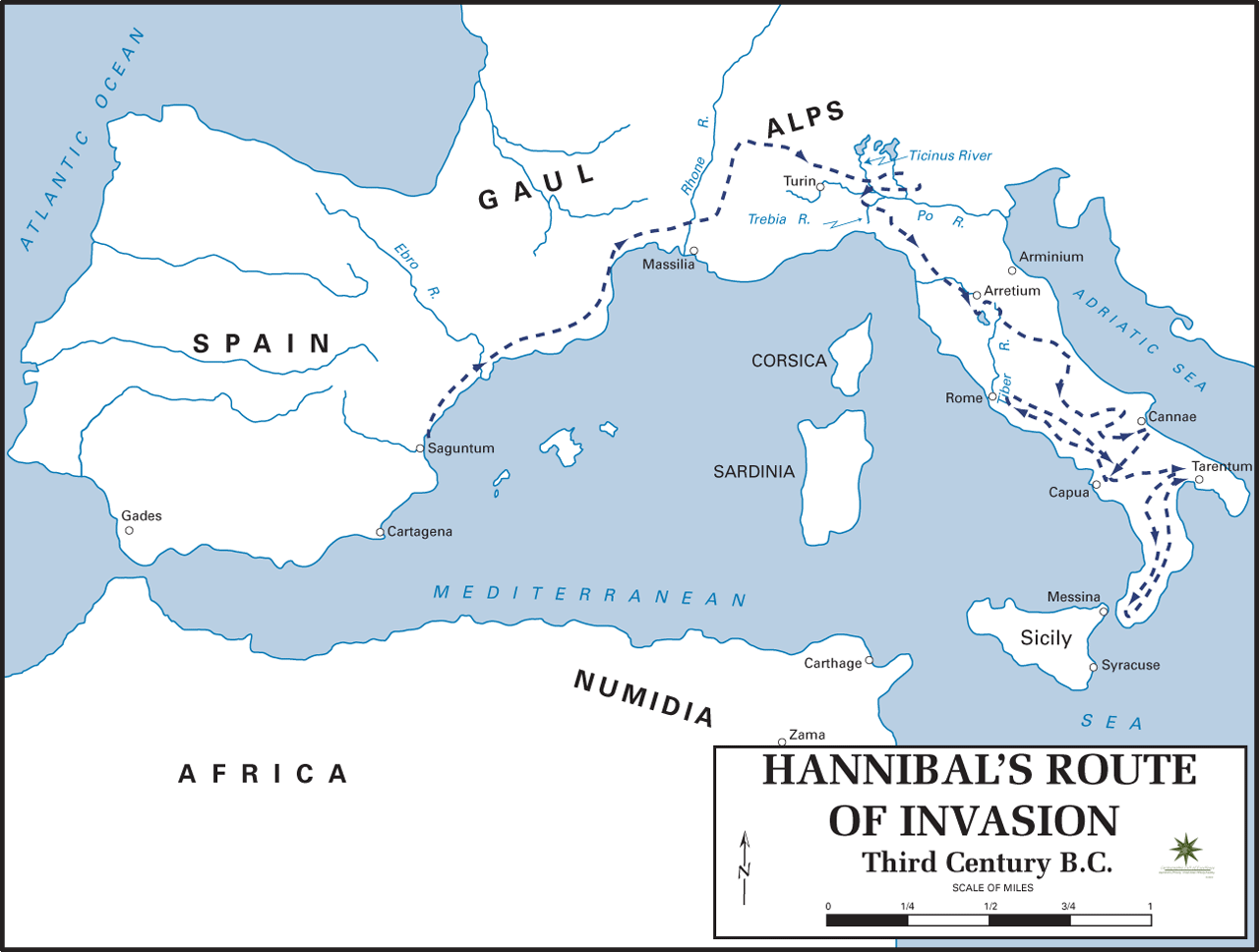
Hannibal is best known for the audacious overland march that brought his army into northern Italy. In 218 BC he led troops and war elephants across the Pyrenees and then through difficult mountain terrain, including several high passes sometimes described collectively as mountain passes, before crossing the Alps. Once in Italy he used terrain, surprise and a combined use of infantry and cavalry to win a string of battles rather than attempting to assault the city of Rome directly. These operations illustrate principles of maneuver and deception that have been studied in later military strategy.
Major battles
- Ticinus and the River Trebia: early engagements where Hannibal's cavalry and tactical dispositions unbalanced Roman formations.
- Cannae (216 BC): often cited as his most famous victory, a well-known double-envelopment that inflicted catastrophic losses on Roman forces, including many of their officers and tens of thousands of troops. Ancient and modern estimates of the exact numbers vary.
- Trasimene and other actions: ambushes and operational-level maneuvers that demonstrated his skill in combining intelligence, terrain and timing.
Despite repeated battlefield successes, Hannibal lacked the heavy siege equipment and the sustained reinforcements necessary to take the city of Rome itself. His long presence in Italy drew Roman attention and resources for many years and forced changes in Roman military organization and diplomacy.
Strategic context and Roman response
Rome adapted by refusing large-scale pitched battles except when advantageous, securing allies, and later by carrying the war to Africa under commanders of the Roman tradition such as Publius Cornelius Scipio. The Roman invasion of North Africa compelled Carthage to recall Hannibal from Italy, whereupon he confronted the Roman field army at Zama and was defeated. The outcome ended Carthage's leading power and established Rome's dominance in the western Mediterranean.
Later life, exile and death
After the war Hannibal served as a civic leader in Carthage and implemented reforms to its finances and military, but he faced political opposition and increasing pressure from Rome. For safety he went into exile and acted as an adviser to rival courts, including the Seleucid king, where he attempted to encourage resistance to Rome and supported plans for renewed conflict with Roman power. When maritime setbacks and Roman diplomatic pressure made his position untenable, he sought refuge with the Bithynian court. Refusing to be surrendered to Rome, classical accounts report that he took poison rather than be handed over, a circumstance often linked in ancient texts with the Roman demand that he give up himself.
Legacy and historical assessment
Hannibal is widely regarded as among the finest of ancient military commanders. His long campaign in Italy demonstrated logistical daring, operational flexibility and tactical ingenuity. Military historians and commentators have variously praised his leadership, and some, including later analysts, have described him as influential in the development of operational strategy. At the same time his career illustrates the limits of battlefield victories that are not supported by political control, resources and secure lines of supply.
Sources and further reading
Knowledge of Hannibal rests on surviving classical historians, archaeological evidence and modern scholarship. Ancient narrators provide the principal narrative framework while modern historians assess numbers, logistics and broader political effects with critical methods. For introductory treatments consult general surveys of Carthage and the Second Punic War, battlefield studies of Cannae and Zama, and treatments of Roman institutional change. Illustrative entries and specialized studies are available in academic collections and military histories; summaries and reference works on Carthage, the Iberian campaigns and Hannibal's movements across the Pyrenees and Alps provide accessible overviews.
Readers may consult translations of classical authors, archaeological reports, and modern syntheses for more detail on troop composition, diplomatic efforts, and the long-term impact of the war on both Carthage and Rome. See also discussions of Roman military reform, the role of allied Italian states, and Hannibal's place in military education and popular memory, including analyses of his operational art and his reputation as a founder of particular strategic ideas.
Legion studies, accounts of his death, and broader collections on ancient warfare offer further entry points. For broader context on Hellenistic polities with which Hannibal interacted see works on the Seleucid realm and the courts of contemporary monarchs often styled as emperors or kings. Comparative analyses that include cavalry use, coalition-building and logistical planning are discussed in modern military literature and scholarly articles on ancient strategy.
Questions and answers
Q: Who was Hannibal?
A: Hannibal was a Carthaginian statesman and general who is most famous for his actions during the Second Punic War.
Q: What did Hannibal do in the Second Punic War?
A: During the Second Punic War, Hannibal marched an army from Iberia over the Pyrenees mountains and the Alps mountains into northern Italy and defeated the Romans in a series of battles. At the Battle of Cannae, he defeated Rome's largest army ever assembled.
Q: How many men were in Rome's army at Cannae?
A: The Roman army at Cannae is reckoned to have been 16 legions with a total of 86,000 men.
Q: What happened to this large army?
A: Over 80% of this army was killed or captured, including many of its commanders.
Q: What did Hannibal do after his defeat at Carthage?
A: After his defeat at Carthage, Hannibal lived at the Seleucid court and convinced its Emperor to fight Rome. When he lost a naval battle, he fled to Bithynia where he eventually killed himself when asked by Rome to give up.
Q: Why is Hannibal considered one of history's greatest military commanders?
A: Military historian Theodore Ayrault Dodge once called Hannibal the "father of strategy" because even his greatest enemy, Rome, copied his military ideas which makes him one of history's greatest military commanders.
Q: What does it mean that Hannibal is considered "the father of strategy"?
A: This means that due to his innovative tactics during war time even his enemies had to copy them which makes him an influential figure in terms of warfare strategies throughout history.
Related articles
Author
AlegsaOnline.com Hannibal Barca: Carthaginian commander of the Second Punic War Leandro Alegsa
URL: https://en.alegsaonline.com/art/120263
Sources
- britannica.com : britannica.com/biography/Hamilcar-Barca
- fordham.edu : fordham.edu/halsall/ancient/polybius-cannae.asp