
Gerry Adams: Irish republican leader and Sinn Féin politician
Overview of Gerry Adams, his role in Sinn Féin, the Northern Ireland peace process, political offices, controversies and retirement.
Overview
Gerry Adams (born 6 October 1948 in Belfast) is a prominent Irish republican political figure best known for his long leadership of Sinn Féin and his central role in Northern Ireland's peace negotiations. His Irish name is often given as Gearóid Mac Ádhaimh. Adams grew up in Belfast and became active in republican politics during the period of civil unrest known as the Troubles. He served in a number of elected roles while practising a policy of abstentionism toward the UK Parliament.
Image gallery
9 Images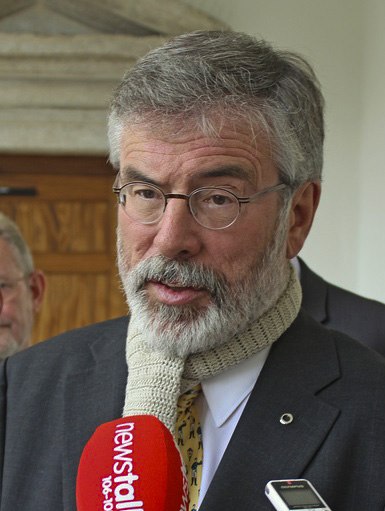


Political career and offices
Adams was president of Sinn Féin, a republican political party, for several decades. He represented West Belfast in elections to both the House of Commons as a Member of Parliament (which he did not take his seat in, following the tradition of abstentionism) and to the Northern Ireland Assembly. Adams has consistently argued for Irish unity, contending that Northern Ireland should have the opportunity to join the Republic of Ireland through peaceful and democratic means.
Role in the peace process
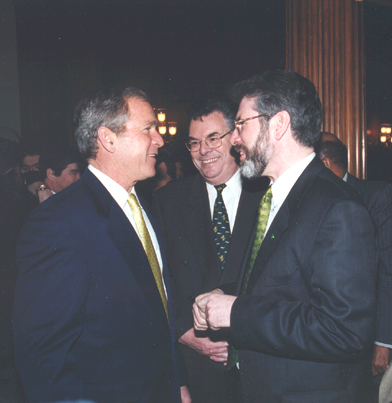
From the late 1980s onward, Adams became a key interlocutor in contacts between republican representatives, other Northern Irish parties such as the SDLP, and both the British and Irish governments. He held discussions with figures including John Hume and helped steer Sinn Féin toward political negotiation rather than armed struggle. These efforts contributed to ceasefires and the negotiated settlement culminating in the Good Friday Agreement era and the wider process of devolution and power-sharing in Northern Ireland.
Affiliations and controversies
Adams has long been associated with the broader republican movement, which at times included the Provisional Irish Republican Army. The IRA was regarded as illegal by the governments of the United Kingdom and the Republic of Ireland, and labelled a terrorist organisation by both. Adams has repeatedly denied being a member of the IRA. He has also faced historical allegations and police questioning about past incidents; these matters have been the subject of public dispute, legal action and political debate. Supporters credit him with persuading republicans to accept political routes and some form of devolved government, while critics question aspects of his record.
Notable facts and later life
- Adams played a visible part in the sequence of ceasefires and talks in the 1990s and 2000s that transformed Northern Irish politics.
- He served as an elected representative for Belfast West in various institutions while upholding abstentionist principles toward Westminster.
- His leadership of Sinn Féin reshaped the party into a significant electoral force in both Northern Ireland and the Republic of Ireland.
For more context on his background, politics and public statements, see related resources: Belfast, Irish, politician, Northern Ireland, and other archival material at language and name sources, party records and biographies. Additional references and reporting are found via Irish and UK contemporary news coverage and analyses (republican movement, legal status, security policy, devolution, other parties).
Adams stepped back from frontline politics in the late 2010s and formally retired from elected office in 2020, leaving a contested legacy as both a political architect of peace and a polarizing public figure.
Questions and answers
Q: Who is Gerard "Gerry" Adams?
A: Gerard "Gerry" Adams is an Irish politician who was the president of Sinn Féin, a political party that wants Northern Ireland to join the Republic of Ireland. He was a member of the Northern Ireland Assembly in Belfast and was a member of the British Parliament for Belfast West.
Q: What is abstentionism?
A: Abstentionism is when someone does not go to Parliament because they do not believe that Britain should control Northern Ireland.
Q: What does the Irish republican movement include?
A: The Irish republican movement includes Sinn Féin and the Provisional Irish Republican Army (PIRA).
Q: Is the IRA legal in both the UK and Republic of Ireland?
A: No, it is illegal in both countries as it is called a terrorist group by both governments.
Q: How did Gerry Adams contribute to peace process in Northern Ireland?
A: Gerry Adams was an important figure in the Northern Ireland peace process from late 1980s onwards. He met with John Hume, leader of SDLP (Social Democratic and Labour Party’s), as well as with Irish and British governments, and other parties involved. This eventually led to IRA stopping fighting in 1995, followed by them declaring war over in 2005.
Q: When did Gerry Adams retire from politics?
A: Gerry Adams retired from politics in February 2020.
Related articles
Author
AlegsaOnline.com Gerry Adams: Irish republican leader and Sinn Féin politician Leandro Alegsa
URL: https://en.alegsaonline.com/art/119735
Sources
- phoblacht.net : Gerry Adams Man Of War and Man Of Peace?