
Garry Kasparov: chess champion, strategist, and political activist
Garry Kasparov (born 1963) is a Russian chess grandmaster and former World Champion, known for dominant tournament play, deep opening preparation, the 1997 Deep Blue match, and later political activism.
Garry Kasparov (born 13 April 1963 in Baku, Azerbaijan) is a chess grandmaster and public figure best known for his long tenure at the top of international chess and for later activity in politics and writing. Born with the family name Weinstein and of mixed ancestry, Kasparov rose through the Soviet school of chess to become, at age 22, one of the youngest players to claim the title of World Chess Champion. He spent much of his competitive career as the highest-rated player in the world and is widely regarded as one of the strongest players in history.
Image gallery
10 Images


Playing style and contributions
Kasparov combined deep theoretical preparation with aggressive, dynamic play. He excelled in opening research, often steering games into complex middlegame positions where he could press practical chances. His approach influenced the preparation methods of later generations and helped elevate the importance of computer-assisted analysis in top-level chess. As a public figure in the chess world, Kasparov also wrote books and collected notable games that remain reference material for players studying modern grandmaster play.
Career highlights
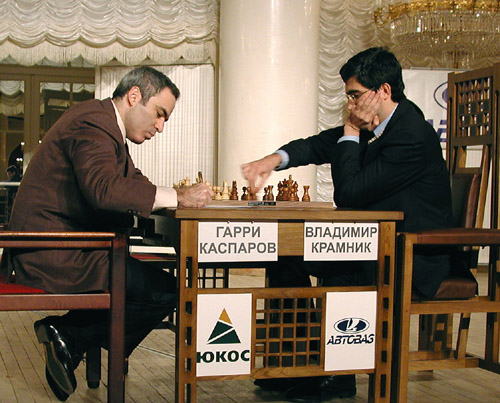
Kasparov became World Champion after a series of hard-fought matches against Anatoly Karpov in the 1980s, inaugurating a rivalry that defined an era. He held the official World Chess Champion title from 1985 until 1993. In 1993 disagreements with FIDE led him to help establish a rival organization and to continue defending a lineage of the classical world title until his defeat by Vladimir Kramnik in 2000.
- Youngest champion of the modern era at the time he won the title.
- Multiple match victories and tournament wins across the 1980s and 1990s.
- Maintained the top Elo rating for many years and set records that stood until later surpassed by players such as Magnus Carlsen.
Matches against computers and public profile
One of the most publicized episodes of Kasparov's career was his series of matches against computer programs. In 1996 he won an initial match against IBM's Deep Blue, but in 1997 he lost a rematch in circumstances that generated intense debate about preparation, machine strength, and the future relationship between humans and artificial intelligence. Kasparov's encounters with computers helped popularize discussion about computing in chess and beyond.
After top-level competition
After retiring from regular competition, Kasparov remained influential in chess as an author, commentator, and mentor. He has offered public advice and occasional consultation to younger players and commentators, and has been a vocal supporter of modern training methods. He has also written extensively on chess strategy and on geopolitics, reflecting a career that spans sport and public affairs.
Politics, writing, and public life
Beginning in the 2000s Kasparov became active outside chess as a political activist and critic of elements of the Russian government. He has taken part in opposition initiatives, published books on politics, and spoken internationally about democracy and human rights. His public role brought him attention beyond chess and illustrated how elite athletes may transition into civic engagement.
Notable facts and distinctions
- Kasparov's matches with Anatoly Karpov and his lengthy dominance of world rankings marked him as a central figure of late 20th-century chess.
- He played a prominent part in the institutional dispute with FIDE in the 1990s and the creation of a competing structure.
- His public loss to Deep Blue symbolized the growing capabilities of computers; the event remains a landmark in AI and chess history.
- Kasparov has been connected to many places and themes mentioned in media: born in Baku, representing Russia in international chess, and often discussed alongside other chess figures and nations such as Norway (home to Magnus Carlsen).
For further reading on his life, games, and public positions, see major chess collections and profiles, tournament databases, and his own published works. Scholarly and popular sources alike document both his competitive achievements and his later activity as a commentator and political voice.
Chess, as the arena in which Kasparov made his name, continues to evolve with new technology and younger champions; his legacy is visible in modern opening theory, preparation habits, and the public profile of elite players. Many of the episodes of his career — the rivalry with Karpov, the split with FIDE, the match with IBM, and his later public life — remain points of reference when discussing the modern era of the game.
Further context and biographies can be found through general chess histories and collections of classic games. Readers interested in specific matches, ratings lists, or Kasparov's political writings should consult detailed tournament records and his published books and articles.
Undisputed and contested aspects of world titles, and examinations of his place in chess history, are discussed by commentators and historians; for balanced perspectives, consult multiple sources and annotated game collections.
Azerbaijan, Vladimir Kramnik, and other contemporaries appear frequently in accounts of Kasparov's career. His story connects competitive achievement, technological change, and political engagement — making him one of the most widely known chess figures of the late 20th and early 21st centuries.
Questions and answers
Q: What is Garry Kasparov's birth name?
A: His birth name is Garry Weinstein.
Q: When did Garry Kasparov become the World Chess Champion?
A: He became the World Chess Champion in 1985 and held the title until 2000.
Q: Why did Kasparov form a rival organisation to FIDE?
A: He formed a rival organisation, the Professional Chess Association, because he felt that FIDE had failed to raise enough money for world title matches.
Q: Who is currently the highest-rated chess player?
A: Magnus Carlsen is currently the highest-rated chess player.
Q: How old was Garry Kasparov when he became World Chess Champion?
A: He was 22 years old when he became World Chess Champion in 1985.
Q: What happened between Garry Kasparov and Deep Blue in 1997?
A: In 1997, Kasparov lost a match (a series of chess games) against Deep Blue, a computer made by IBM.
Q: Who has Garry been coaching lately since his retirement from competition?
A: Since his retirement from competition, he has been coaching Magnus Carlsen, the young player from Norway who is currently world #1.
Related articles
Author
AlegsaOnline.com Garry Kasparov: chess champion, strategist, and political activist Leandro Alegsa
URL: https://en.alegsaonline.com/art/119402
Sources
- theguardian.com : "Chess champion Garry Kasparov granted Croatian citizenship"
- kasparov.ru : "Гарри Каспаров Справки - Каспаров.Ru"
- ratings.fide.com : "FIDE Chess ratings"
- chessmetrics.com : "Peak Average Ratings: 3 year peak range"
- thetimes.co.uk : "The Times & The Sunday Times"
- usatoday.com : "Kasparov released from Moscow jail"
- nytimes.com : "Kasparov says he was forced to end bid for Presidency"