
Friedrich Georg Wilhelm von Struve — astronomer, cataloguer of double stars, and geodesist
German-born astronomer (1793–1864) who worked in the Russian Empire; led Dorpat and Pulkovo observatories, compiled influential double-star catalogues, measured stellar parallaxes, and advanced geodesy.
Overview
Friedrich Georg Wilhelm von Struve (15 April 1793 – 23 November 1864; Julian calendar: 11 November) was a German-born astronomer who spent most of his professional life in the Russian Empire. He is best known for systematic studies of double and multiple stars, early attempts to measure stellar parallax, leadership of major observatories, and large-scale geodetic surveys. Struve combined careful observational technique with an ambitious program of cataloguing that influenced positional astronomy for generations.
Image gallery
3 Images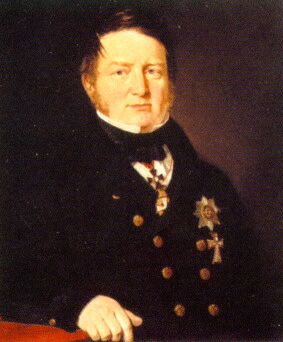


Life and career
Born in Altona (now part of Hamburg), Struve studied astronomy and mathematics in Germany before accepting a position at the observatory in Dorpat (the university now known as Tartu). As director of the Dorpat Observatory (1817–1839; Dorpat) he reorganized observational programs and trained a generation of astronomers. In 1839 he moved to the new Pulkovo Observatory near St. Petersburg and served there as director until retirement in 1862; Pulkovo became a central institution for Russian astronomy under his direction (Pulkovo).
Scientific contributions
Struve made lasting contributions in several interrelated areas of astronomy and geodesy. He carried out extensive micrometric measurements of double stars, demonstrating that binary and multiple systems were common and subject to Newtonian gravity rather than being mere line-of-sight coincidences. He was also among the first astronomers to attempt direct measurement of stellar parallaxes, working almost contemporaneously with Friedrich Bessel and Thomas Henderson; these early parallax measurements ushered in a new, empirical scale of stellar distances.
Beyond stellar work, Struve engaged in precise positional astronomy and applied those techniques to terrestrial measurement. He led triangulation surveys, including work in Livonia and the measurement of meridian arcs, as part of efforts to determine the Earth's shape and size. These geodetic initiatives laid groundwork later extended as the Struve Geodetic Arc, an international chain of survey points developed to link measurements across northern and eastern Europe.
Catalogues, methods and influence
Beginning in 1822 Struve published a sequence of double-star catalogues whose identifying numbers remain in use. The original catalogue entries used the Greek letter sigma (Σ) as a prefix; in subsequent literature many of these binaries are referred to by the name "Struve" with catalogue numbers (for example, Struve 2398). His catalogues combined accurate relative positions, separations and position angles, and they provided a statistical perspective showing how numerous close pairs are in the sky.
- Observational rigor: Struve emphasized repeated measurements and careful reduction to detect orbital motion in binaries and to reduce systematic error.
- Institution building: Under his direction Dorpat and Pulkovo became important centers for training and research.
- Geodetic legacy: His triangulations contributed to later multi‑national efforts to map parts of Europe accurately.
Struve published many papers and catalogues during his career, and he also established a family tradition in astronomy: his son Otto Wilhelm von Struve succeeded him at Pulkovo and continued the observatory's work. The combination of careful instrument use, long-term monitoring of doubles, and application of astronomical methods to geodesy makes Friedrich von Struve a central figure in 19th‑century observational science. For more on the historical context of his observatory work and calendar references see biographical summaries and institutional histories (Dorpat, Pulkovo).
Questions and answers
Q: Who was Friedrich Georg Wilhelm von Struve?
A: Friedrich Georg Wilhelm von Struve was a German-born Russian astronomer. He was born in Altona (now an area of Hamburg), Germany, but later lived in Russia.
Q: What did he specialize in?
A: He specialized in double stars and measuring stellar parallax, which is closely related to the work by Friedrich Bessel.
Q: What did he write?
A: He wrote Stellarum Duplicum et Multiplicum (1837), which proved that double stars are not exceptional and that star systems are governed by the laws of gravity.
Q: Where did he work?
A: He worked at Dorpat Observatory from 1817–39 and then became director of the new Pulkovo Observatory near St. Petersburg until his retirement in 1862, when his son took over in the post.
Q: How many astronomical works did he produce?
A: In total, Friedrich Struve produced 272 astronomical works.
Q: How many children did he have?
A: He had 18 children.
Q: Who succeeded him as director of Pulkovo Observatory after his retirement?
A: His son Otto Wilhelm von Struve succeeded him as director (1862–89) of the Pulkovo Observatory after his retirement.
Related articles
Author
AlegsaOnline.com Friedrich Georg Wilhelm von Struve — astronomer, cataloguer of double stars, and geodesist Leandro Alegsa
URL: https://en.alegsaonline.com/art/119282