
Frederick II of Prussia (Frederick the Great)
Enlightened absolutist and military commander who ruled Prussia (1740–1786), known for military victories, administrative reforms, patronage of the arts and correspondence with Enlightenment thinkers.
Overview
Frederick II (1712–1786), commonly called Frederick the Great, was King in Prussia from 1740 until his death. A member of the Hohenzollern dynasty, he transformed a regional power into a leading European state through a combination of military success, centralized administration and cultural patronage. He is remembered both as an innovative military leader and as an "enlightened despot" who adapted some Enlightenment ideas to monarchical rule. For his German name and epithets see German forms and for the kingdom he ruled consult Prussia.
Image gallery
10 Images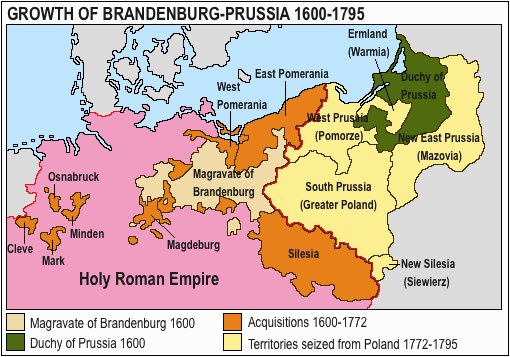




Early life and character
Born into an intensely disciplined court, Frederick’s youth contrasted sharply with the austere militarism of his father. As crown prince he cultivated music, philosophy and literature, and his lifelong interest in the arts set him apart from an upbringing dominated by drill and duty. A failed escape attempt with his friend Hans Hermann von Katte ended in the latter’s execution and left a lasting psychological imprint. His complex personal life and intimate friendships have led many historians to describe him as bisexual, while accounts differ about his private practices later in life. He also held the hereditary title of Margrave of Brandenburg as a prince-elector of the electoral college and operated within the political framework of the Holy Roman Empire.
Military career and territorial changes
Shortly after ascending the throne, Frederick initiated the Silesian Wars against Austria to seize the wealthy province of Silesia. Success in these campaigns and in subsequent conflicts raised Prussia’s standing in Europe. During his reign his armies proved effective, disciplined and tactically adaptable, factors that contributed to Prussia’s emergence as a major power. Later in his rule he took part in the diplomatic partitions of neighboring states, most notably the First Partition of Poland in 1772, which enlarged and consolidated Prussian territories; see the partitions of Poland.
Administration, law and religion
At home Frederick reformed the civil service, streamlined taxation and modernized the bureaucracy to strengthen state capacity. He promoted meritocratic principles within government institutions and sought to make administration more efficient; contemporary debates around his policies and their social effects remain important to historians. He advocated religious tolerance for different Christian confessions and other faiths, encouraging immigration of skilled settlers. For aspects of his bureaucratic reforms see civil service reforms.
Patronage, culture and intellectual life
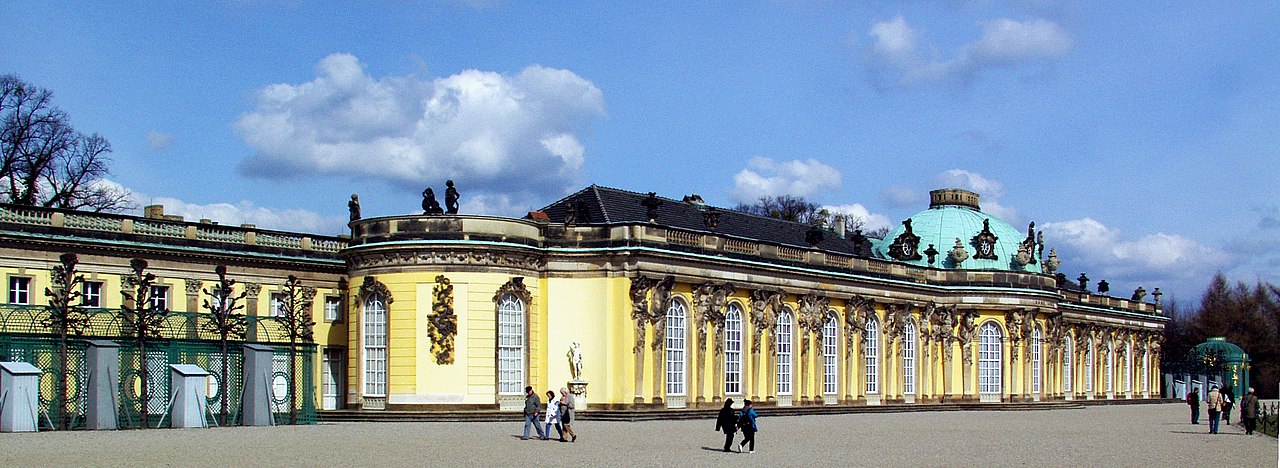
Frederick was a patron of music, architecture and literature. An amateur flautist and composer, he built the Sanssouci palace in Potsdam as a retreat and cultural salon; he was buried there after his death and the site remains associated with him (Sanssouci). He maintained a lively correspondence with leading Enlightenment figures, most famously the philosopher and writer Voltaire, exchanging ideas about governance, history and arts that influenced his self-image as an enlightened monarch.
Legacy and succession
Frederick’s reign reshaped northern and central Europe: he established Prussia as a military and administrative model, fostered economic and legal reforms, and left a cultural legacy that blended courtly magnificence with intellectual engagement. He died childless and was succeeded by his nephew; for details of succession see Frederick William II. For the dynasty background consult the Hohenzollern family article and for further biographical or institutional context use the linked entries above. His complex reputation—heroic commander, authoritarian ruler, and enlightened patron—continues to generate study and debate among scholars.
Selected conflicts and institutions
- Major military conflicts: Silesian Wars; wider European engagements often grouped under the War of the Austrian Succession and the Seven Years' War.
- Key institutions: Prussian monarchy, reformed civil service and standing army.
- Cultural notes: patronage of music and philosophy; correspondence networks across Europe.
Further reading and primary documents can be found via related reference links: names and titles, state of Prussia, dynastic history, electoral role, imperial context, Silesia, Polish partitions, Voltaire correspondence, administrative reforms, Sanssouci, succession.
Questions and answers
Q: Who was Frederick II?
A: Frederick II was a King in Prussia from the Hohenzollern dynasty, and he was also the sovereign prince of the Principality of Neuchâtel. He is often referred to as Frederick the Great or der alte Fritz ("Old Fritz").
Q: What did Frederick do when he was young?
A: When he was young, Frederick mostly interested in music and philosophy and not military affairs. He even tried to escape his strict father with his childhood friend, Hans Hermann von Katte.
Q: How did Frederick become King in Prussia?
A: After the death of his father, Frederick William I, in 1740, Frederick became King in Prussia. Shortly after becoming king, he attacked Austria and claimed Silesia during the Silesian Wars.
Q: What is known about Fredericks's personal life?
A: Many historians consider him to be bisexual and perhaps possibly celibate in his later life. After becoming king, he only attended his wife with formal visits once a year.
Q: What are some accomplishments attributed to Frederick II?
A: During his reign as king, Fredrick modernized the Prussian bureaucracy and civil service and promoted religious tolerance. He also patronized the arts and philosophers, wrote flute music, and united most of his separated parts of his kingdom through the First Partition of Poland near the end of his life.
Q: Who succeeded him after death?
A: Because he died childless, Frederick was succeeded by his nephew, Frederick William II of Prussia - son of Prince Augustus William of Prussia - after death.
Q: Where is Fredrick buried?
A:Frederick is buried at Sanssouci Palace in Potsdam - one of favorite residences during life time
Related articles
Author
AlegsaOnline.com Frederick II of Prussia (Frederick the Great) Leandro Alegsa
URL: https://en.alegsaonline.com/art/119224
Sources
- books.google.com : Bibliographie Friedrich der Grosse, 1786–1986: das Schrifttum des deutschen Sprachraums und der Ubersetzungen aus Fremdsprachen