
Eratosthenes of Cyrene: Greek scholar, geographer and early scientist
Eratosthenes (c. 276–194 BC) was a Hellenistic polymath who led the Library of Alexandria and pioneered methods in geography, chronology and astronomical measurement, including an early estimate of Earth's circumference.
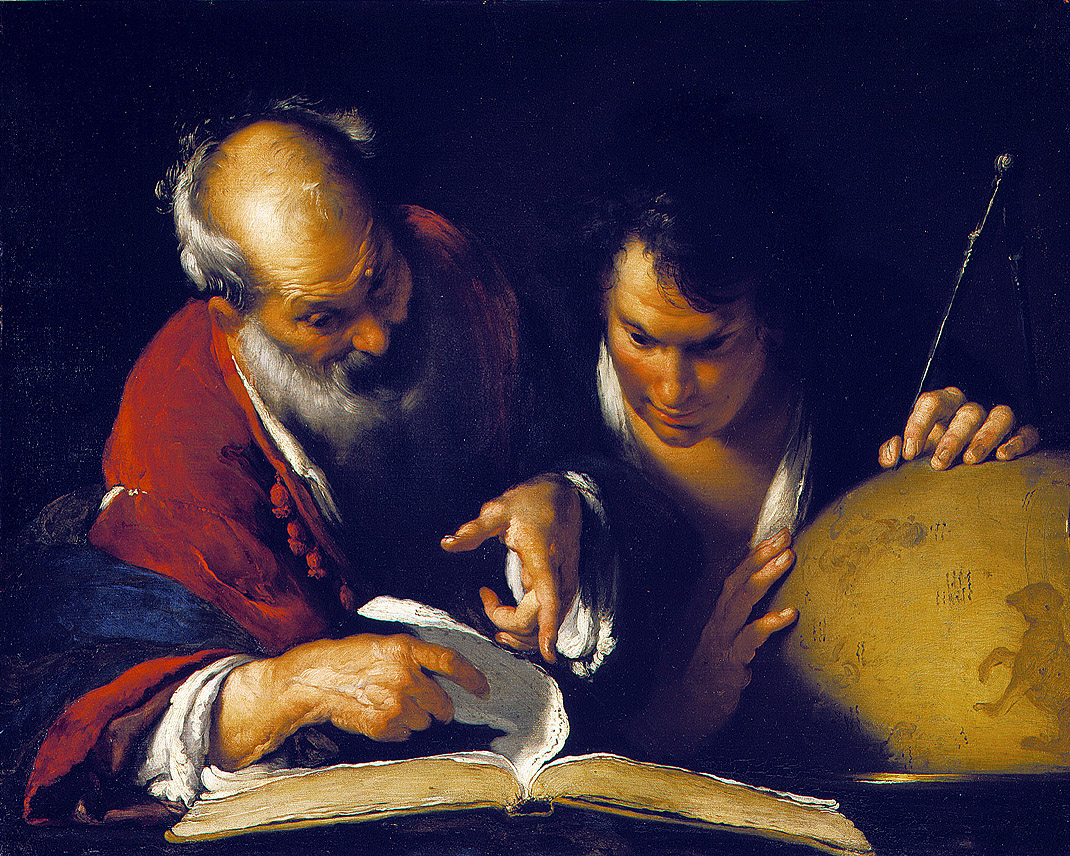
Overview: Eratosthenes of Cyrene was a leading Hellenistic scholar active in the 3rd century BC. Trained and celebrated across several fields, he is remembered as a mathematician, a mathematical author, a geographer and an astronomer. For much of his career he directed the great research collection known as the Library of Alexandria, which made the city a center for learning and for the compilation of earlier knowledge.
Image gallery
10 Images



Life and historical record
Biographical detail about Eratosthenes survives mainly in later summaries and lexica rather than in original manuscripts. The 10th-century Byzantine encyclopedia known as the Suda records anecdotes about his education and reputation, including a tradition that colleagues nicknamed him "Beta" because he was often judged second-best in many areas of learning. He was a contemporary and correspondent of other great figures of the period, including Archimedes, and worked in an intellectual environment that prized technical invention and theoretical reasoning; some accounts call him an inventor in his own right.
Writings and lost works
Many of Eratosthenes' original books did not survive antiquity; what we know comes from quotations and references by later writers. Ancient geographers and historians attribute to him a systematic work on geography and a treatise often rendered as "On the measurement of the Earth." These books appear to have combined empirical observation, compilation of reports from travelers, and rational methods intended to place locations on a common framework.
Major achievements
Eratosthenes is widely credited with several important advances that influenced later science and mapping. Among the most significant were:
- A method to estimate the circumference of the Earth, using observations of the Sun at different places and known distances between them.
- The development of a practical grid of latitude and longitude concepts to describe positions on the globe, an early step toward the coordinate systems used in mapping.
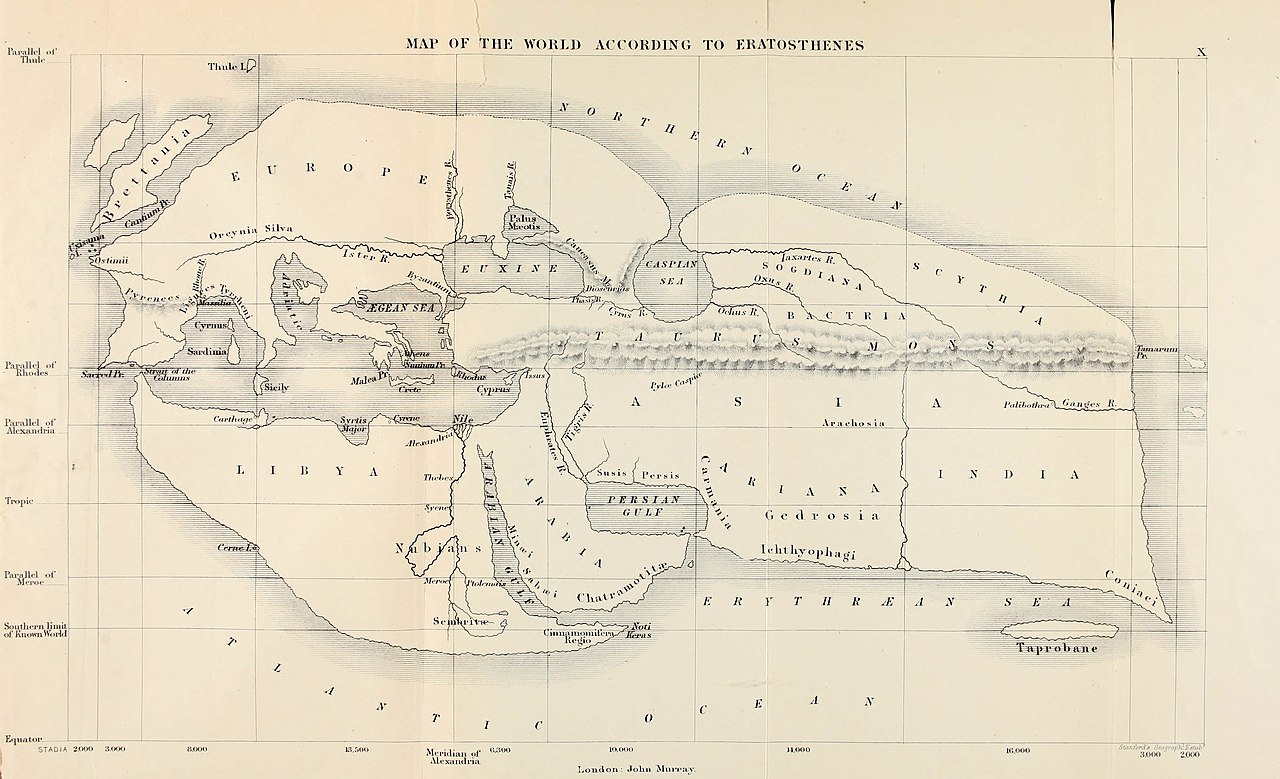
- The production of a comprehensive map of the known world that attempted to integrate the best contemporary geographic reports.
- Work in chronology and the ordering of historical events, including efforts to date early milestones in Greek tradition such as the fall of Troy.
Method and scientific approach
His measurement of the planet's circumference is often highlighted as an early example of combining observation with geometric reasoning. Eratosthenes used the differing angles of the Sun's rays at two locations at the same time of day to infer the curvature of Earth's surface. By relating the angle difference to the distance separating the locations, he obtained a numerical estimate for the whole circumference. The method depends on several reasonable assumptions (for example, that the two sites lie roughly on the same meridian and that the Sun's rays are effectively parallel), and later commentators have discussed possible sources of error in the values available to him.
Legacy and significance
Eratosthenes is remembered for applying quantitative reasoning to broad questions about the world. His combination of measurement, geometry and critical compilation influenced how later scholars approached geography, cartography and chronology. While many original documents are lost, his reputation survives through the consistent credit later authors give him for introducing systematic methods into the study of the Earth's size, the arrangement of places, and the dating of events. Modern historians regard him as a pivotal figure in the gradual shift from descriptive to analytical approaches in ancient science.
For further reading, see specialized treatments of Hellenistic science and the classical tradition in geography and chronology via the library resources linked above.
mathematician mathematics geographer astronomer Library of Alexandria Suda Archimedes inventor Beta nickname circumference Earth latitude longitude map Troy
Questions and answers
Q: Who was Eratosthenes of Cyrene?
A: Eratosthenes of Cyrene was a 3rd century BC Greek mathematician, geographer and astronomer. He was head of the Library of Alexandria from 240 BC until his death.
Q: What nickname did his contemporaries give him?
A: His contemporaries nicknamed him Beta, (the second letter of the Greek alphabet), because he was the second best in the world in almost any field.
Q: What works did Eratosthenes write?
A: According to Strabo (~63BC–24AD), Eratosthenes wrote On the measurement of the Earth and Geographica.
Q: What discoveries and inventions is he credited with making?
A: Eratosthenes made several remarkable discoveries and inventions. He was the first person to calculate the circumference of the Earth (with remarkable accuracy), and he invented a system of latitude and longitude. He calculated the tilt of the earth's axis (again with remarkable accuracy); he may also have accurately calculated the distance from the earth to the sun and invented leap day. He created a map of the world based on available geographical knowledge at that time.
Q: What else is Eratosthenes known for founding?
A: Eratosthenes is also known as founder scientific chronology; he wanted to fix dates for chief literary and political events from conquest Troy onwards.
Q: Who was Archimedes, who lived in Alexandria at same time as Eratosthens?
A: Archimedes was a great mathematician and inventor who lived worked in Alexandria during same period as Erastothens; they were friends with each other.
Related articles
Author
AlegsaOnline.com Eratosthenes of Cyrene: Greek scholar, geographer and early scientist Leandro Alegsa
URL: https://en.alegsaonline.com/art/118586
Sources
- wired.com : 'Wired' 2008
- traianus.rediris.es : "Roman Surveying" · web.archive.org
- anthonybloggeneral.wordpress.com : "How did Eratosthenes measure the circumference of the earth?"
- primes.utm.edu : Nicomachus Introduction to arithmetic, I, 13 · archive.org
- wikidata.orgQ43182.html : wikidata.orgq43182.html
- authority.bibsys.no : 95001492
- catalogo.bne.es : XX1128886
- catalogue.bnf.fr : cb12483904c
- data.bnf.fr : (data)
- cantic.bnc.cat : a10077960
- ci.nii.ac.jp : DA11746617
- d-nb.info : 118530674
- isni.org : 0000 0000 8148 6989