
Emperor Nintoku — traditional 16th sovereign of Japan and his legacy
Emperor Nintoku is the traditional 16th emperor of Japan. His life and reign are known mainly from early chronicles; his attributed tomb and legends shaped later imperial tradition and archaeological interest.
Overview
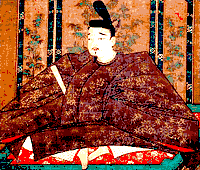
Emperor Nintoku is counted in the traditional succession as the 16th emperor of Japan. This sequence appears in early Japanese chronicles and later court lists, but historians treat many details about Nintoku as part of a partly legendary early record rather than strictly documented biography. The conventional list places him among the formative rulers of the Yamato polity and links him to later imperial genealogies. See the traditional list of rulers via traditional order and the broader context of Japan.
Image gallery
4 Images

Sources and historicity
Information about Nintoku comes chiefly from the Kojiki and the Nihon Shoki, eighth‑century compilations that blend oral tradition, myth, and court genealogies. Because these works were written centuries after the events they describe, modern scholars regard the narrative as possibly legendary though not without historical value. The personal name "Nintoku" itself is a posthumous title assigned by later chroniclers and court compilers; such names were standardized well after the supposed lifetimes of early rulers (posthumous names). The list of early emperors was formalized and widely accepted by the time of Emperor Kammu (Emperor Kammu), and later generations played a role in shaping the received account (later generations).
Attributed reign and character
Traditional texts portray Nintoku as a benevolent and frugal ruler whose policies favored agricultural recovery and popular welfare. Stories emphasize modesty, relief measures during famine or disaster, and efforts to limit taxation. These accounts have been influential in later literature and moral exemplars, though they should be read as part of a moral-historical narrative rather than as documentary evidence of specific reforms.
Tomb and archaeology
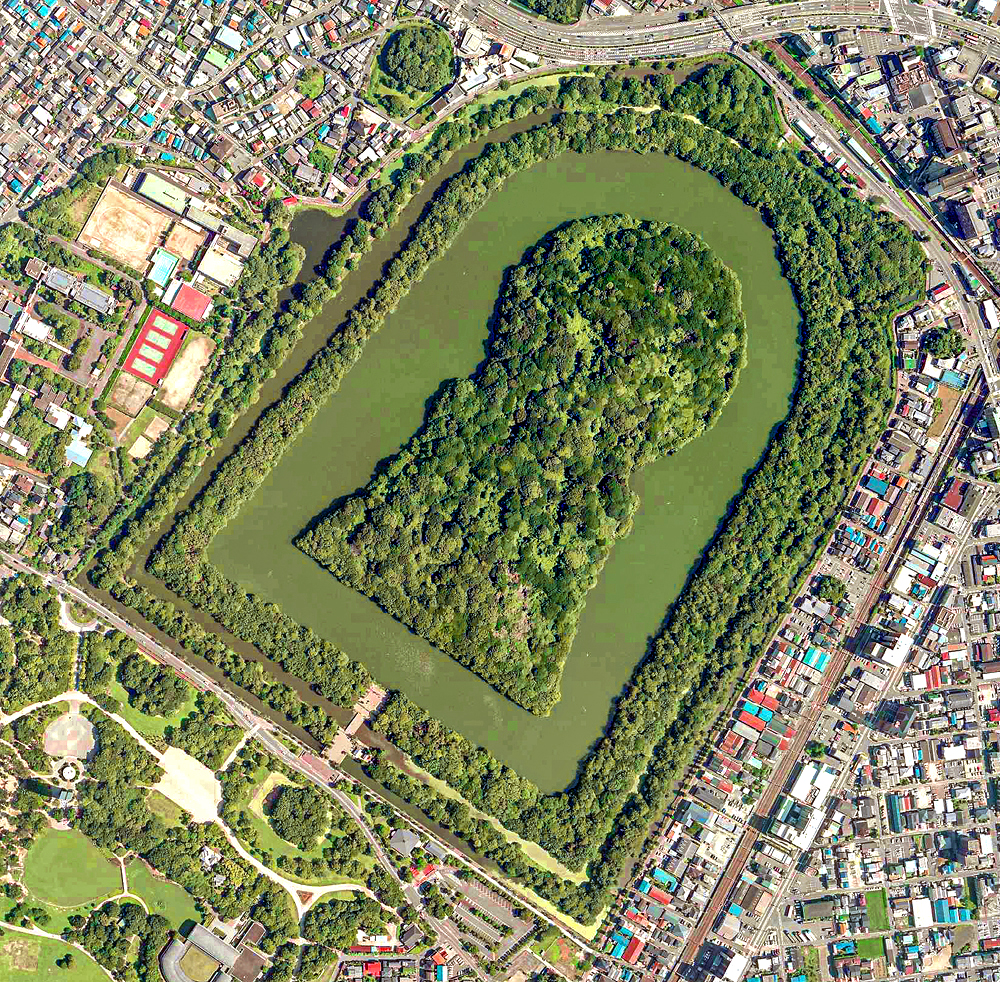
Nintoku is commonly associated with a very large keyhole-shaped burial mound (kofun) located in the Mozu-Furuichi Kofun Group near Sakai in present-day Osaka Prefecture. Known as Daisen Kofun in popular and administrative usage, this tumulus is one of the largest of its type worldwide and has attracted archaeological and public interest. The Imperial Household Agency designates certain kofun as imperial tombs and restricts excavation, which complicates efforts to confirm identities archaeologically.
Legacy and cultural significance
Whether fully historic or partly legendary, Nintoku functions as an important figure in Japan's early imperial identity. He appears in artistic representations, folklore, and as a reference point in discussions about the formation of early state structures in the archipelago. His story illustrates how myth, court compilation, and archaeological remains interact in constructing national history.
Key points
- Listed as the 16th emperor in traditional sequences (traditional order).
- Primary literary sources are the Kojiki and Nihon Shoki; historicity is uncertain (possibly legendary).
- Associated with Daisen Kofun, a major keyhole-shaped burial mound; archaeological access is limited.
- His posthumous name and place in the imperial list were shaped by later generations and standardized by the time of Emperor Kammu.
For concise introductions and further readings, consult general histories of early Japan and summaries that bridge the chronicles and archaeological findings (posthumous name, Japan).
Questions and answers
Q: Who was Emperor Nintoku?
A: Emperor Nintoku was the 16th emperor of Japan according to the traditional order of succession.
Q: How do historians view the details of Emperor Nintoku's life?
A: Historians consider details about the life of Emperor Nintoku to be possibly legendary but probable.
Q: Was Emperor Nintoku given his name during his lifetime?
A: No, the name Nintoku-tennō was created for him posthumously by later generations.
Q: Can a specific timeline be assigned to Emperor Nintoku's life or reign?
A: No, no certain dates can be assigned to Emperor Nintoku's life or reign.
Q: When were the conventionally accepted names and sequence of early emperors confirmed as "traditional"?
A: The conventionally accepted names and sequence of the early emperors were not confirmed as "traditional" until the reign of Emperor Kammu, who was the 50th monarch of the Yamato dynasty.
Q: What dynasty did Emperor Nintoku belong to?
A: Emperor Nintoku belonged to the Yamato dynasty.
Q: How is Emperor Nintoku regarded in Japanese history?
A: Emperor Nintoku is regarded as a significant figure in Japanese history, known for his leadership and contributions to society during his reign.
Related articles
Author
AlegsaOnline.com Emperor Nintoku — traditional 16th sovereign of Japan and his legacy Leandro Alegsa
URL: https://en.alegsaonline.com/art/118517
Sources
- kunaicho.go.jp : 仁徳天皇 (16)
- t-net.ne.jp : "Kofun Culture,"
- t-net.ne.jp : Japanese Archaeology.
- independent.co.uk : "Japan guards the emperors' secrets; Ban on digs in ancient imperial tombs frustrates archaeologists,"