
Emperor Kōnin (r. 770–781)
Emperor Kōnin, born Prince Shirakabe (709–782), reigned as Japan's 49th emperor from 770 to 781. His accession followed the death of Empress Shōtoku and his reign aimed to restore court stability and succession.
Overview
Emperor Kōnin (personal name Shirakabe) was born in 709 and is traditionally counted as the 49th emperor of Japan. He reigned from 770 until his abdication in 781 and died the following year. His time on the throne is often characterized as a period of cautious reconstruction after a decade of political tension at the imperial court.
Image gallery
1 Image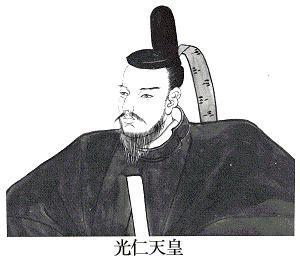
Background and accession
Kōnin came to the throne after the death of Empress Shōtoku, at a moment when the court sought a compromise figure acceptable to several powerful clans and factions. As an older member of the imperial family with a reputation for stability, he was chosen to restore regular succession and to calm factional disputes that had emerged in previous decades.
Reign and initiatives
Throughout his eleven-year reign Kōnin pursued policies intended to strengthen central authority and improve administration. Court records and later histories credit his government with taking practical steps to stabilize finances, reaffirm legal procedures at the capital, and manage succession matters more deliberately than had sometimes been the case. He is also associated with supporting Buddhist institutions, which were integral to state ritual and legitimacy in this era.
Succession and legacy
In 781 Kōnin abdicated in favor of his son, who became Emperor Kanmu, a ruler known for later major reforms and for moving the capital. Kōnin's role is therefore often seen as transitional: he helped reestablish orderly imperial succession and provided a bridge between turbulent court politics of the mid-eighth century and the more reformist generations that followed.
Notable facts
- Personal name: Shirakabe (a name used before accession).
- Traditional reign: 770–781; died 782.
- His accession reflected a search for compromise and stability at court.
- Viewed historically as a stabilizing, transitional sovereign rather than an innovator.
Questions and answers
Q: Who was Emperor Kōnin?
A: Emperor Kōnin was the 49th emperor of Japan.
Q: When was Emperor Kōnin born and when did he die?
A: Emperor Kōnin was born on November 18, 709 and died on January 11, 782.
Q: What was the duration of Emperor Kōnin's reign?
A: Emperor Kōnin's reign lasted from 770 to 781.
Q: According to what order of succession was Emperor Kōnin the 49th emperor of Japan?
A: Emperor Kōnin was the 49th emperor of Japan according to the traditional order of succession.
Q: What title was given to Emperor Kōnin in Japan?
A: Emperor Kōnin's title was Kōnin-tennō.
Q: What was the significance of Emperor Kōnin in Japan?
A: As the 49th emperor of Japan, Emperor Kōnin played a significant role in the country's history.
Q: What was the period during which Emperor Kōnin ruled Japan known as?
A: The period during which Emperor Kōnin ruled Japan is known as the Nara period.
Related articles
Author
AlegsaOnline.com Emperor Kōnin (r. 770–781) Leandro Alegsa
URL: https://en.alegsaonline.com/art/118506
Sources
- kunaicho.go.jp : 光仁天皇 (49)
- books.google.com : Nipon o dai itsi ran: ou Annales des empereurs du Japon
- books.google.com : 愚管抄: A Translation and Study of the Gukansho, an Interpretative History of Japan Written in 1219
- books.google.com : 愚管抄: A Translation and Study of the Gukansho, an Interpretative History of Japan Written in 1219
- simple.wiktionary.orgLegend.html : Legendary period