
Emperor Kōgen — legendary eighth sovereign in Japan's traditional order
Emperor Kōgen is numbered as the eighth emperor in Japan's traditional lists. Regarded as a legendary figure, his life and reign have no verifiable dates and are known mainly from early chronicles and later genealogical tradition.
Overview
Emperor Kōgen (孝元天皇, Kōgen-tennō) is conventionally listed as the eighth emperor in the traditional succession of the rulers of Japan. Modern historians regard him as a legendary or semi-legendary figure: there are no contemporary records or archaeological inscriptions that can be reliably attributed to him. The personal name and the title Kōgen-tennō were assigned after the fact by later chroniclers and court compilers.
Image gallery
2 Images
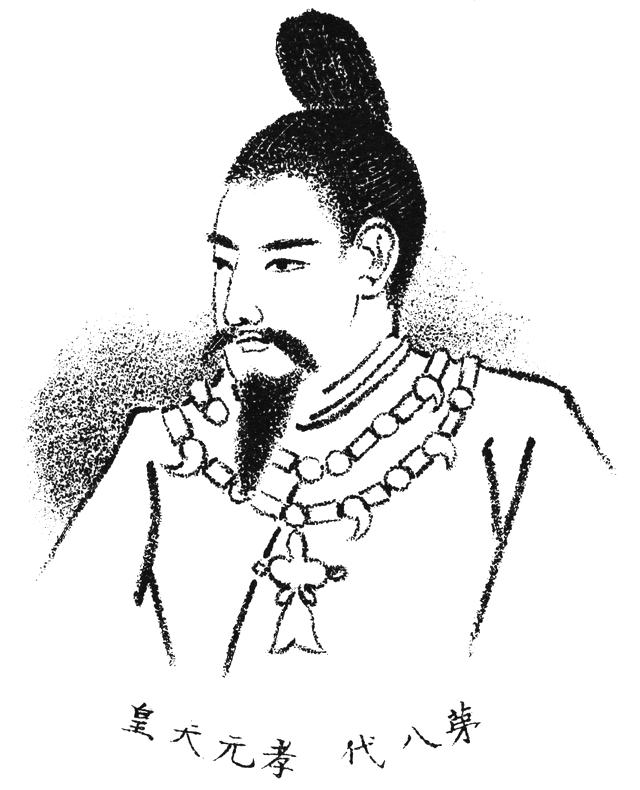
Sources and historicity
The primary written sources that enumerate early Japanese rulers and their deeds are compilations such as the Kojiki and Nihon Shoki, and later medieval works that organized the imperial genealogy. These sources mix myth, oral tradition, and genealogical claims. The posthumous name and the standard placement of Kōgen within the sequence of emperors were fixed by later tradition rather than by contemporary documentation; in the process the name Kōgen-tennō was created, and such naming conventions were reinforced by later generations of court historians.
Traditional genealogy and palace
According to the historical tradition preserved in medieval chronicles and commentaries, Kōgen is described as a descendant in the line of early Yamato rulers. The Gukanshō and other compilations report that his seat was at the palace named Sakaihara-no-miya, located at Karu in what later became known as Yamato Province. These attributions reflect how court historians situated legendary rulers within an imagined geographical and dynastic framework.
Why historians treat Kōgen as legendary
- No contemporaneous documentary or material evidence (inscriptions, dated artifacts) supports the existence of an individual matching Kōgen's traditional profile.
- The early portions of the imperial list were not standardized until centuries later; the established order was formalized by the time of Emperor Kanmu, the fiftieth ruler of the Yamato dynasty.
- Chronicles interweave supernatural motifs, genealogical claims, and political legitimization, so names and dates from these sections are treated cautiously.
Cultural role and significance
Even where historical certainty is lacking, figures like Kōgen play a role in Japan's cultural memory and the ideological construction of imperial continuity. Listing such early sovereigns established an unbroken line that later courts used for ritual, legitimacy, and identity. Legendary rulers are therefore important not as verifiable historical actors but as components of a narrative that shaped institutions and perceptions of the imperial house.
Notable distinctions
Key points to bear in mind: the traditional sequence that includes Kōgen was shaped by compilers and retrospective naming practices; the status of these early emperors differs from later monarchs whose reigns are supported by better documentary and archaeological evidence; and discussions of Kōgen typically emphasize mytho-historical analysis rather than factual biography. Further reading and source citations are provided in many reference works and modern studies that examine the intersection of legend and early Japanese state formation. For entries in reference lists and chronologies see standard compendia and translations of the primary chronicles (chronological lists, national histories).
Questions and answers
Q: Who was Emperor Kōgen?
A: Emperor Kōgen was the 8th emperor of Japan, according to the traditional order of succession.
Q: Do historians believe that Emperor Kōgen was a real person?
A: Historians consider Emperor Kōgen to be a legendary person.
Q: Was the name Kōgen-tennō given to Emperor Kōgen during his lifetime?
A: No, the name Kōgen-tennō was created for him posthumously by later generations.
Q: Can specific dates be assigned to Emperor Kōgen's life or reign?
A: No, no certain dates can be assigned to this emperor's life or reign.
Q: When were the conventionally accepted names and sequence of the early emperors confirmed as "traditional"?
A: The conventionally accepted names and sequence of the early emperors were not to be confirmed as "traditional" until the reign of Emperor Kammu.
Q: Where did the Gukanshō records say that Emperor Kōgen ruled from?
A: The Gukanshō records say that Kōgen ruled from the palace of Sakaihara-no-miya at Karu in what will come to be known as Yamato province.
Q: What was Emperor Kammu's reign number in the Yamato dynasty?
A: Emperor Kammu was the 50th monarch of the Yamato dynasty.
Related articles
Author
AlegsaOnline.com Emperor Kōgen — legendary eighth sovereign in Japan's traditional order Leandro Alegsa
URL: https://en.alegsaonline.com/art/118504
Sources
- kunaicho.go.jp : 孝元天皇 (8)
- t-net.ne.jp : "Kofun Culture,"
- t-net.ne.jp : Japanese Archaeology.
- search.japantimes.co.jp : "Life in the Cloudy Imperial Fishbowl,"
- simple.wiktionary.orgLegend.html : Legendary period