
Bismarck (German battleship)
German battleship Bismarck was a large World War II capital ship that sailed one major Atlantic sortie in 1941, sank HMS Hood, and was hunted and sunk by the Royal Navy; her wreck was located in 1989.
Overview
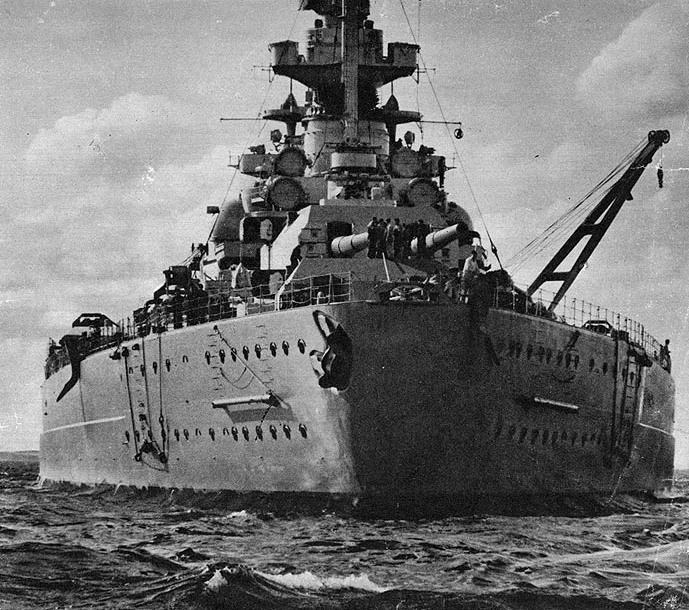
The Bismarck was a German Kriegsmarine battleship of the Second World War, named for the 19th‑century statesman Otto von Bismarck. Laid down in 1936 and launched in February 1940, she was one of the largest and most powerful surface combatants built by a European power in the 20th century. Bismarck is best known for her single major Atlantic sortie in May 1941 and the dramatic Royal Navy pursuit that ended her career.
Image gallery
10 Images




Design and characteristics
Designed as a fast, well‑armed capital ship, Bismarck combined heavy main guns, thick armor and relatively high speed for a battleship. Her main battery consisted of large‑calibre guns in multiple twin turrets, supported by secondary armament and fire‑control systems that reflected contemporary naval technology. The class emphasized protection and striking power to challenge enemy surface forces and to operate in the open ocean.
Construction and commissioning
Construction began in a Hamburg shipyard in 1936 and she was launched on 14 February 1940. After fitting out and sea trials, Bismarck entered service with the German navy where she served as a flagship. Her sister ship, the Tirpitz, was completed later and represented the only other member of her class.
Operation Rheinübung
In May 1941 Bismarck sortied into the Atlantic with the heavy cruiser Prinz Eugen on Operation "Rheinübung," a mission intended to attack Allied merchant shipping and to divert Royal Navy forces. During this operation she encountered British units in the Battle of the Denmark Strait. In that engagement Bismarck inflicted a catastrophic explosion on the British battlecruiser HMS Hood, which sank with heavy loss of life.
Pursuit and final battle
The Denmark Strait engagement left Bismarck damaged and visible to pursuing British forces. A sustained hunt by the Royal Navy involved aircraft carriers, cruisers and battleships. British aerial torpedo attacks damaged her steering, and on 27 May 1941 she was engaged by multiple Royal Navy capital ships and cruisers. The ship sank after intense fighting and actions by her crew; subsequent accounts and investigations have discussed the respective roles of enemy fire and deliberate scuttling in her loss.
Wreck discovery and investigations
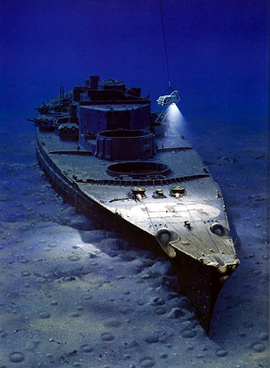
Decades later the wreck of Bismarck was located on the floor of the North Atlantic in 1989 by an oceanographic expedition. Examination of the wreck provided material evidence that has informed historical analysis of the ship's final hours and condition. The find renewed public and scholarly interest in the ship and in the wider operational context of surface raiding during the war.
Historical significance and legacy
Bismarck's brief but dramatic career made her one of the best‑known warships of World War II. Her sortie highlighted the risks of operating major surface units without secure air cover and logistics, and her loss shaped naval thinking about the vulnerability of capital ships in the era of air power and long‑range reconnaissance. Bismarck is widely studied in naval histories and commemorated in museums and maritime research.
Further reading and resources
Research on Bismarck touches on ship design, operational planning, Atlantic convoy warfare and the Royal Navy's response. For general context see materials on the German naval build‑up in Nazi Germany and on warship development in the prewar period. Additional archival and museum sources in Germany and the United Kingdom hold detailed records; relevant entries appear in collections and studies identified under general subjects such as warship history and Atlantic naval operations. Local links and repositories include references to the shipyard in Hamburg where she was built and to public documentation about the vessel and her sister ship.
For specific themes—construction, the Denmark Strait action, the pursuit, and wreck analysis—readers can consult specialized naval histories and museum catalogues that treat Bismarck and her operational environment in detail. Archive descriptions and curated exhibitions provide additional primary material for researchers and enthusiasts alike.
Questions and answers
Q: Who built the German battleship Bismarck?
A: The Bismarck was built by Nazi Germany.
Q: What was the Bismarck's most famous mission?
A: The Bismarck's most famous mission was known as Operation "Rheinübung".
Q: Who was the Bismarck named after?
A: The Bismarck was named in honor of the German statesman, Otto von Bismarck.
Q: Where was the Bismarck constructed?
A: The Bismarck was constructed in a shipyard in Hamburg, Germany.
Q: When was the Bismarck launched?
A: The Bismarck was launched on 14 February 1940.
Q: What was special about the Bismarck class battleship?
A: The Bismarck class battleship was the largest type of battleship built by any European power.
Q: Was there another battleship in the same class as the Bismarck?
A: Yes, the Tirpitz was the second battleship in the same class as the Bismarck.
Related articles
Author
AlegsaOnline.com Bismarck (German battleship) Leandro Alegsa
URL: https://en.alegsaonline.com/art/11800