
Cy Twombly: American Painter of Calligraphic Gesture and Mythic Imagery
Cy Twombly (1928–2011), known for large, scribbled, calligraphic paintings, blended drawing and painting with classical myth, poetry and graffiti-like marks to reshape postwar abstraction.
Edwin Parker "Cy" Twombly Jr. (April 25, 1928 – July 5, 2011) was an American artist whose work became a distinctive strand of postwar painting. Commonly called "Cy" after his father and the famous pitcher Cy Young, Twombly is best known for canvases that mix energetic, handwritten marks with broad, often muted grounds. He lived and worked for much of his life in Europe, and his practice is remembered for erasing tidy boundaries between drawing and painting while engaging literature, history and classical myth as recurring subjects. Name and biography references
Image gallery
7 Images


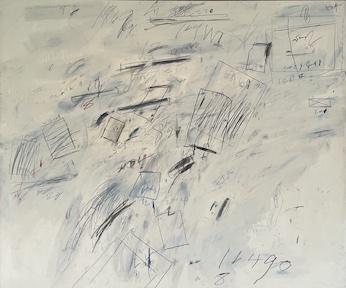


Visual characteristics and materials
Twombly's pictures are immediately recognizable for several formal elements. They frequently feature large expanses of gray, tan or off‑white ground on which loops, scratches, scrawls and smudges are laid down with crayon, pencil, oil stick and paint. Marks can resemble graffiti, schoolroom cursive, or the gestures of automatic drawing; at times a single line or smudge is treated as the subject itself. His surfaces range from the heavily worked to the sparsely inscribed, and the scale of his works—often mural‑size paintings or series of large drawings—encourages a physical encounter where brushwork, erasure and accidental staining are as important as composition.
Themes, texts and classical references
Twombly repeatedly drew on poetic and mythic sources. Words, names and fragments of phrases appear as visual elements rather than straightforward captions: repeated inscriptions of the name “Virgil,” references to gods such as Apollo, and titles evoking ancient stories or poets are common. His work often negotiates the space between private gesture and cultural memory, using the look of hurried inscription to suggest emotion, narrative or elegy. He cited poets such as Stéphane Mallarmé and absorbed the languages of antiquity, archaeology and European painting traditions into a modern idiom that reads as both intimate and monumental.
Development and influences
Trained in the United States and active on the international art scene, Twombly encountered diverse currents of modern art while developing his vocabulary of mark‑making. His paintings owe something to Abstract Expressionism’s emphasis on gesture and process, but they also diverge through an insistence on calligraphic sign and literary allusion. By the late 1960s and 1970s he had settled into a mode that foregrounded written marks and pared palettes; later series reintroduced color, floral forms and more explicit allusions to mythic narratives. Curators and critics have noted the tension in his oeuvre between the anecdotal and the formally austere. For discussion of his stylistic terms and critical debates see critical contexts.
Reception, controversy and influence
From the start Twombly provoked strong responses. Some viewers and reviewers found his scribbled, word‑laden canvases baffling or indulgent; others celebrated them as a vital expansion of what painting could be. Major retrospectives and museum acquisitions helped secure his reputation, even as individual works continued to divide opinion. Twombly’s approach influenced a generation of younger artists interested in combining text, myth and painterly gesture—names frequently associated with that legacy include Anselm Kiefer, Francesco Clemente and Julian Schnabel. Institutions and collectors across North America and Europe have preserved and exhibited his work, and debates about readability and meaning in his paintings remain part of discussions of late twentieth‑century art. See exhibition histories and institutional notes at museum references.
Notable works and legacy
Among Twombly’s better known projects are groups of blackboard‑like canvases from the 1960s, large mythic series made on Italian grounds, and sculptural or installation works that expand his vocabulary of signs. A number of single‑word or name‑based drawings—such as repeated inscriptions of "VIRGIL"—illustrate how language functioned as both form and meaning in his practice. Over time, institutions and scholars have placed him within broader narratives of postwar European and American art while continuing to probe the distinctive mixture of intimacy, erasure and classical echo that marks his contribution. Whether admired as a poetic innovator or critiqued as difficult, Twombly remains a central figure in discussions about the possibilities of painting in the modern era.
- Key traits: large scale, calligraphic marks, muted grounds, literary allusion
- Recurring sources: classical myth, European poetry, personal gesture
- Legacy: influential on later artists and institutional collections worldwide
Questions and answers
Q: Who was Edwin Parker "Cy" Twombly?
A: Edwin Parker "Cy" Twombly, Jr. was an American artist. He used the nickname "Cy", after his father and the star baseball pitcher Cy Young.
Q: What type of paintings did he create?
A: Twombly was known for his large-scale, freely scribbled, calligraphic-style graffiti paintings, on solid fields of mostly gray, tan, or off-white colors.
Q: How did his work blur the line between drawing and painting?
A: Many of his best-known paintings of the late 1960s are reminiscent of a school blackboard on which someone has practiced cursive "e"s. Twombly had at this point discarded painting figurative, representational subject-matter, citing the line or smudge – each mark with its own history – as its proper subject. Later, many of his paintings and works on paper moved into "romantic symbolism".
Q: What themes were often present in his work?
A: Twombly often quoted the poet Stéphane Mallarmé, as well as many classical myths and allegories in his works. Examples of this are his Apollo and The Artist and a series of eight drawings consisting solely of inscriptions of the word "VIRGIL".
Q: How have critics responded to Twombly's work?
A: In a 1994 retrospective, curator Kirk Varnedoe described Twombly's work as “influential among artists, discomfiting to many critics and truculently difficult not just for a broad public, but for sophisticated initiates of postwar art as well". After acquiring Twombly's Three Studies from the Temeraire (1998–99), the Director of the Art Gallery of New South Wales said "sometimes people need a little bit of help in recognising a great work of art that might be a bit unfamiliar".
Q: Who is said to have been influenced by him?
A: He is said to have influenced younger artists such as Anselm Kiefer, Francesco Clemente, and Julian Schnabel.
Related articles
Author
AlegsaOnline.com Cy Twombly: American Painter of Calligraphic Gesture and Mythic Imagery Leandro Alegsa
URL: https://en.alegsaonline.com/art/116929
Sources
- artinamericamagazine.com : "Cy Twombly, Legendary Scribbler, Dead Age 83"
- guardian.co.uk : ""Cy" (Cyclone) Twombly, obituary"
- artsbeat.blogs.nytimes.com : "Cy Twombly, Idiosyncratic Painter, Dies at 83"
- smh.com.au : "With his feet on classical ground"
- washingtonpost.com : Cy Twombly, influential Va.-born abstract artist, dies at 83