
Carl Gustav Jacob Jacobi
German mathematician (1804–1851) noted for foundational work on elliptic and theta functions, determinants, number theory, and algorithms that bear his name in analysis and linear algebra.
Carl Gustav Jacob Jacobi (10 December 1804 – 18 February 1851) was a German mathematician whose work shaped several fields of 19th‑century mathematics. He is especially remembered for systematic treatments of elliptic and theta functions, important contributions to the theory of determinants and linear algebra, and influential results in number theory. Jacobi was also the first Jewish mathematician appointed to a professorship at a German university.
Image gallery
2 Images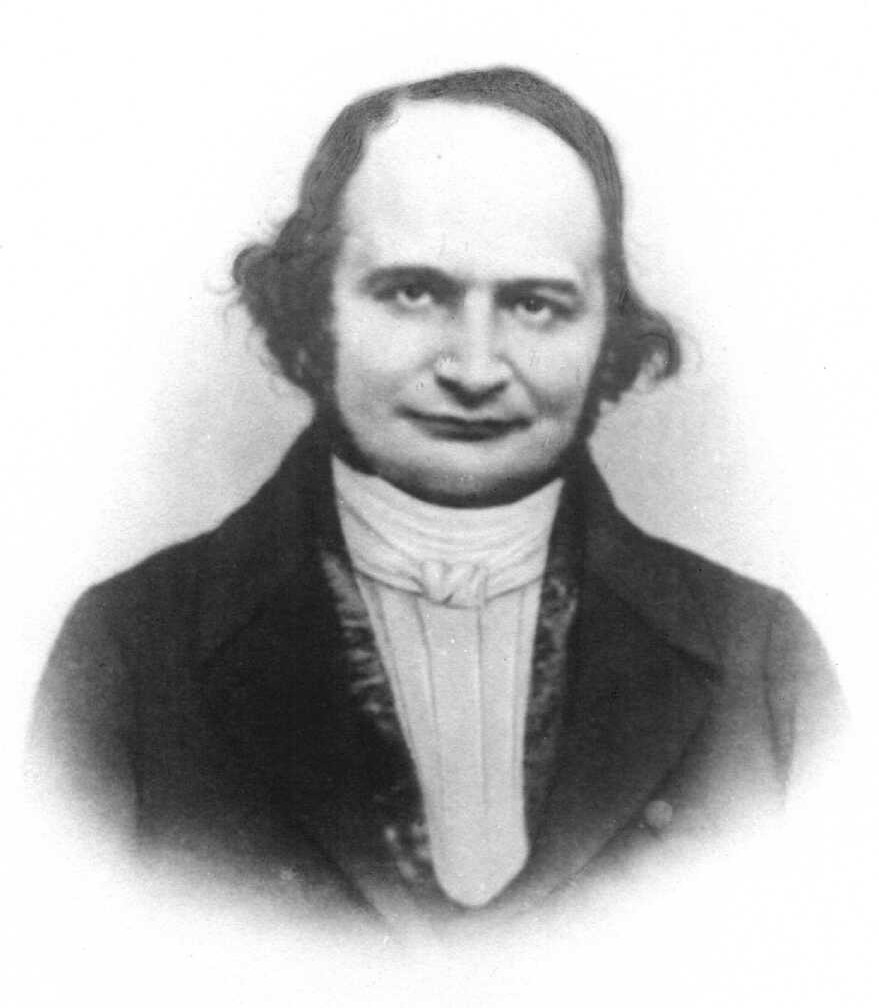

Life and career
Born in Potsdam, Jacobi trained in the mathematical circles of early 19th‑century Germany and became a prominent academic figure. During his career he held university positions and maintained active correspondence with leading mathematicians of his time. His research was notable both for deep theoretical advances and for effective computational methods that later found wide application.
Main contributions
Jacobi's work spans several interrelated areas. He developed a powerful approach to elliptic functions using theta‑functions and established identities that remain central to the subject. The Jacobian elliptic functions (commonly denoted sn, cn, dn) and his theta series are tools for solving problems in analysis and mathematical physics. Readers can find accessible introductions to his methods in treatments of elliptic functions.
- Determinants and linear algebra: Jacobi advanced the formal theory of determinants, proved useful identities (including formulas relating derivatives of determinants to traces), and gave algorithms for diagonalizing symmetric matrices. His iterative eigenvalue routine is known as the Jacobi method in numerical linear algebra.
- Differential equations and mechanics: He contributed to methods for integrating partial and ordinary differential equations and to the analytical foundations of classical mechanics through canonical transformations; see further notes on differential equations.
- Number theory: Jacobi introduced and popularized objects now bearing his name, such as the Jacobi symbol, and proved identities used in quadratic reciprocity and modular arithmetic; introductory material is available under number theory.
Notable identities, algorithms, and eponyms
Several theorems and concepts carry Jacobi's name: Jacobi theta functions and the Jacobi triple product formula in complex analysis; the Jacobi identity in the algebraic theory of brackets; Jacobi polynomials in the theory of orthogonal polynomials; and the Jacobi matrix (or tridiagonal matrix) related to recurrence relations. His ideas influenced later developments by Riemann, Weierstrass and others. For a concise biographical overview, consult a specialist source linked as Jacobi biography.
Jacobi's combination of theoretical insight and computational technique left a durable legacy: his formulas and algorithms continue to appear in research and applications ranging from pure number theory to numerical methods and mathematical physics.
Questions and answers
Q: Who was Carl Gustav Jacob Jacobi?
A: Carl Gustav Jacob Jacobi was a German mathematician.
Q: What was Carl Gustav Jacob Jacobi's contribution to mathematics?
A: Carl Gustav Jacob Jacobi contributed to elliptic functions, differential equations, determinants, and number theory.
Q: When was Carl Gustav Jacob Jacobi born?
A: Carl Gustav Jacob Jacobi was born on December 10, 1804.
Q: When did Carl Gustav Jacob Jacobi die?
A: Carl Gustav Jacob Jacobi died on February 18, 1851.
Q: What is Carl Gustav Jacob Jacobi known for?
A: Carl Gustav Jacob Jacobi is known for his significant contributions to mathematics, especially in the areas of elliptic functions, differential equations, determinants, and number theory.
Q: What was significant about Carl Gustav Jacob Jacobi's appointment as professor at a German university?
A: Carl Gustav Jacob Jacobi was the first Jewish mathematician to be appointed as a professor at a German university, which was significant given the marginalization and discrimination faced by Jewish people in Germany at the time.
Q: What was Carl Gustav Jacob Jacobi's nationality?
A: Carl Gustav Jacob Jacobi was German.
Related articles
Author
AlegsaOnline.com Carl Gustav Jacob Jacobi Leandro Alegsa
URL: https://en.alegsaonline.com/art/115987
Sources
- mathworld.wolfram.com : mathworld.wolfram.com/JacobiEllipticFunctions.html
- encyclopediaofmath.org : encyclopediaofmath.org/index.php?title=Jacobi_elliptic_functions&oldid=11940.html
- mathworld.wolfram.com : mathworld.wolfram.com/Jacobian.html
- mathworld.wolfram.com : mathworld.wolfram.com/JacobiPolynomial.html
- encyclopediaofmath.org : encyclopediaofmath.org/index.php?title=Jacobi_polynomials&oldid=18958.html
- jeff560.tripod.com : "Earliest Uses of Symbols of Calculus"
- haaretz.com : "Setting the record straight about Jewish mathematicians in Nazi Germany"
- wikidata.orgQ76564.html : wikidata.orgq76564.html
- catalogue.bnf.fr : cb122025359
- data.bnf.fr : (data)
- cantic.bnc.cat : a1143269x
- d-nb.info : 118775766
- isni.org : 0000 0001 0881 7259
- id.loc.gov : n84804757
- genealogy.math.ndsu.nodak.edu : 15635