
Braconidae: family of parasitoid wasps
Braconidae are a large family of parasitoid wasps with tens of thousands of species worldwide. Many attack insect pests and are important in ecology, biological control and entomological research.
The Braconidae are a globally distributed family of parasitoid wasps. Females lay eggs on or inside other arthropods; the developing larvae consume the host and usually kill it. The term parasitoid describes this strategy between predation and parasitism and underpins the ecological role of braconids. Estimates of diversity vary widely but commonly cited ranges place the family between roughly 50,000 and 150,000 species, arranged in about 45 subfamilies and near a thousand genera.
Image gallery
10 Images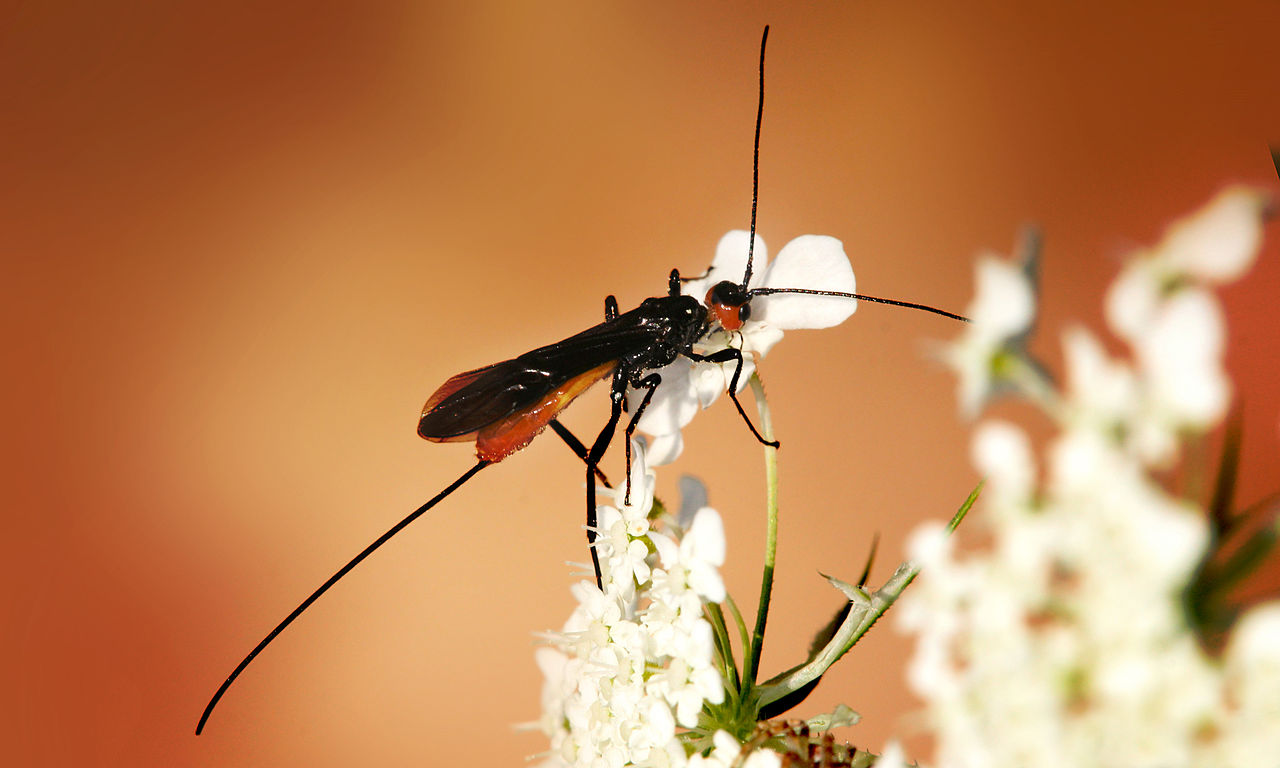


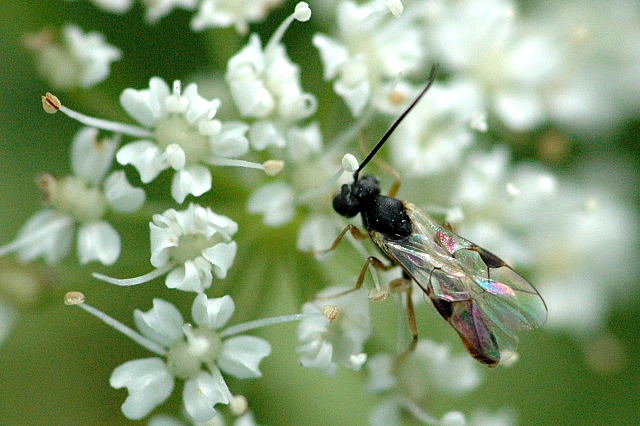

Characteristics and life history
Braconids vary in size and appearance but often have slender bodies, a well-developed wing venation pattern characteristic of the group, and an ovipositor adapted for inserting eggs into hosts or substrates. Species may be ectoparasitoids (developing externally on a host) or endoparasitoids (developing inside). Many braconids produce venoms or carry symbiotic viruses that suppress host immune responses and development, notably polydnaviruses in some lineages.
Typical life stages include egg, larva, pupa and adult. Females use behavioral and chemical cues to locate hosts; some attack concealed or mobile hosts. Developmental strategies differ: some are solitary, producing one adult per host, while others are gregarious. Ecological terms such as koinobiont (allowing the host to continue development) and idiobiont (arresting host development) capture these differences. For overview resources on life history and development see life cycle resources.
Diversity, hosts and taxonomy
Braconids exploit a wide range of insect hosts, commonly including caterpillars (Lepidoptera), beetle larvae (Coleoptera), flies (Diptera) and various hemipterans. They occupy nearly all terrestrial habitats where suitable hosts occur. Taxonomy is active: molecular phylogenetics and morphological studies continue to revise subfamily relationships and species limits, and authoritative keys and databases are available through specialist portals (taxonomic resources).
- Approximately 45 subfamilies and about 1,000 recognized genera are conventional counts used by entomologists.
- Both solitary and gregarious life histories occur; many species show host specificity while others have broader host ranges.
Ecology, applied importance and research
Because many braconids parasitize herbivorous insects, they are important agents of natural biological control in forests, crops and gardens. Several species have been mass-reared or introduced deliberately to suppress agricultural pests; their effectiveness depends on life history, host range and ecological interactions. Comparisons with related families (for example the Ichneumonidae) highlight differences in morphology, wing venation and ecology.
Ongoing research addresses their evolutionary history, fossil record, symbiotic associations (including viral partners), and applied uses in integrated pest management. Accessible summaries of current research and reviews can be found at specialist pages and literature collections (research summaries).
Questions and answers
Q: What is the Braconidae family?
A: The Braconidae family is a group of parasitoid wasps.
Q: How many species of Braconidae are there worldwide?
A: There are between 50,000 and 150,000 species of Braconidae worldwide.
Q: How are the species of Braconidae grouped?
A: The species of Braconidae are grouped into 45 subfamilies and about 1,000 genera.
Q: Are Braconidae common among insects?
A: Yes, Braconidae are one of the richest families of insects.
Q: What is the peculiar characteristic of the Braconidae?
A: The peculiar characteristic of the Braconidae is that they are parasitic wasps.
Q: What is the difference between a parasitoid wasp and a parasitic wasp?
A: Parasitoid wasps kill their hosts, and parasitic wasps do not.
Q: Is the Braconidae family an important family of insects?
A: Yes, the Braconidae family is one of the richest families of insects.
Related articles
Author
AlegsaOnline.com Braconidae: family of parasitoid wasps Leandro Alegsa
URL: https://en.alegsaonline.com/art/115503
Sources
- sciencemag.org : "Polydnaviruses of Braconid wasps derive from an ancestral Nudivirus"
- doi.org : 10.1126/science.1166788