
Bob Corker
American businessman and Republican politician; U.S. Senator from Tennessee (2007–2019), former mayor of Chattanooga, known for work on foreign policy, fiscal issues, and occasional public criticism of party leaders.
Overview
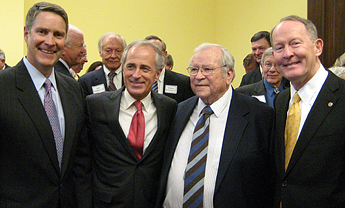
Bob Corker is an American businessman and Republican politician who represented Tennessee in the U.S. Senate from 2007 to 2019. Before serving in the Senate he was mayor of Chattanooga. During his time in Washington he became known for a focus on foreign policy, fiscal matters, and for blunt public commentary that sometimes put him at odds with leaders in his own party. He announced in late 2017 that he would not seek re-election in 2018 and left the Senate at the end of his term.
Image gallery
8 Images



Early life and education
Corker was born in Orangeburg, South Carolina, and grew up in the Southeast. He attended the University of Tennessee, where he completed his undergraduate studies. His background combines private-sector experience in business and development with involvement in local civic affairs prior to seeking elected office. For details about his birthplace and early background see Orangeburg and his academic affiliation at the University of Tennessee.
Political career
Corker served as mayor of Chattanooga from 2001 to 2005, a period that raised his profile in Tennessee politics and set the stage for a run for national office. He was elected to the U.S. Senate and served two full terms from 2007 until 2019. He publicly announced on September 26, 2017, that he would not run for a third term. Biographical and archival information about his Senate service can be found through his official legislative pages and local histories, for example at Senate resources and local government histories such as Chattanooga mayoral records.
Roles and policy focus
In the Senate Corker held positions on key committees and was especially visible on matters of foreign relations and fiscal oversight. He served as a committee chair and worked on legislation and hearings addressing international diplomacy, security, and budgetary issues. His approach combined advocacy for robust oversight of foreign policy with attention to economic and regulatory questions at home.
Notable facts and legacy
- Corker combined a private-sector career with elected office, moving from local government to national politics.
- He earned attention for forthright public statements and at times frank criticism of party leadership, which shaped perceptions of him as an independent voice within his caucus.
- After leaving the Senate he returned to private life and business activities while remaining a figure in public commentary on policy.
Personal details commonly cited in biographical profiles note that he is married to Elizabeth and they have two daughters. For more structured biographies and records, readers can consult archived profiles and civic resources linked above.
Questions and answers
Q: Who is Bob Corker?
A: Bob Corker is an American politician who served as the US Senator from Tennessee from 2007 to 2019 and was also Mayor of Chattanooga from 2001 to 2005.
Q: When and where was Corker born?
A: Corker was born on August 24, 1952 in Orangeburg, South Carolina.
Q: Where did Corker graduate from?
A: Corker graduated from the University of Tennessee.
Q: How many daughters does Corker have?
A: Corker has two daughters with his wife Elizabeth.
Q: When did Corker announce that he would not run for re-election?
A: Corker announced that he would not run for re-election in 2018 on September 26, 2017.
Q: What political position did Corker hold for four years?
A: Corker was Mayor of Chattanooga for four years from 2001 to 2005.
Q: How long did Corker serve as a US Senator?
A: Corker served as a US Senator from Tennessee for 12 years from 2007 to 2019.
Related articles
Author
AlegsaOnline.com Bob Corker Leandro Alegsa
URL: https://en.alegsaonline.com/art/115381
Sources
- bioguide.congress.gov : "Corker, Robert (Bob)"
- nytimes.com : "Tennessee's Bob Corker Announces Retirement from Senate"