
Æthelred (Athelred) of Wessex (c. 845–871)
King of Wessex from 865 to 871 who faced the Viking Great Heathen Army; he resisted early invasions and whose reign set the stage for Alfred the Great.
Æthelred (also spelled Athelred, c. 845–871) was king of the kingdom of Wessex from about 865 until his death in 871. He became ruler at a critical moment when a large Viking force arrived in England, and his brief reign is chiefly remembered for the military and political responses to that invasion.
Image gallery
8 Images
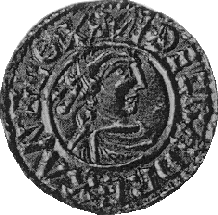




Background and family
Æthelred was one of the sons of King Æthelwulf, and he followed several brothers who had held kingship before him. Unlike some of his siblings, he had not served long as an under-king of a sub-kingdom before ascending to the West Saxon throne. His younger brother, Alfred, succeeded him and later became known as Alfred the Great.
Reign and the Viking challenge
Æthelred's rule coincided with the arrival and advance of the so-called Great Heathen Army, a large coalition of Scandinavian forces that began large-scale campaigns in England in the mid-860s. The incursion forced Æthelred and his nobles to confront a substantial and mobile enemy and to coordinate defence across Wessex and neighbouring territories.
Battles and military activity
Contemporary chronicles record a series of encounters between West Saxons and the Viking invaders during Æthelred’s reign. Engagements in early 871 included both setbacks and hard-won successes, showing the resilience of West Saxon forces even when pressed by a powerful invader.
- Initial clashes with the Viking army that landed and campaigned in England.
- Notable field actions in early 871: a mix of defeats and a key victory that demonstrated West Saxon resistance.
- Ongoing pressure on Wessex that required rapid mobilisation of fyrd (local militia) and leaders.
Legacy and significance
Æthelred’s reign was short but consequential. Although he did not secure a lasting peace, his resistance helped preserve Wessex as a centre of Anglo-Saxon independence at a time when other English kingdoms were falling under Viking control. The continuity of West Saxon monarchy after his death enabled his brother Alfred to consolidate and reform defence and governance in the years that followed.
Sources and historical record
Our knowledge of Æthelred comes mainly from near-contemporary sources such as the Anglo-Saxon Chronicle and later medieval writers who relied on such records. Because surviving accounts are concise and sometimes partisan, historians treat details cautiously, emphasizing broad outlines: succession, conflict with the Viking forces, and the transition to Alfred’s rule after Æthelred’s death in 871. For further context on the invasion and the era, see accounts of the Great Heathen Army.
Questions and answers
Q: Who was Athelred?
A: Athelred or Æthelred was the King of Wessex from 865 to 871.
Q: When did Athelred become the King of Wessex?
A: Athelred became the King of Wessex after his brother Ethelbert at the time of the invasion of England by the "Great Heathen Army."
Q: What was the "Great Heathen Army"?
A: The "Great Heathen Army" was the name given to a coalition of Viking warriors who invaded England in the late 9th century.
Q: Who were the father and siblings of Athelred?
A: Athelred was one of the four sons of Athelwulf, the father of Alfred the Great. His siblings were Ethelbald, Ethelbert, and Alfred the Great.
Q: What was the rule of Athelred's siblings before he became the King of Wessex?
A: Athelred was the first of the four sons of Athelwulf not to rule as "under-king" before he became the King of Wessex.
Q: When was Athelred born and when did he die?
A: Athelred was born around 845 and died around 871.
Q: What is the significance of Athelred's reign?
A: Athelred's reign was marked by the Great Heathen Army's invasion of England, which ultimately led to his defeat and the succession of Alfred the Great.
Related articles
Author
AlegsaOnline.com Æthelred (Athelred) of Wessex (c. 845–871) Leandro Alegsa
URL: https://en.alegsaonline.com/art/114686