
Albrecht Dürer: German Renaissance Painter, Printmaker, and Theorist
Comprehensive overview of Albrecht Dürer (1471–1528): his life in Nuremberg, signature prints and paintings, technical methods, writings on proportion, and influence on the Northern Renaissance.
Overview
Albrecht Dürer (1471–1528) was a German artist whose reputation rests on his mastery of multiple media and his role in transmitting Italian Renaissance ideas north of the Alps. Trained in Nuremberg, he became celebrated as a painter, as an engraver and printmaker, and as a practical theorist of measurement and proportion often described as a mathematician in the context of his treatises. His works—especially his woodcuts and engravings—made him known across Europe before he was thirty.
Image gallery
10 Images




Life and development
Dürer was born and raised in Nuremberg, a thriving commercial and artistic center in what is now Germany. He was trained in his father's goldsmith workshop and apprenticed to the painter Michael Wolgemut, gaining early exposure to both ornament and large workshop projects. He traveled to northern Italian cities, where he studied proportion, perspective and classical motifs, and these visits shaped his approach to form and theory. Dürer's career combined a busy workshop practice in Nuremberg with commissions for altarpieces, portraits and prints. He occasionally employed specialist block-cutters and assistants in the production of woodcuts.
Major works and techniques
Dürer is best known for powerful woodcut series and detailed engravings that pair technical precision with allegorical depth. Notable series and individual prints include:
- Apocalypse (woodcut series, 1498), featuring the Four Horsemen;
- Knight, Death and the Devil (engraving, 1513);
- Melencolia I and Saint Jerome in His Study (engravings, 1514);
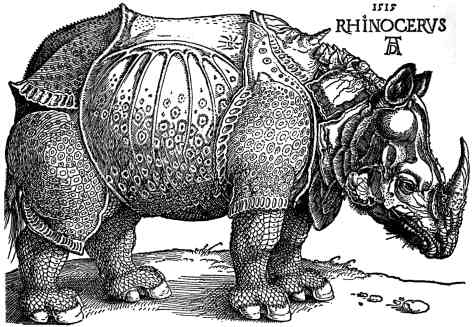
- the famed Rhinoceros woodcut and numerous striking self-portraits;
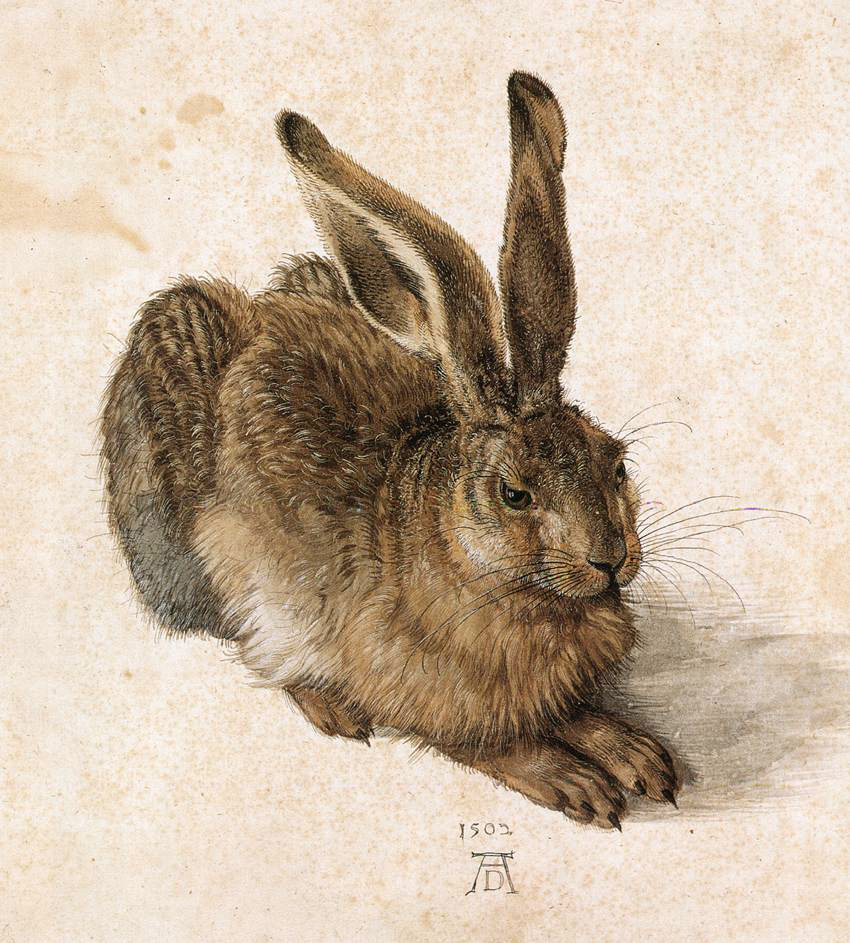
- oil paintings and delicate watercolours showing his range in colour and landscape.
He worked across media with a concern for linear precision, hatchwork in engraving, and complex compositional geometry. Many of his prints circulated widely and were copied or adapted by other artists.
Writings, theory and influence
Dürer wrote practical treatises that applied geometric and mathematical ideas to art. His publications on measurement, perspective and human proportion codified methods for artists and metalworkers and influenced Northern European practice. These theoretical works, together with his works on paper and panel, positioned him as a central figure of the Renaissance north of the Alps. He combined observational detail with classical learning, helping to bridge regional styles.
Legacy and notable facts
Today Dürer is remembered both for the technical brilliance of his prints and for his intellectual curiosity. He helped elevate printmaking to a medium of wide cultural circulation and artistic ambition—his series and single prints functioned as both devotional imagery and collectible artworks in early modern Europe. Scholars also note his pioneering role in artist self-portraiture and in publishing practical manuals for the visual arts. His life and output remain central to studies of the Northern Renaissance in Nuremberg and beyond.
For introductions and reproductions of his works and writings, see general resources on early modern prints and on artists of Nuremberg: Nuremberg references and print catalogues provide further context. Other online and print overviews of Dürer's engraving techniques and his treatises continue to inform students and specialists alike on old master prints.
Further reading and collections of images and scholarship are available through museum catalogues and academic studies; many institutions and publishers maintain searchable collections and commentary for Dürer's oeuvre and theoretical writings (biographical summaries) and (print catalogues).
Questions and answers
Q: Who was Albrecht Dürer?
A: Albrecht Dürer was a Hungarian-German painter, engraver and mathematician. He is best known as a maker of old master prints.
Q: When and where was he born and died?
A: He was born on May 21, 1471 in Nuremberg, Germany and died on April 6, 1528 in Nuremberg, Germany.
Q: What are some of his most famous series?
A: His most famous series are the Apocalypse (1498) and his two series on the passion of Christ, the Great Passion (1498–1510) and the Little Passion (1510–1511).
Q: What are some of his best known individual engravings?
A: His best known individual engravings include Knight, Death, and the Devil (1513), Saint Jerome in his Study (1514) and Melencolia I (1514).
Q: What are some of his iconic images?
A: His most iconic images are his woodcuts of the Four Horsemen of the Apocalypse (1497–1498) from the Apocalypse series, the Rhinoceros, and numerous self-portraits in oils.
Q: Did Dürer cut his own woodblocks?
A: It is not certain if Dürer cut his own woodblocks but it is possible that he employed a skilled carver who followed his drawings faithfully.
Q: How did Dürer become famous across Europe before 30?
A: Dürer's prints made him famous across Europe before 30 with many people hailing him as the greatest artist of the Renaissance in Northern Europe.
Related articles
Author
AlegsaOnline.com Albrecht Dürer: German Renaissance Painter, Printmaker, and Theorist Leandro Alegsa
URL: https://en.alegsaonline.com/art/113586