
Abram Games — British graphic designer (1914–1996)
Abram Games was a leading British graphic designer known for wartime posters, a reductive visual language and the maxim “maximum meaning, minimum means.” He worked across posters, identity and public information.
Abram Games (born Abraham Gamse, 29 July 1914 – 27 August 1996) was a British graphic designer celebrated for a spare, memorable visual approach and a long career that spanned propaganda, public information and commercial identity work. He was the son of immigrant parents and anglicized his surname while still young. Largely self-taught, Games combined brief formal study with intensive practical experience in London studios and night classes to develop a distinctive method of visual reduction and conceptual clarity.
Image gallery
5 Images


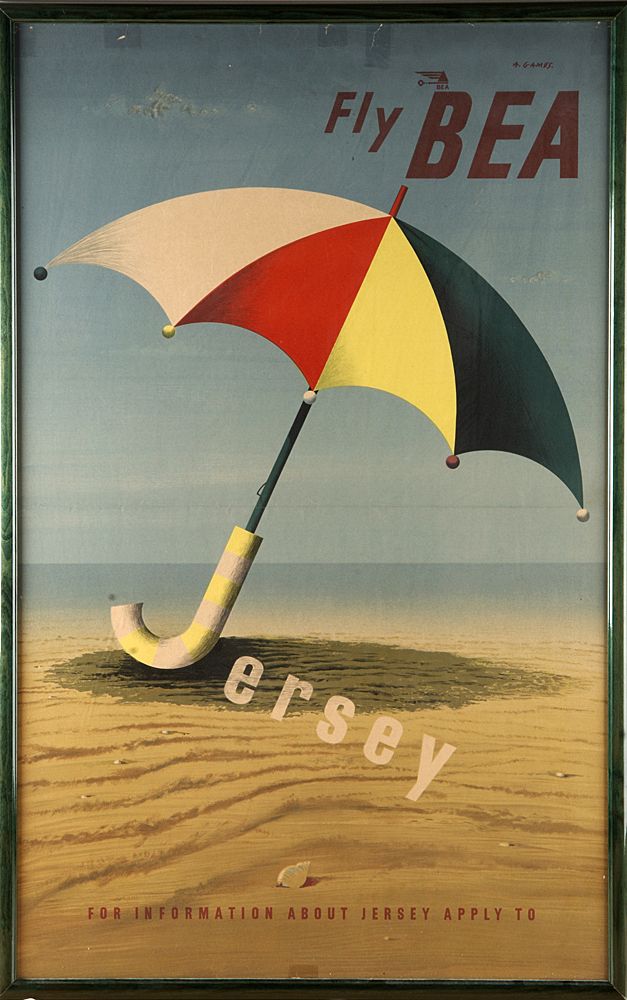
Style and methods
Games advocated a disciplined process in which a single strong idea would be explored and refined until it could be expressed with the fewest elements necessary. He used bold shapes, limited colour palettes and controlled negative space to make messages legible at a glance. This economy of means—summed up in his maxim “maximum meaning, minimum means”—meant that his work functioned equally well at distance or in small printed formats. His compositions often employ simplified silhouettes, a single focal motif, and typography chosen to support rather than compete with the visual idea.
Early life and training
Born Abraham Gamse to a Latvian photographer father and a Russo-Polish seamstress mother, he grew up in a multilingual London and shortened his name to Games at about age 12. He attended St Martin's School of Art for only a short time and otherwise learned through practical work. In the early 1930s he worked as a studio assistant at a commercial design firm, taking evening classes in life drawing and making entries to public competitions. Success in municipal poster contests and small public commissions established his reputation and allowed him to work as a freelance poster artist by the mid‑1930s.
Wartime and public-information work
During the Second World War Games produced government and public-information posters. His wartime commissions required clarity, immediacy and persuasion; he applied his reductive approach to messages about civilian safety, security and national morale. The work from this period shows his skill at translating a complex or urgent brief into a single, memorable image that could be read quickly by a broad audience.
Postwar career and commissions
After the war he extended his practice into commercial identity, exhibition graphics, book covers and other applied graphics. He brought the same principle of visual economy to corporate logos and exhibition branding, where a compact, repeatable motif and consistent typographic rhythm helped create recognisable identities. Over decades he worked for a range of institutions and clients, always favouring concept over ornament and clarity over decorative detail.
Process and working habits
Games’s working routine typically began with a short list of competing ideas translated into sketches and thumbnails. He selected one clear concept and reduced it to its essential form before committing to colour and lettering. Sketches often show rigorous editing: extraneous detail removed until only the core idea remained. This editorial eye is part of what many teachers of graphic design point to when demonstrating how to convey information economically.
Recognition and influence
He received formal recognition for his contribution to design, including honours that acknowledged both public service and industrial design achievement. Histories of graphic design and teaching curricula frequently cite his posters as exemplary studies in clarity of communication. Museums, books and exhibitions continue to reproduce and study his images to illustrate the power of a single strong visual idea.
Notable facts and resources
- He was born Abraham Gamse and changed his name as a child; his personal history is often discussed in biographies of British designers. More on his name and family
- His training combined brief formal study with extensive on‑the‑job learning and night classes. Training and early work
- His parents were immigrants from Eastern Europe, a background that shaped his upbringing in London. Family background
- He learned production techniques while employed in a London commercial studio in the 1930s. Studio years
- Early competition success in the mid‑1930s assisted his transition to freelance practice. Competition history
- During World War II he produced government and public‑information posters that required immediacy and clear symbolism. Wartime work
- In the postwar decades he worked on corporate identities, exhibition graphics and editorial commissions. Postwar commissions
- He was honoured for his services to design and cited as an influential figure in British graphic history. Honors and retrospectives
- Students of graphic design still study his posters for their economy of expression and problem‑solving approach. Design teaching
- Collections, books and museum displays preserve and interpret his work for contemporary audiences. Collections and further reading
Further reading and archives: For those researching his work, catalogues, exhibition catalogues and monographs discuss his themes, process and selected commissions. Contemporary design courses use his practice to illustrate how strong concept and careful editing can make communication more effective.
Questions and answers
Q: Who was Abram Games?
A: Abram Games was a British graphic designer.
Q: What was Abram Games' original name?
A: Abram Games' original name was Abraham Gamse.
Q: Who were Abram Games' parents?
A: Abram Games' parents were a Latvian photographer and a Russo-Polish seamstress.
Q: When did Abram Games anglicize his name?
A: Abram Games anglicized his name at the age of 12.
Q: Did Abram Games study design formally?
A: No, Abram Games was an autodidactic designer and only attended two terms at London's St. Martins School of Art.
Q: What did Abram Games do while working at Askew-Young in London?
A: While working at Askew-Young, Abram Games took night classes in life drawing.
Q: Was Abram Games successful in poster competitions?
A: Yes, Abram Games placed second in the Health Council Competition in 1934 and won a poster competition for the London City Council in 1935.
Related articles
Author
AlegsaOnline.com Abram Games — British graphic designer (1914–1996) Leandro Alegsa
URL: https://en.alegsaonline.com/art/113260