
70 Virginis b – an early massive exoplanet in Virgo
70 Virginis b is a massive extrasolar planet roughly 60 light-years away in Virgo. Discovered in 1996 by Marcy and Butler using radial-velocity, it is eccentric, relatively close to its star, and not considered habitable.
Overview
70 Virginis b is an extrasolar planet first announced in 1996 and widely cited as one of the early discoveries that expanded knowledge of planetary systems beyond the Solar System. It orbits the star 70 Virginis in the constellation Virgo at a distance from Earth of about 60 light‑years. The object is classified among the massive gas-giant type planets rather than a small rocky world, and it is generally discussed in surveys of known exoplanets.
Image gallery
1 Image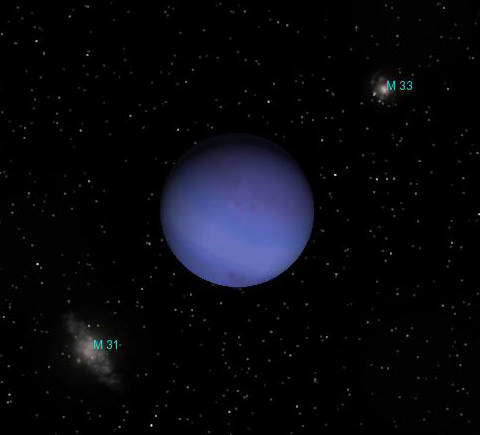
Physical characteristics
The planet has a minimum mass several times that of Jupiter, placing it firmly in the gas-giant regime; because mass estimates come from the radial-velocity method, the true mass depends on orbital inclination and could be larger. Observations show that 70 Virginis b follows an eccentric, non-circular orbit, so its distance from the host star changes noticeably over the course of an orbit. This eccentricity and the planet's substantial mass strongly affect its climate and structure compared with lower-mass, near-circular-orbit exoplanets.
Discovery and follow-up
A team led by Geoffrey Marcy and R. Paul Butler announced the detection using precise Doppler spectroscopy, often called the radial-velocity method, which measures small shifts in the star's spectrum caused by the planet's gravitational tug. Initial estimates and limited knowledge of the star led some to suggest the planet might lie within a temperate or habitable zone, but later, improved stellar parameters and a better orbital solution showed the planet's path is more eccentric and generally unsuitable for Earth-like conditions. Subsequent observations refined orbital elements and reinforced its classification as a massive, likely gaseous companion.
Significance and implications
70 Virginis b played a role in early exoplanet science by illustrating how detection biases and incomplete stellar data can affect interpretations of habitability and planetary type. Its discovery helped motivate more careful characterization of host stars and encouraged follow-up monitoring to constrain orbital eccentricities and masses. The system also serves as a reminder that an exoplanet's minimum mass determined from radial velocity can leave open the possibility of a much more massive body if the orbital inclination is low.
Notable distinctions and current view
- One of the earlier radial-velocity detections of a planet around a Sun‑like star.
- A high minimum mass suggests a gas giant; if much heavier it could border on the brown-dwarf regime, though available data favor a planetary classification.
- Its eccentric orbit and proximity to the host star at closest approach make it unlikely to host surface-habitable conditions; any discussion of habitability instead focuses on hypothetical large moons rather than the planet itself.
Today 70 Virginis b remains an instructive example in exoplanet catalogs and textbooks: an early success of precision Doppler surveys and a case study in why accurate stellar characterization matters when assessing planetary environments. For more general context about planets like 70 Virginis b, see summaries of extrasolar planets and habitable-zone concepts as linked above.
Questions and answers
Q: What is 70 Virginis b?
A: 70 Virginis b is an extrasolar planet that orbits a star in the constellation of Virgo.
Q: How far away from Earth is 70 Virginis b?
A: 70 Virginis b is around 60 light-years away from Earth.
Q: Who discovered 70 Virginis b?
A: 70 Virginis b was discovered by astronomers Geoffrey Marcy and R. Paul Butler and announced in 1996.
Q: Was 70 Virginis b the first extrasolar planet discovered?
A: No, but it was one of the first stars known to have planets orbiting it.
Q: Was 70 Virginis b thought to be inside its star's habitable zone when first announced?
A: Yes, 70 Virginis b was thought to be inside its star's habitable zone when first announced.
Q: What was later found about 70 Virginis b's orbit?
A: It was later found that 70 Virginis b has an eccentric orbit that is closer to its parent star.
Q: Is 70 Virginis b still considered potentially habitable?
A: No, due to the eccentric and closer orbit to its star, 70 Virginis b is no longer considered potentially habitable.
Related articles
Author
AlegsaOnline.com 70 Virginis b – an early massive exoplanet in Virgo Leandro Alegsa
URL: https://en.alegsaonline.com/art/113042
Sources
- sciam.com : "A Parade of New Planets"
- adsabs.harvard.edu : "Hipparcos distances and mass limits for the planetary candidates: 47 Ursae Majoris, 70 Virginis, 51 Pegasi"