
Bietigheim-Bissingen
Bietigheim-Bissingen is a town in northern Baden-Württemberg, Germany, known for its historic centre, a prominent railway viaduct, and its location between Stuttgart and Heilbronn.
Overview
Bietigheim-Bissingen is a midsize town in the northern centre of Baden-Württemberg, Germany. It lies roughly 19 kilometres (11.8 miles) north of Stuttgart and about 20 kilometres (12.4 miles) south of Heilbronn. Within its district it is second in size only to the city of Ludwigsburg. The town serves as a local centre for commerce, culture and transport in the region.
Image gallery
6 Images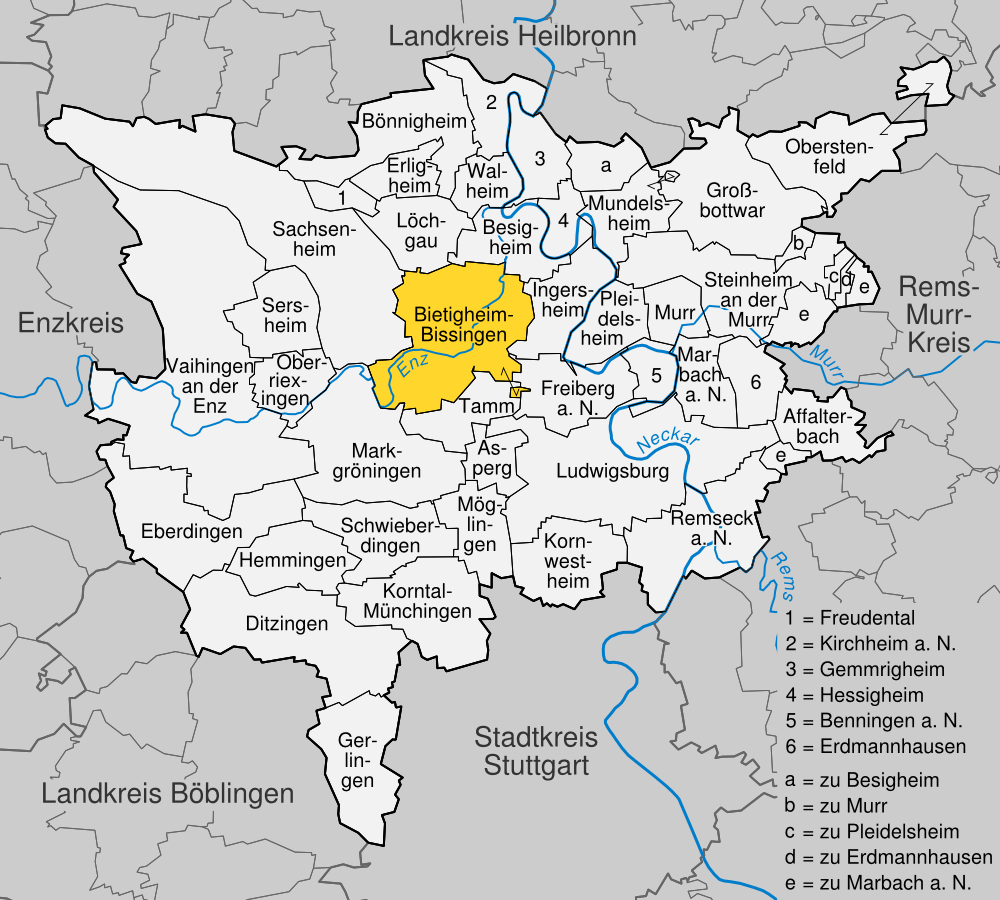


Geography and urban structure
The municipality sits where small river valleys and low hills meet the Neckar plain. Its urban area combines an older historic core with more modern residential and industrial districts. Green corridors, parks and sections of riverbank are part of the town’s public landscape, and there are both compact neighbourhoods and areas with detached housing typical of suburban communities around major German cities.
Historical development
The modern town grew from two older settlements that have long local histories. Over centuries these places evolved from agricultural and market centres into more urbanised communities as trade, crafts and industry developed. Architectural traces of different periods — medieval, early modern and 19th-century industrial expansion — can be seen in its buildings and street plan.
Economy and transport
Local economic life is a mix of small and medium-sized enterprises, service businesses and firms linked to the wider Stuttgart metropolitan economy. Many residents commute to larger nearby cities. The town is well connected by regional rail and road: rail services provide frequent connections toward Stuttgart and Heilbronn, and nearby motorways link the town to the wider state network.
Culture, landmarks and events
Bietigheim-Bissingen combines cultural venues, museums and municipal festivals with everyday civic life. A notable landmark is the large nineteenth-century railway viaduct that spans the valley, often regarded as a local symbol. The old town area preserves historic streets, churches and market buildings that host markets and seasonal events. Local clubs and associations remain active, supporting music, theatre and sports.
Distinctive facts
- Positioned between two regional centres, the town functions both as a commuter base and as a local service hub.
- Its railway, road links and preserved historic centre make it a frequent stop for visitors exploring northern Baden-Württemberg.
- Administratively it is the second-largest municipality in the Ludwigsburg district, after Ludwigsburg.
For more regional information, consult resources about Baden-Württemberg and transport links to Stuttgart and Heilbronn. Local municipal pages and tourist guides provide current details on events, opening times and visitor facilities (country overview, distance references, mileage conversions).
Questions and answers
Q: Where is Bietigheim-Bissingen located?
A: Bietigheim-Bissingen is located in the northern centre of Baden-Württemberg in Germany.
Q: How far is Bietigheim-Bissingen from Stuttgart?
A: Bietigheim-Bissingen is about 19 kilometres (11.8 miles) north of Stuttgart.
Q: How far is Bietigheim-Bissingen from Heilbronn?
A: Bietigheim-Bissingen is about 20 kilometres (12.4 miles) south of Heilbronn.
Q: Is Bietigheim-Bissingen the biggest city in the district of Ludwigsburg?
A: No, Bietigheim-Bissingen is the second biggest city in the district of Ludwigsburg, with Ludwigsburg City being the biggest.
Q: What is the pronunciation of Bietigheim-Bissingen?
A: The German pronunciation of Bietigheim-Bissingen is [ˌbiːtikʰhaim ˈbisiŋən].
Q: Where is Bietigheim-Bissingen in relation to Stuttgart and Heilbronn?
A: Bietigheim-Bissingen is north of Stuttgart and south of Heilbronn.
Q: In what state is Bietigheim-Bissingen located?
A: Bietigheim-Bissingen is located in the state of Baden-Württemberg in Germany.
Tags
Related articles
Author
AlegsaOnline.com Bietigheim-Bissingen Leandro Alegsa
URL: https://en.alegsaonline.com/art/11296
Sources
- statistik.baden-wuerttemberg.de : "Alle politisch selbständigen Gemeinden mit ausgewählten Merkmalen am 31.12.2018 (4. Quartal)"
- destatis.de : destatis.de/DE/ZahlenFakten/LaenderRegionen/Regionales/Gemeindeverzeichnis/Administrativ/…
- destatis.de : "Gemeinden in Deutschland nach Fläche, Bevölkerung und Postleitzahl am 30.09.2016"
- bietigheim-bissingen.de : "Partnerstädte"