
24 Hours of Le Mans
Annual 24-hour endurance sports car race near Le Mans, France. Oldest active endurance race (first run 1923). Known for endurance, multiple classes, technological innovation and dramatic night driving.
Overview
The 24 Hours of Le Mans is an annual endurance sports car race held near the city of Le Mans in France. First run in 1923, it is the oldest active endurance race and one of motorsport's most prestigious events. Teams attempt to cover the greatest distance in a continuous 24-hour period; the car that completes the most laps at the end of the time wins overall. Multiple types of cars compete on the track at the same time, producing separate class results as well as an overall classification.
Image gallery
10 Images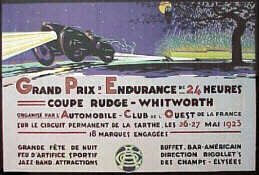


Circuit and race format
The event takes place on the Circuit de la Sarthe, a course that combines permanent circuit sections with closed public roads. The race traditionally begins in the afternoon, runs through the night and finishes at the same clock time on the following day. Night driving, changing weather and mixed public-road surfaces increase the challenge. Pit stops for fuel, tires and repairs are frequent, and teams must balance speed with mechanical sympathy to survive the full 24 hours.
Cars, classes and teams
Le Mans fields several classes of cars that fall into two broad categories: purpose-built prototypes (the fastest machines) and production-based grand touring (GT) cars. Over its history the top prototype category was known as LMP1; in recent years manufacturers and organizers have introduced new top classes to reflect evolving regulations and technology. Each car is campaigned by a team and driven by multiple drivers; modern rules commonly require three drivers per car to share driving duties during the race.
Strategy, regulations and racecraft
Endurance racing at Le Mans emphasizes reliability, efficiency and teamwork as much as outright pace. Important elements include:
- Driver stints: drivers rotate through planned stints to manage fatigue. Stint lengths depend on regulations, conditions and team strategy.
- Fuel and tires: teams manage fuel consumption, tire wear and brake life to minimize time lost in the pits.
- Repairs: quick but effective pit repairs can keep a car in contention; extended mechanical issues often end a team’s race.
History and notable facts
Le Mans has a long history of innovation and dramatic competition. It has influenced road-car technology through advances in aerodynamics, engine efficiency and durability. The race once featured the iconic "Le Mans start," where drivers ran to their cars, a practice discontinued for safety reasons. Tom Kristensen holds the record for the most driver victories at Le Mans, and several manufacturers have used the event to showcase engineering prowess and endurance credentials.
Legacy and cultural importance
Beyond its sporting significance, the 24 Hours of Le Mans is an international spectacle that attracts factory teams, privateers and fans from around the world. The event has inspired films, books and a global following, and remains a key benchmark for automotive performance and endurance. For more information on the circuit and event history see official and archival resources such as race archives, technical analyses at specialist sites, and manufacturer histories at makers' pages.
Questions and answers
Q: What is the 24 Hours of Le Mans?
A: The 24 Hours of Le Mans is the world's oldest active sports car race in endurance racing, held annually near the town of Le Mans, France.
Q: When did the first race take place?
A: The first race took place in 1923.
Q: What is the duration of this race?
A: The cars must run for 24 hours without mechanical damage.
Q: What are the consumables that need to be managed during the race?
A: It is important to manage the cars' consumables, mostly fuel, tires and braking materials.
Q: How long does a driver go behind the wheel before stopping in the pits?
A: The driver goes over two hours behind the wheel before stopping in the pits.
Q: How is the driving duty shared among drivers?
A: Today it is a rule that three drivers share each car.
Q: What type of cars compete in different categories and what is the fastest category?
A: Different types of cars race in different categories. Currently, there are four different categories, with the fastest cars racing in the 'LMP1' category.
Related articles
Author
AlegsaOnline.com 24 Hours of Le Mans Leandro Alegsa
URL: https://en.alegsaonline.com/art/112742
Sources
- independent.co.uk : "Weekly auto agenda: Le Mans"
- lemans.org : "Schedule"