
2017 French presidential election
A two-round presidential contest in France held in April–May 2017 that produced Emmanuel Macron as president, ended the incumbent’s bid not to run and reshaped the country’s political landscape.
Overview
The 2017 French presidential election was held in two rounds on 23 April and 7 May 2017. It followed France's standard two-round, majority-runoff system for choosing the president by direct universal suffrage; if no candidate wins an absolute majority in the first round, the top two advance to a decisive second round. Detailed information on the organization of the vote is available from the official election information. The election took place in France against a backdrop of economic concern, security debates and voter dissatisfaction with established parties.
Image gallery
10 Images




Electoral context and rules
The presidency in France is a five-year term and the election required candidates to secure signatures of elected officials to appear on the ballot. The incumbent president, François Hollande, announced that he would not seek re-election, an uncommon decision for a sitting head of state. That choice, together with wider disaffection with the traditional parties, helped create space for new movements and unpredictable outcomes.
Major candidates and parties
The first-round field included established politicians and newer challengers. Prominent figures were Emmanuel Macron, founder of the centrist movement En Marche!; Marine Le Pen of the National Front; François Fillon representing the mainstream right and associated with The Republicans; and Benoît Hamon for the Socialist Party. Other notable candidacies included Jean-Luc Mélenchon, François Asselineau, Nicolas Dupont-Aignan, Philippe Poutou, Nathalie Arthaud, Jacques Cheminade and Jean Lassalle.
Campaign themes and events
The campaign addressed immigration, security, unemployment, taxation and France's role in the European Union. It was marked by intense media scrutiny, debates and, in some cases, controversy over finances and conduct. Voters also reacted to the perceived decline of the traditional center-left and center-right parties, which influenced party strategies and voter alignments during both rounds.
Results and immediate aftermath
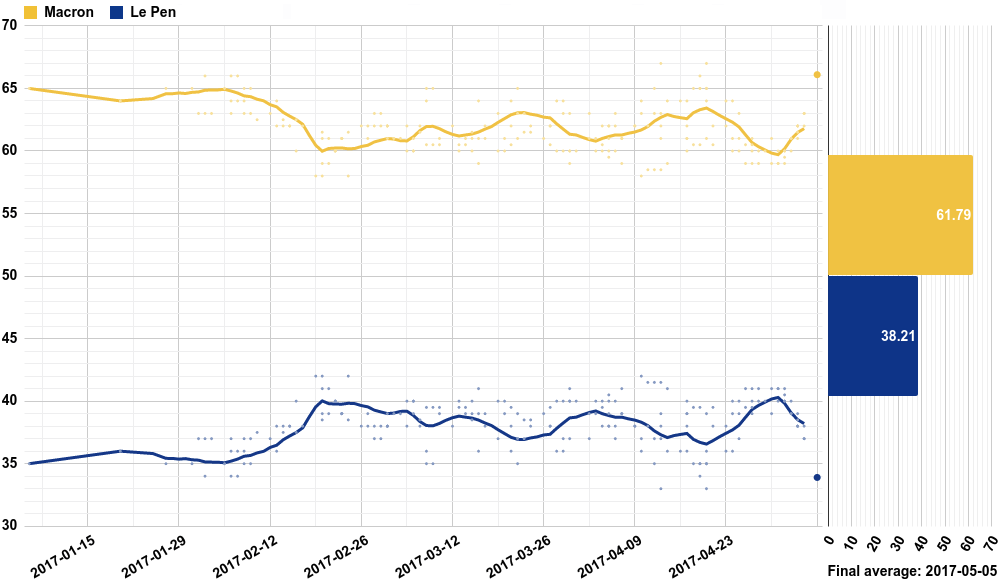
In the first round on 23 April 2017, Emmanuel Macron led with about 24% of the vote while Marine Le Pen finished second with around 21%, enabling both to advance to the May runoff. In the second round on 7 May, Macron defeated Le Pen by a wide margin, securing roughly two-thirds of the vote to her one-third. The official count and detailed breakdowns are referenced at runoff results. The outcome produced a new centrist presidency and triggered a reconfiguration of parliamentary politics in the months that followed.
Significance and legacy
The 2017 election is widely seen as a pivotal moment in recent French politics: it accelerated a realignment away from longstanding mainstream parties, elevated a newly formed movement to the presidency, and demonstrated the resilience of France’s two-round system in producing a clear executive mandate. Analysts have continued to debate its long-term effects on policy, party organization and electoral behaviour.
Questions and answers
Q: When did the 2017 French presidential election take place?
A: The 2017 French presidential election took place on May 7th, 2017.
Q: Why did François Hollande not run for a second term in the 2017 French presidential election?
A: François Hollande did not run for a second term in the 2017 French presidential election because of his low approval ratings.
Q: Who were the main candidates in the 2017 French presidential election?
A: The main candidates in the 2017 French presidential election were Nicolas Dupont-Aignan from Debout la France, Marine Le Pen from the National Front, Emmanuel Macron from En Marche!, Benoît Hamon from the Socialist Party, Nathalie Arthaud from Lutte Ouvrière, Philippe Poutou from the New Anticapitalist Party, Jacques Cheminade from Solidarity and Progress, Jean Lassalle from Résistons!, Jean-Luc Mélenchon from La France insoumise, François Asselineau from Popular Republican Union and François Fillon from The Republicans.
Q: Who won the first round of voting in the 2017 French presidential election?
A: Emmanuel Macron won the first round of voting in the 2017 French presidential election with 24% of the vote.
Q: Who did Macron face in the second round of voting in the 2017 French presidential election?
A: Macron faced Marine Le Pen in the second round of voting in the 2017 French presidential election.
Q: What was the result of the second round of voting in the 2017 French presidential election?
A: Macron won a landslide victory in the second round of voting in the 2017 French presidential election with 66% of the vote, while Le Pen received 34%.
Q: Which political parties did the main candidates in the 2017 French presidential election belong to?
A: The main candidates in the 2017 French presidential election belonged to Debout la France, the National Front, En Marche!, the Socialist Party, Lutte Ouvrière, the New Anticapitalist Party, Solidarity and Progress, Résistons!, La France insoumise, the Popular Republican Union, and The Republicans.
Related articles
Author
AlegsaOnline.com 2017 French presidential election Leandro Alegsa
URL: https://en.alegsaonline.com/art/112598
Sources
- cnbc.com : "Here's all you need to know about the French election"
- bbc.com : "France presidency: Francois Hollande decides not to run again"
- lemonde.fr : "En direct, Emmanuel Macron élu président : « Je défendrai la France, ses intérêts vitaux, son image »"