
Kosovo's 2008 declaration of independence
On 17 February 2008 Kosovo's assembly declared independence from Serbia. The move followed years of UN administration and diplomacy, prompted international debate, and was the subject of an ICJ advisory opinion.
Overview
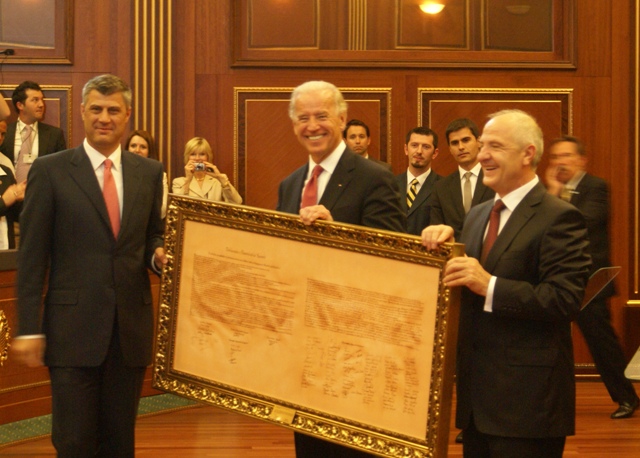
On 17 February 2008 the Provisional Institutions of Self-Government Assembly of Kosovo adopted a declaration announcing Kosovo's independence from Serbia. The measure was passed by the members present in the assembly and proclaimed the establishment of the Republic of Kosovo as a separate political entity. The 2008 declaration followed an earlier proclamation made by Kosovo Albanian leaders in 1990, and it marked a defining moment in the long-running dispute over Kosovo's status.
Image gallery
9 Images


Background and context
Following the end of conflict in the late 1990s, Kosovo was placed under interim international administration by the United Nations Security Council, which sought to stabilize the province while its final status was negotiated. During the 2000s a series of negotiations, proposals and reports addressed possible outcomes for Kosovo, including proposals that envisaged supervised independence. Political institutions established under international supervision laid the groundwork for Kosovo's own representative bodies and governance structures. For related institutional detail see the Assembly of Kosovo and background on Kosovo.
The declaration and immediate reactions
The declaration of 17 February was issued by Kosovo's representative assembly and publicly announced the creation of an independent state. The government of Serbia rejected the declaration as unlawful and stated that Kosovo remained part of Serbia. International reactions were mixed: several countries, particularly in Western Europe and North America, moved to recognize the new entity, while others, including some permanent members of the United Nations Security Council, declined to do so. The differing responses contributed to a pattern of partial recognition that persists in international relations.
Legal challenge and advisory opinion
Serbia brought the question of the declaration's legality to the International Court of Justice. The court considered a request for an advisory opinion and, in response, issued a legal finding addressing whether the act of declaring independence breached general international law. The court's opinion, delivered after consideration of submissions from multiple states and organizations, concluded that the declaration did not violate general international law. For more on the judicial proceedings see the International Court of Justice and the ICJ advisory opinion.
International recognition, administration and consequences
Recognition of Kosovo has been uneven. A substantial number of states recognized Kosovo's independence, enabling it to establish diplomatic relations with many countries; at the same time, several states, including Serbia, Russia and others, withheld recognition. International missions continued to operate in Kosovo to support rule of law, civil administration and security, with NATO-led forces maintaining a presence to provide stability. EU-led initiatives have sought to normalize relations between Belgrade and Pristina through dialogue and agreements addressing practical matters.
Notable aspects and legacy
The 2008 declaration is notable for combining an internal political act by Kosovo's assembly with an ensuing international debate over sovereignty, recognition and the role of international institutions. It highlighted tensions between territorial integrity and self-determination in contemporary international law and practice. The episode also underscored how diplomatic recognition, multilateral mediation and judicial opinions interact in complex territorial disputes. For further institutional or historical context consult sources on the Serbia–Kosovo relationship and international mediation efforts such as the proposals prepared in the years prior to 2008, including the Ahtisaari-related process described in many policy reviews.
- Key date: 17 February 2008 — declaration adopted by Kosovo's assembly.
- Prior event: 1990 declaration by Kosovar Albanian leaders.
- Legal outcome: ICJ advisory opinion found no violation of general international law.
The political and legal consequences of the declaration remain subjects of study and diplomacy, as Kosovo's status continues to be recognized differently across the international community and as bilateral and multilateral efforts seek durable arrangements.
Assembly of Kosovo | Kosovo | Serbia | International Court of Justice | ICJ advisory opinion
Questions and answers
Q: Who adopted the 2008 Kosovo declaration of independence?
A: The 2008 Kosovo declaration of independence was adopted by the Provisional Institutions of Self-Government Assembly of Kosovo.
Q: When was the 2008 Kosovo declaration of independence adopted?
A: The 2008 Kosovo declaration of independence was adopted on 17 February 2008.
Q: What did the Kosovo declaration of independence declare?
A: The Kosovo declaration of independence declared Kosovo to be independent from Serbia.
Q: How many members were present when the Kosovo declaration of independence was adopted?
A: All of the 109 members that were present adopted the Kosovo declaration of independence.
Q: Was the 2008 Kosovo declaration of independence the first declaration of independence by Kosovo's Albanian-majority political institutions?
A: No, the first declaration of independence by Kosovo's Albanian-majority political institutions was proclaimed on 7 September 1990.
Q: What was the stance of the government of Serbia on the Kosovo declaration of independence?
A: The government of Serbia said that the Kosovo declaration of independence was illegal.
Q: What did the International Court of Justice say about the Kosovo declaration of independence?
A: The International Court of Justice said that the Kosovo declaration of independence did not violate international law.
Related articles
Author
AlegsaOnline.com Kosovo's 2008 declaration of independence Leandro Alegsa
URL: https://en.alegsaonline.com/art/112409
Sources
- news.bbc.co.uk : "Serbian president visits Kosovo"
- news.yahoo.com : "World court says Kosovo's independence is legal - Yahoo! News"
- forbes.com : "UN Security Council to meet on Kosovo - diplomat UPDATE" · web.archive.org
- nytimes.com : "Kosovo Declares Its Independence From Serbia – New York Times"
- guardian.co.uk : "Albanian celebrations leave Serbs defiant | World news | The Guardian"
- english.aljazeera.net : "ICJ rules on Kosovo statehood - Europe"