
2005 Pacific hurricane season
Summary of the 2005 northeast Pacific hurricane season, covering activity, notable storms, impacts, forecasts, and how it compared to other seasons.
The 2005 Pacific hurricane season in the northeast Pacific basin was quieter than many people remember from the same year in the Atlantic, producing a modest set of tropical systems that mostly remained over open water. The official season runs from May 15 to November 30, and in 2005 the first system, Hurricane Adrian, formed on May 17 while the last system, Tropical Depression Sixteen-E, dissipated on October 20. Over the course of the season there were 17 tropical cyclones, of which 15 became tropical storms, 7 intensified into hurricanes and 2 reached major-hurricane strength.
Image gallery
10 Images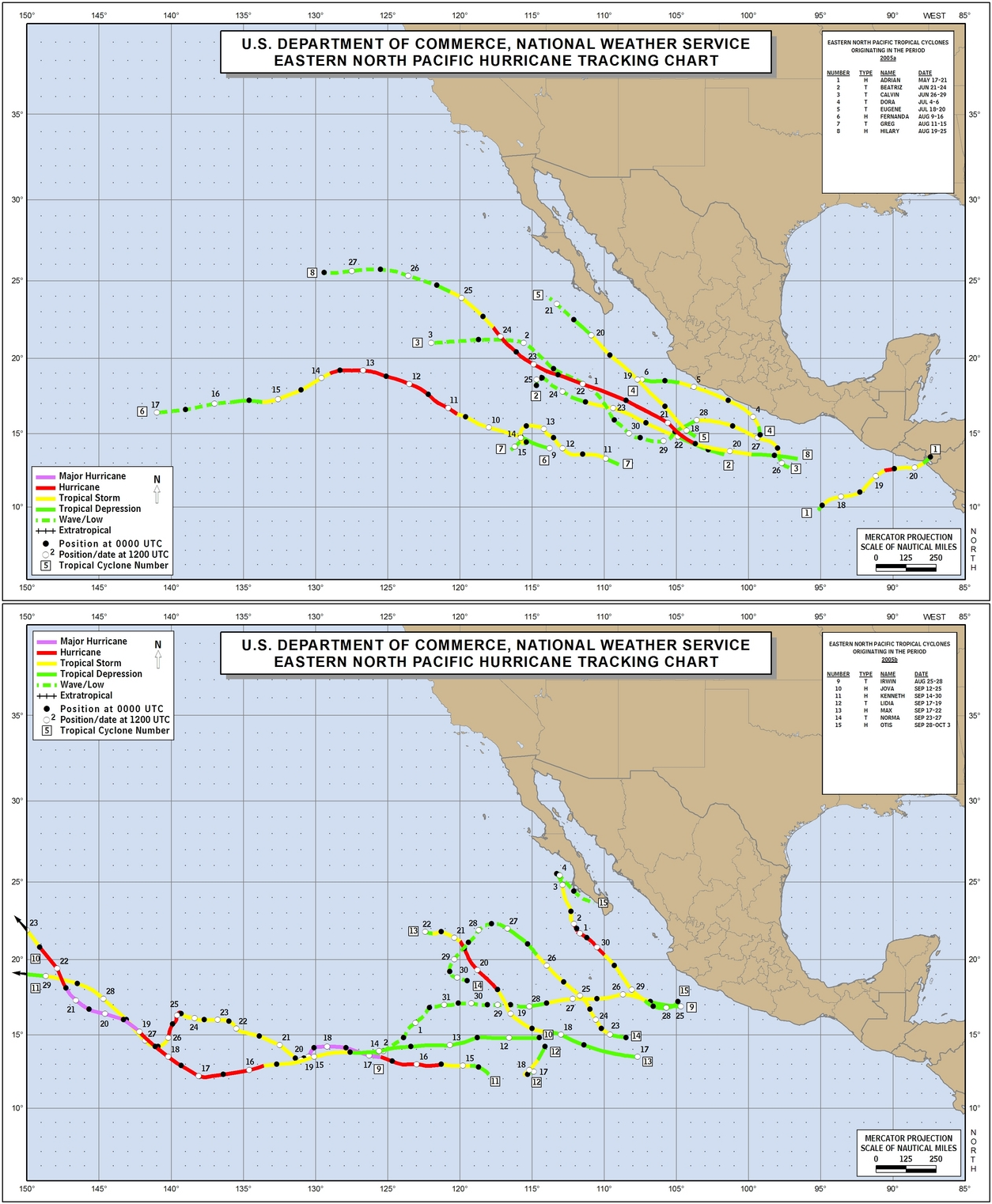


Season summary and statistics
Overall activity was near to slightly below long‑term averages for the northeast Pacific. The month with the greatest number of formations was September, which produced six of the season's systems. A preseason outlook issued by U.S. forecasters predicted a moderate season, and the observed counts fit within those ranges: the U.S. National Oceanic and Atmospheric Administration and related agencies had called for roughly 11–15 named storms and 6–8 hurricanes, with 2–4 expected to become major hurricanes. Observed totals — 15 named storms and 7 hurricanes with 2 major hurricanes — were consistent with that forecast window.
Notable storms and impacts
Few systems made significant landfall. The earliest and one of the most consequential was Hurricane Adrian, which weakened rapidly before striking Central America and moved ashore near El Salvador as a dissipating tropical depression; related flooding in Nicaragua produced the only known fatality attributed to the Pacific season. Tropical Storm Dora and Hurricane Hilary passed close enough to bring tropical storm–force winds to parts of coastal Mexico, although reports indicated little or no damage. The strongest storm of the season, Hurricane Kenneth, remained a remote oceanic hurricane for most of its life, but its remnants later contributed to rainfall over the Island of Hawaii and nearby islands. Another remnant system, Tropical Depression One‑C, also produced heavy rains on Hawaii; measured totals included an 8.8‑inch report (about 224 mm) at one site.
- Totals: 17 tropical cyclones, 15 tropical storms, 7 hurricanes, 2 major hurricanes.
- First storm: Hurricane Adrian (formed May 17).
- Last system: Tropical Depression Sixteen‑E (dissipated October 20).
- Deadly impacts: One confirmed fatality from inland flooding in Nicaragua.
Season context and notable features
Compared with the exceptional Atlantic hurricane season of 2005, the northeast Pacific was relatively subdued. This difference is a useful reminder that activity in the two adjacent basins can vary independently because of differing sea surface temperatures, wind shear patterns, and larger climate signals. The strongest systems in the Pacific basin during 2005 did not produce major coastal disasters: Hurricane Kenneth, for example, remained primarily at sea and only its moisture and remnants affected land. For reference or further reading on specific systems and their tracks, consult summaries and reports from national meteorological services and post‑season analyses.
Legacy and records
From an operational standpoint the 2005 Pacific season provided routine forecasting challenges but few dramatic emergencies. The season's statistics and the limited land impacts made it a relatively low‑impact year in the region. Researchers and forecasters continue to study seasons like 2005 to understand how interannual variability and longer‑term trends influence tropical cyclone formation in the northeast Pacific.
For more detailed storm reports, track maps and rainfall analyses see the agency summaries and individual storm writeups: Hurricane Kenneth report, agency seasonal summary, and country summaries for El Salvador, Nicaragua and coastal Mexico. Specific rainfall observations from Hawaii include station reports referenced at the local rainfall site and the millimetric conversion noted at a unit conversion reference. General information about tropical cyclone behavior and seasonal definitions is available through regional meteorological services and educational resources such as island and regional climate pages.
Questions and answers
Q: What was the start and end date of the 2005 Pacific hurricane season?
A: The 2005 Pacific hurricane season officially started on May 15 and ended on November 30.
Q: How many tropical cyclones formed during this season?
A: A total of 17 tropical cyclones, 15 tropical storms, 7 hurricanes and 2 major hurricanes formed during the 2005 Pacific hurricane season.
Q: What month had the most activity?
A: September was the most active month of the year with 6 out of 17 tropical cyclones forming during this time.
Q: How many named storms were predicted in pre-season forecasts?
A: Pre-season forecasts from U.S National Oceanic and Atmospheric Administration called for 11-15 named storms.
Q: How many hurricanes were predicted in pre-season forecasts?
A: Pre-season forecasts from U.S National Oceanic and Atmospheric Administration called for 6-8 hurricanes.
Q: How many major hurricanes were predicted in pre-season forecasts?
A: Pre-season forecasts from U.S National Oceanic and Atmospheric Administration called for 2-4 major hurricanes to form during this season.
Q: What storm caused only one fatality during this season?
A: Flooding in Nicaragua caused by Tropical Depression One C was responsible for only one fatality during this season.
Related articles
Author
AlegsaOnline.com 2005 Pacific hurricane season Leandro Alegsa
URL: https://en.alegsaonline.com/art/112369