
2004 Indian Ocean earthquake and tsunami (Sumatra–Andaman event)
A massive undersea megathrust earthquake on 26 December 2004 off Sumatra triggered trans‑oceanic tsunamis that caused very large loss of life across Indian Ocean coasts and prompted major advances in warning systems.
Overview
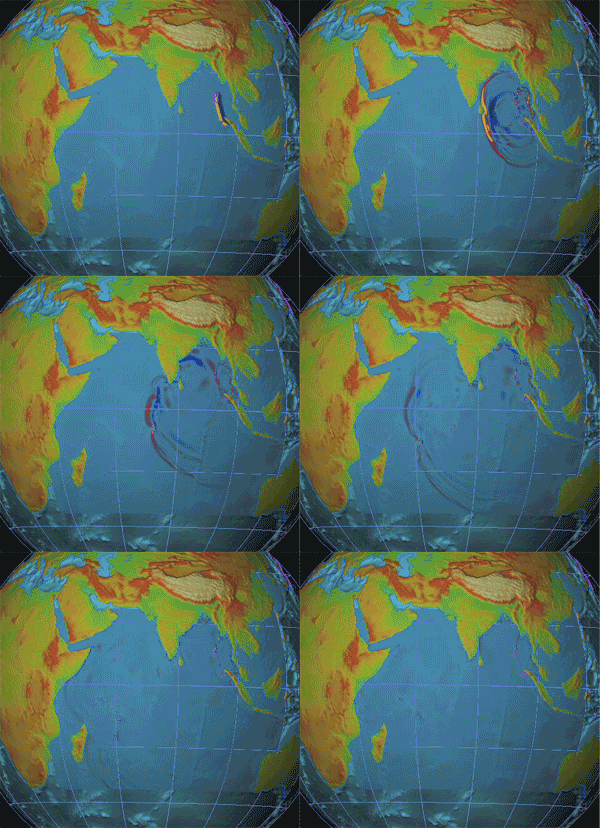
On 26 December 2004 a very large undersea rupture occurred in the eastern Indian Ocean, commonly referred to as the 2004 Indian Ocean earthquake and tsunami or the Sumatra–Andaman event. The main shock began just before 01:00 UTC and persisted for several minutes, producing a train of tsunami waves that radiated across the Indian Ocean and inundated coastlines from Southeast Asia to East Africa. Contemporary descriptions called it an undersea earthquake with unusually long duration and global effects.
Image gallery
10 Images



Earthquake source and characteristics
The event was a megathrust rupture on the subduction zone where the Indo‑Australian Plate is forced beneath the Sunda Plate. The initial epicenter lay off the west coast of Sumatra in Indonesia. Seismological analyses placed the event among the largest instrumentally recorded earthquakes in history, with moment‑magnitude estimates commonly cited in the range of 9.1–9.3. Ground shaking continued far longer than is usual for most earthquakes, and the release of long‑period seismic energy was measured around the Earth. The rupture also generated significant aftershocks and triggered seismic responses at remote locations.
Tsunami generation and propagation
The sudden vertical displacement of the seafloor displaced enormous volumes of water, initiating tsunami waves that travelled across ocean basins at high speed. Wave heights and run‑up varied greatly by location and coastal geometry; in some places waves travelled many tens of metres inland. The tsunami crossed the ocean and struck widely separated shores, producing catastrophic coastal inundation and erosion. The event produced measurable seismic waves and ocean signals that were recorded by instruments worldwide and even induced distant crustal responses noted in regions such as Iceland.
Human impact and affected areas
The tsunami struck at a time when many coastal areas were occupied by holidaymakers and local communities, producing very large casualties and displacement. The hardest hit country was Indonesia, particularly communities along the western coast of Sumatra. Other severely affected nations included Thailand, Sri Lanka, India and the Maldives; waves also caused fatalities and damage along coasts of East Africa. Estimates of the total human death toll run into the hundreds of thousands, and the disaster displaced large numbers of people and destroyed infrastructure, housing and livelihoods.
Response, recovery and international aid
The scale of the catastrophe prompted an enormous international humanitarian response, including emergency relief, search and rescue, medical assistance and long‑term reconstruction efforts. Governments, non‑governmental organisations and multilateral agencies coordinated relief and recovery programmes. The disaster highlighted shortfalls in regional preparedness and the need for improved coordination of alerts, community education and coastal evacuation planning.
Legacy and improvements in warning systems
One of the most important outcomes was the acceleration of efforts to establish an Indian Ocean tsunami warning system and to upgrade seismic and sea‑level monitoring networks. The event stimulated scientific research into tsunami generation, propagation and coastal vulnerability, and it led to better public‑education programmes, early‑warning protocols and investments in resilience. Academic and technical reviews of the event drew on instrumental records such as contemporaneous assessments of shaking and magnitude often compared with older measures like the Richter scale.
Key facts
- Date: 26 December 2004.
- Location: epicentral region off western Sumatra, Indonesia.
- Cause: megathrust undersea rupture producing trans‑oceanic tsunamis (undersea earthquake).
- Magnitude: among the largest recorded (moment‑magnitude commonly cited above 9.0).
- Global effects: long‑period seismic energy recorded across the Earth and distant ocean impacts.
The 2004 Indian Ocean earthquake and tsunami remain a defining natural disaster of the early 21st century. Their immediate human cost and the subsequent policy, scientific and technical responses have had lasting influence on tsunami science, coastal planning and international disaster cooperation. For further introductory materials and technical background, consult authoritative seismology, oceanography and disaster‑management resources (epicentral studies, coastal impact analyses, regional reports).
Questions and answers
Q: What is the 2004 Indian Ocean earthquake and tsunami?
A: The 2004 Indian Ocean earthquake and tsunami was a great underwater earthquake that occurred on December 26, 2004, off the west coast of Sumatra, Indonesia.
Q: What is the scientific name of the 2004 Indian Ocean earthquake and tsunami?
A: The 2004 Indian Ocean earthquake and tsunami is also known as the Sumatra-Andaman earthquake among the scientific community.
Q: When did the earthquake occur?
A: The earthquake occurred at 00:58:53 UTC (07:58:53 local time) on December 26, 2004.
Q: What was the magnitude of the earthquake?
A: At first, the earthquake was measured as a 9.0 on the Richter scale.
Q: How long did the earthquake last?
A: The earthquake lasted between 500 (8.3 minutes) and 600 (10 minutes) seconds.
Q: How powerful was the earthquake?
A: The earthquake was so powerful that it caused the entire Earth to vibrate and started other earthquakes as far away as Iceland.
Q: Where was the epicenter of the earthquake?
A: The epicenter of the earthquake was off the west coast of Sumatra, Indonesia.
Related articles
Author
AlegsaOnline.com 2004 Indian Ocean earthquake and tsunami (Sumatra–Andaman event) Leandro Alegsa
URL: https://en.alegsaonline.com/art/112354
Sources
- earthquake.usgs.gov : "Magnitude 9.1 – Off the West Coast of Sumatra"
- indianoceantsunami.web.unc.edu : "Indian Ocean Tsunami – Economic Aspects"
- soundwaves.usgs.gov : "Astonishing Wave Heights Among the Findings of an International Tsunami Survey Team on Sumatra"
- geomorphologie.revues.org : "Nannoliths abundance and distribution in tsunami deposits: example from the December 26, 2004 tsunami in Lhok Nga (northwest Sumatra, Indonesia)"
- doi.org : 10.4000/geomorphologie.7865
- tsunami-evaluation.org : "Joint evaluation of the international response to the Indian Ocean tsunami: Synthesis Report" · web.archive.org
- earthquake.usgs.gov : "Earthquakes with 50,000 or More Deaths"
- bbc.com : "Indian Ocean tsunami anniversary: Memorial events held"