
1944 United States presidential election
Presidential election held November 7, 1944, in which Franklin D. Roosevelt won a fourth term over Thomas E. Dewey amid World War II; an election with lasting constitutional and political consequences.
Overview
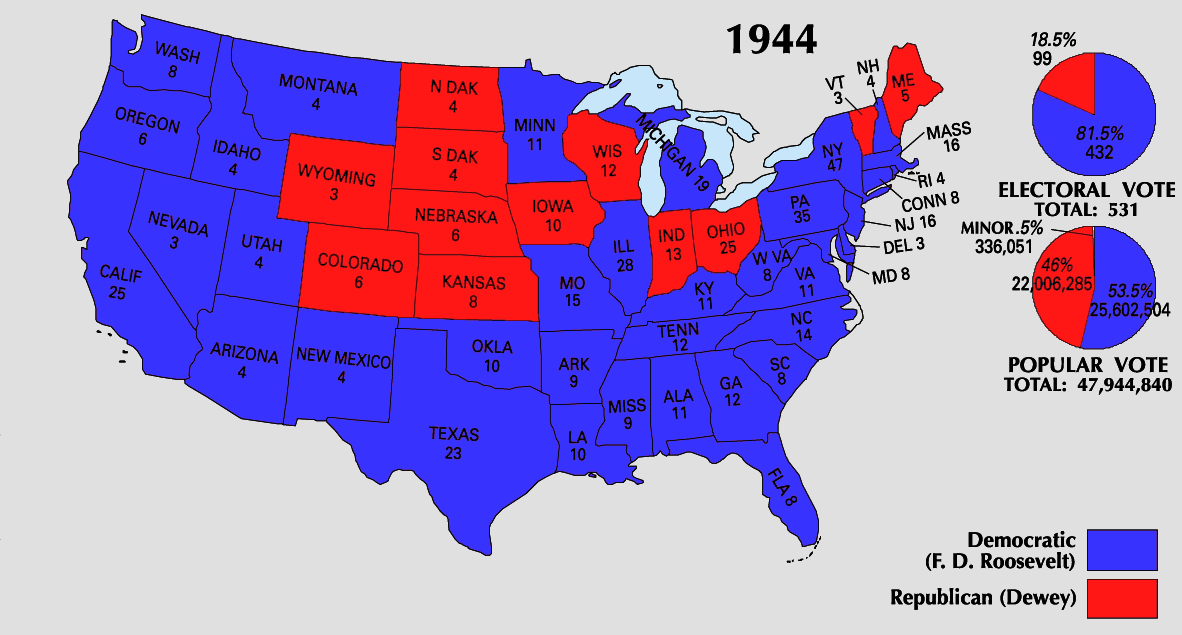
The 1944 United States presidential election took place on November 7, 1944. The incumbent President Franklin D. Roosevelt ran for an unprecedented fourth term as the nominee of the Democratic Party. He defeated the Republican nominee, Thomas E. Dewey, the Governor of New York, to win re-election. The vote in the Electoral College was decisively in Roosevelt's favor, and he secured a fourth term that would prove to be his last.
Image gallery
10 Images




Candidates and tickets
Roosevelt's 1944 ticket paired him with Senator Harry S. Truman of Missouri, who had been selected at the Democratic convention in place of Vice President Henry Wallace. The Republican ticket was led by Governor Thomas E. Dewey with Senator John W. Bricker as his running mate. Dewey ran as a modernizing conservative who criticized parts of Roosevelt's domestic program and advocated for a smaller federal role in certain areas.
Wartime context
The campaign unfolded during the final year of World War II, when Allied fortunes were improving. The state of the war effort and plans for postwar peace weighed heavily on voters. Roosevelt's leadership during the crisis and the ongoing mobilization of the United States and its Allies were central themes; many Americans preferred continuity of command as military operations progressed overseas.
Campaign themes and issues
Domestic debate in 1944 mixed wartime management with questions about the future role of government. Dewey and other Republicans criticized elements of the New Deal and promoted ideas of smaller government and administrative efficiency. Roosevelt's campaign emphasized wartime leadership, social security advances, and the need for experienced stewardship through the transition to peace. Concerns about Roosevelt's declining health circulated during the campaign, and the president's inner circle responded to those health concerns privately while presenting a steady public image.
Results and immediate aftermath
Roosevelt carried a substantial majority of the Electoral College, while Dewey won several important states and conducted a vigorous contest. The victory secured Roosevelt a historic fourth term, but he would not complete it: Roosevelt died in office the following spring, on a date remembered by history, and Vice President Truman assumed the presidency. The election therefore had both an immediate wartime consequence and a direct impact on the succession of leadership.
Significance and legacy
The 1944 election is often studied for its mixture of wartime politics, presidential health and succession, and the strains placed on American constitutional practice by four-term presidencies. In the years after Roosevelt's tenure, concerns about extended incumbency contributed to the adoption of the 22nd Amendment, which limits presidents to two elected terms. The contest also helped define postwar policy debates about reconversion, international engagement, and the scope of federal programs.
- Election date: November 7, 1944
- Electoral vote outcome: Roosevelt strong majority, Dewey minority
- Campaigns shaped by the popularity of wartime leadership and questions of domestic policy
- Long-term effect: impetus for term limits and postwar political alignment
For more on the participants and their policies, see discussions of Roosevelt's wartime administration and Dewey's reformist conservatism, and consult primary summaries of the campaign and its results. The 1944 contest remains a focal point for understanding how crises influence electoral choices and constitutional change in the United States, and how leadership transitions can alter the course of history.
Related topics and references: Republican Party, campaign strategy, incumbency, the Allies in wartime coordination, and planning for peacetime demobilization.
Questions and answers
Q: Who won the 1944 United States presidential election?
A: Incumbent President Franklin D. Roosevelt (FDR) won over Republican Thomas E. Dewey in the general election. In the Electoral College, Roosevelt won 432 votes while Dewey won 99.
Q: What was the date of this election?
A: The 1944 United States presidential election happened on November 7, 1944.
Q: What party did FDR represent?
A: FDR represented the Democratic Party.
Q: How many terms as president had FDR served by this time?
A: By this time, FDR had already served an unprecedented four terms as president.
Q: What was Governor Thomas E. Dewey's platform during his campaign?
A: During his campaign, Governor Thomas E. Dewey campaigned against the New Deal and for a smaller government.
Q: Was there any doubt that Roosevelt would run for another term as president?
A: There was little doubt that he would run for another term as president, as his health was failing.
Q: Who succeeded Roosevelt after he died in office three months after starting his fourth term?
A: After Roosevelt died in office three months after starting his fourth term, Vice President Harry S. Truman succeeded him and served out the remainder of his term of office
Related articles
Author
AlegsaOnline.com 1944 United States presidential election Leandro Alegsa
URL: https://en.alegsaonline.com/art/111996
Sources
- presidency.ucsb.edu : "Voter Turnout in Presidential Elections"
- presidency.ucsb.edu : "Election of 1944"
- history.com : "FDR wins unprecedented fourth term"
- gilderlehrman.org : "Franklin Delano Roosevelt—Four-Term President—and the Election of 1944"
- uselectionatlas.org : "1944 Presidential General Election Results"
- u-s-history.com : "Election of 1944: Four Terms for FDR"