
1923 Great Kantō earthquake
Major 1923 earthquake and resulting fires and tsunami that devastated the Kantō region of Japan, killed about 140,000 people, and reshaped Japanese urban planning and seismic policy.
Overview
The Great Kantō earthquake struck the Kantō plain on the main island of Japan on Saturday, 1 September 1923 at 11:58:44 a.m. JST. It is widely remembered as one of Japan's most destructive modern earthquakes. Seismologists estimate a large shallow rupture offshore of the Kantō region and along the Sagami Trough produced violent shaking that lasted several minutes. Contemporary accounts report shaking between four and ten minutes and a measured magnitude commonly cited in modern summaries.
Image gallery
10 Images

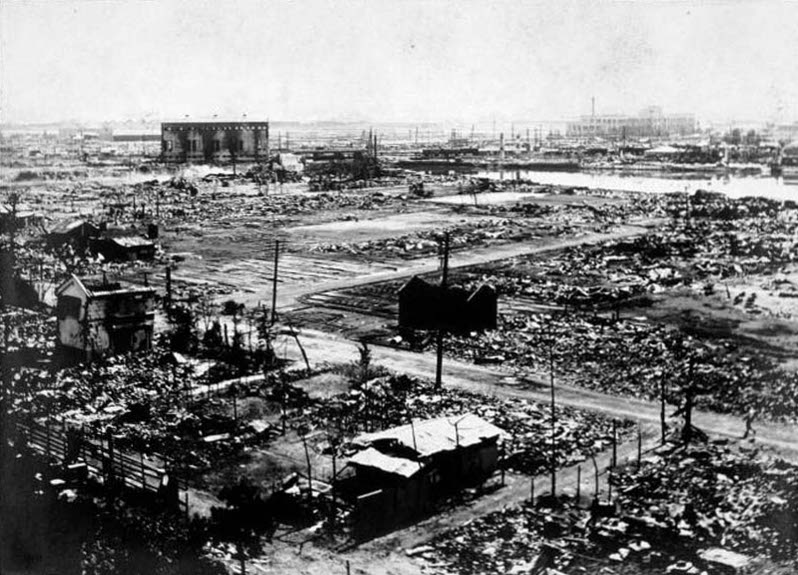
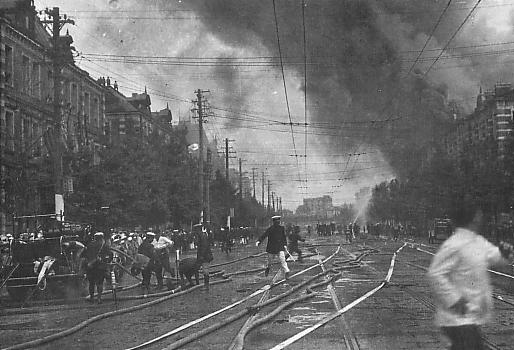


Extent and immediate effects
Ground motion and secondary disasters ruined much of the built environment across the region. The quake and its aftershocks caused widespread collapse of wooden houses, ruptured utilities and gas lines, and triggered fires and tsunami waves along coastal areas. Major urban and suburban centers directly affected included Tokyo and the port of Yokohama, and damage extended throughout the greater Kantō area on the island of Honshū. Several surrounding prefectures, including Chiba, Kanagawa, and Shizuoka, experienced severe damage to homes, roads and harbors.
Casualties and humanitarian crisis
Death toll estimates vary by source, but historical accounts put the number of fatalities at roughly 140,000 people, many of whom perished in firestorms or coastal inundations after the initial shaking. Water mains and transportation routes were broken, hampering firefighting and rescue efforts and producing an acute humanitarian emergency. Temporary camps, relief supplies and international donations were organized in the weeks that followed.
Social and political consequences
The disaster precipitated social unrest and severe civil strains. Rumors and panic contributed to vigilante attacks and extrajudicial violence against ethnic minorities and perceived outsiders. Authorities declared emergency controls to restore order while also confronting shortages of housing and food. The catastrophe had significant short-term political effects and intensified debates about urban governance and public safety.
Reconstruction, science and legacy
Rebuilding after the quake led to major changes in urban planning, fire prevention and building regulations. Reconstruction efforts favored wider streets, more firebreaks, modern utilities and stricter construction standards for earthquake resistance. The disaster also accelerated seismological research and public awareness of seismic risk in Japan. Memorials and annual observances remember those lost and the lessons learned. For further historical summaries and archival materials see resources on this natural calamity and the affected region: disaster overview.
Notable facts
- The catastrophe combined shaking, conflagration and tsunami to create one of the deadliest events in Japan's 20th-century history.
- Its scale influenced later building codes and emergency planning across earthquake-prone countries.
- Contemporary reportage and later scholarship use both official records and survivor accounts to reconstruct the event and its aftermath.
Questions and answers
Q: What was the Great Kantō earthquake?
A: The Great Kantō earthquake was a natural disaster in the Kantō region of the island of Honshū.
Q: When did the Great Kantō earthquake occur?
A: The earthquake struck at 11:58:44 am JST (2:58:44 UTC) on Saturday, September 1, 1923.
Q: How long did the earthquake last?
A: The earthquake lasted between 4 and 10 minutes.
Q: Which cities were destroyed by the earthquake?
A: The earthquake destroyed Tokyo, the port city of Yokohama, and the surrounding prefectures of Chiba, Kanagawa, and Shizuoka.
Q: How much damage did the earthquake cause?
A: The earthquake caused widespread damage.
Q: How many people died as a result of the earthquake?
A: About 140,000 people died as a result of the earthquake.
Q: In which region of Japan did the earthquake occur?
A: The earthquake occurred in the Kantō region of the island of Honshū.
Related articles
Author
AlegsaOnline.com 1923 Great Kantō earthquake Leandro Alegsa
URL: https://en.alegsaonline.com/art/111932
Sources
- ui.adsabs.harvard.edu : 2005EP&S...57..261K
- doi.org : 10.1186/BF03352562
- idsa.in : "Japan Coping with a National Calamity"
- authors.library.caltech.edu : "The energy release in great earthquakes"
- ui.adsabs.harvard.edu : 1977JGR....82.2981K
- doi.org : 10.1029/JB082i020p02981
- gsj.jp : "Fault models of the 1703 Genroku and 1923 Taisho Kanto earthquakes inferred from coastal movements in the southern Kanto erea"
- bousai.go.jp : "首都直下地震モデル検討会"
- repository.dl.itc.u-tokyo.ac.jp : "Tsunami Behavior of the 1923 Kanto Earthquake at Atami and Hatsushima Island in Sagami Bay"
- jstage.jst.go.jp : "Aftershock Activities for Two Days after the 1923 Kanto Earthquake (M=7.9) Inferred from Seismograms at Gifu Observatory"
- doi.org : 10.5610/jaee.4.4_21
- earthquake.usgs.gov : "Today in Earthquake History"
- nisee.berkeley.edu : "The 1923 Tokyo Earthquake and Fire" at University of California, Berkeley