
Encyclopædia Britannica, Eleventh Edition (1910–1911)
A concise examination of the 1910–1911 Eleventh Edition of the Encyclopædia Britannica: its scope, structure, scholarly value, historical context, modern uses and criticisms, and its digitization.
Overview
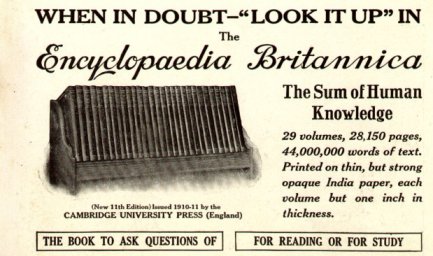
The Encyclopædia Britannica Eleventh Edition, produced between 1910 and 1911, is one of the most well‑known single editions of the long‑running Encyclopædia Britannica. Compiled under editorial leadership of Hugh Chisholm, it was intended as a comprehensive reference for general and scholarly use. Many articles were contributed by prominent academics and specialists of the late 19th and early 20th centuries, giving the edition its reputation for learned, authoritative coverage in numerous subjects.
Image gallery
2 Images
Characteristics and structure
The work was published as a multi‑volume set and combined long, signed articles with shorter topical entries and numerous illustrations and maps. Its articles often read like concise scholarly essays rather than brief dictionary entries, reflecting a practice of substantive treatment that appealed to readers seeking depth. Notable features include bibliographies or references in some articles, and a mixture of narrative history, technical descriptions, and contemporary scientific summaries.
Notable aspects
- Scholarly contributors: many entries were written by leading figures of the period, which preserved the expert voice and conventions of contemporary scholarship.
- Scope: it covered a wide range of disciplines—literature, history, science, geography, and the arts—often with more extended treatments than earlier reference works.
- Style: emphasis on exposition and interpretation rather than brief factual capsule summaries.
Historical context and influence
The Eleventh Edition reflects the intellectual outlook and research standards of its era. As a snapshot of early 20th‑century knowledge it has been used by historians, literary scholars, and researchers interested in the history of ideas and historiography. Its approach influenced later reference publishing by demonstrating demand for authoritative, essay‑like entries rather than mere definitions.
Reception, usefulness, and criticisms
For modern readers the edition remains valuable as a primary source for how topics were understood at the time. However, it also contains limitations: many articles reflect the biases and assumptions of their period, including imperial, racial, and gender perspectives now regarded as outdated. Scientific and technical sections naturally lack developments that occurred after publication. Users should therefore treat the edition as a historic document and consult current scholarship for up‑to‑date factual or interpretive claims.
Availability, digitization and legacy
The Eleventh Edition has been extensively reprinted and digitized and is widely accessible online. Because it was published more than a century ago it is largely in the public domain and has been incorporated into several online repositories and projects. For general reference see the main Encyclopædia Britannica resource or browse specialized digital archives that host historic editions. Its enduring importance lies in both its scholarly contributions and its value as evidence of early 20th‑century intellectual culture.
Note: While the Eleventh Edition remains of historical interest, readers researching contemporary facts should rely on current peer‑reviewed sources and modern reference works for accurate, up‑to‑date information.
Questions and answers
Q: What is the Encyclopædia Britannica Eleventh Edition?
A: The Encyclopædia Britannica Eleventh Edition is one of the most famous editions of the Encyclopædia Britannica, published between 1910 and 1911.
Q: Who wrote some of the articles in the Encyclopædia Britannica Eleventh Edition?
A: Some of the articles in the Encyclopædia Britannica Eleventh Edition were written by the best-known scholars of the time.
Q: Are the articles in the Encyclopædia Britannica Eleventh Edition still of value and interest to modern scholars?
A: Yes, the articles in the Encyclopædia Britannica Eleventh Edition are still of value and interest to modern scholars as examples of the knowledge of the 19th and early 20th centuries.
Q: Are there any problematic areas in the Encyclopædia Britannica Eleventh Edition for modern scholars using them as a source?
A: Yes, there are a number of problematic areas in the Encyclopædia Britannica Eleventh Edition for modern scholars using them as a source.
Q: Is the Encyclopædia Britannica Eleventh Edition still restricted by copyright?
A: No, the Encyclopædia Britannica Eleventh Edition is no longer restricted by copyright.
Q: Is the Encyclopædia Britannica Eleventh Edition available online?
A: Yes, the Encyclopædia Britannica Eleventh Edition is available online, both in its original text and in part in other online encyclopedias and works.
Q: Why is the Encyclopædia Britannica Eleventh Edition still of interest to modern scholars?
A: The Encyclopædia Britannica Eleventh Edition is still of interest to modern scholars because it provides a window into the historical knowledge and thinking of the 19th and early 20th centuries.
Related articles
Author
AlegsaOnline.com Encyclopædia Britannica, Eleventh Edition (1910–1911) Leandro Alegsa
URL: https://en.alegsaonline.com/art/111907