
Bhavani River — course, basin, dams and regional importance
The Bhavani River in the western Tamil Nadu region is a perennial tributary of the Kaveri. This article describes its course from the Nilgiri Hills, basin, major dams, uses and ecological and cultural importance.
Overview
The Bhavani River is a significant perennial river in south India, rising in the Nilgiri Hills of the Western Ghats and forming an important tributary of the Kaveri (Cauvery) system. It flows principally through the Kongu Nadu area of Tamil Nadu and has influence across state boundaries in Kerala and Karnataka. With a length commonly cited as about 217 kilometres, the Bhavani supports agricultural plains, reservoir systems and pockets of protected forest along its course in India.
Image gallery
6 Images


Course and basin
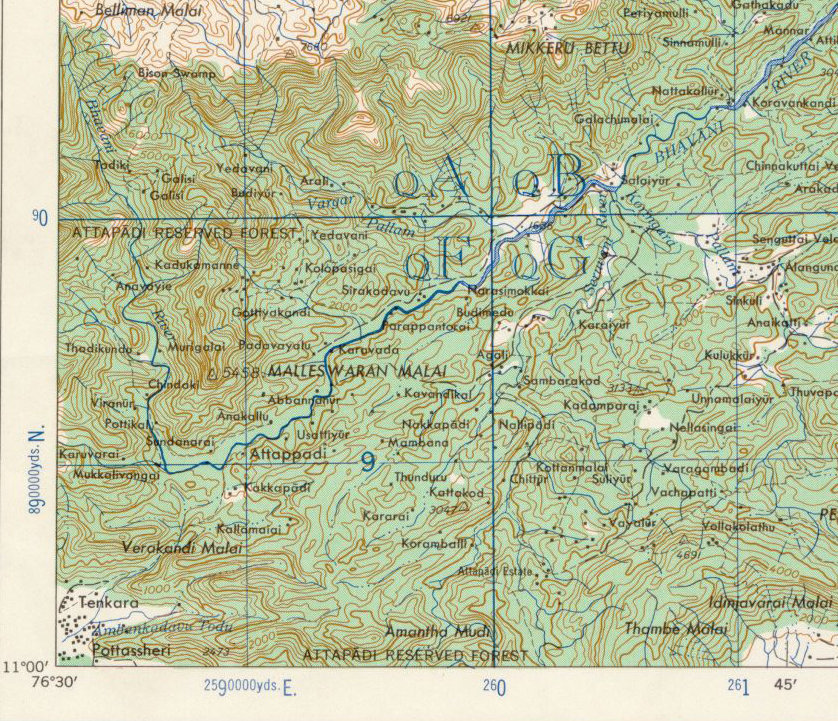
The river originates in the high ranges of the Nilgiris and initially descends through montane forests before entering lowland terrain. Along its upper reach it passes near or through ecologically sensitive zones such as parts of Silent Valley and adjoining protected tracts in Kerala, before turning back into Tamil Nadu where it traverses plains and joins the Kaveri. The Bhavani drains an area reported at roughly 0.62 million hectares; most of that basin lies in Tamil Nadu (about 87 percent), with smaller shares in Kerala (about 9 percent) and Karnataka (about 4 percent).
Hydrology and uses
The Bhavani is described as a perennial river, supplying water year-round in most reaches. Agriculture is the dominant consumer of its flow; estimates indicate that roughly nine out of ten units of available water are diverted for irrigation and related rural uses, supporting crops and livelihoods in the Kongu Nadu plains and neighbouring districts. Rivers of this type also contribute to groundwater recharge, local fisheries and seasonal riverine wetlands.
Dams and engineered works
Several major structures regulate the Bhavani for irrigation, storage and local water management. The largest and most prominent is the Bhavanisagar (also known as Lower Bhavani) dam located in Erode district, Tamil Nadu. This earthen embankment is notable for its size — it extends for several kilometres and stores a substantial reservoir volume. Another important weir is the Kodiveri structure near Gobichettipalayam, used mainly for irrigation diversion and local supply.
- Bhavanisagar dam: One of the largest earthen dams in the region, often cited for its length and storage capacity; it creates a major reservoir used for irrigation and regional water regulation.
- Kodiveri dam: A smaller diversion and check dam that supports irrigation canals and agriculture near Gobichettipalayam.
Ecological, cultural and economic importance
Ecologically, the Bhavani links montane forest habitats in the Western Ghats to lowland riverine systems, providing corridors for wildlife and habitat for riverine flora and fauna. Where it flows near or through protected areas it helps sustain high-biodiversity landscapes. Culturally and economically, the river underpins traditional farming systems in western Tamil Nadu: irrigation from the Bhavani supports paddy, sugarcane, oilseeds and other crops and thus shapes rural economies and settlement patterns. Local towns and districts depend on its regulated flows for drinking water, seasonal fisheries and small-scale industry.
Notable facts and distinctions
- The Bhavani is one of the principal tributaries of the Kaveri, contributing to one of southern India’s major river systems.
- Its basin spans three states, with the majority area in Tamil Nadu but cross-border influence extending into Kerala and Karnataka.
- Large dam works such as the Bhavanisagar reservoir (in Erode district) are central to the river’s role in regional irrigation and water management.
Understanding the Bhavani requires attention to its upstream forested origins, the engineered reservoirs that regulate its flow, and the rural landscapes that depend upon it. Ongoing management balances water allocation for agriculture, conservation of riparian ecosystems and the needs of growing towns in western Tamil Nadu and neighbouring states.
Questions and answers
Q: Where is the Bhavani River located?
A: The Bhavani River is located in the Kongu Nadu region of Tamil Nadu, India.
Q: What is the length of the Bhavani River?
A: The Bhavani River is 217-kilometre (135 mi) long.
Q: What is the origin of the Bhavani River?
A: The Bhavani River originates from the Nilgiri hills of the Western Ghats.
Q: What is the percentage of Tamil Nadu that the Bhavani River drains?
A: The Bhavani River drains 87% of Tamil Nadu.
Q: What is the major tributary of the Kaveri River?
A: The Bhavani River is a major tributary of the Kaveri River.
Q: What is the primary use of the Bhavani River water?
A: About 90% of the Bhavani River's water is used for agricultural irrigation.
Q: Where are the Bhavanisagar and Kodiveri dams located?
A: Bhavanisagar dam is located in Erode district of Tamil Nadu, India, while Kodiveri dam is located near Gobichettipalayam in Western Tamil Nadu on the Bhavani River.
Author
AlegsaOnline.com Bhavani River — course, basin, dams and regional importance Leandro Alegsa
URL: https://en.alegsaonline.com/art/11184
Sources
- erode.tn.nic.in : "Tourist Information for Erode district"
- cstibhavanisagar.org : "Uniqueness of Bhavanisagar dam"