
1803
A pivotal year in the early 19th century marked by the Louisiana Purchase, the U.S. Supreme Court's assertion of judicial review, renewed war between Britain and Napoleonic France, and notable scientific advances.
Overview
1803 was a year of political realignment and scientific activity that shaped the modern world. It fell in the early Napoleonic era and saw events that accelerated United States territorial expansion, clarified the role of courts in republican government, and intensified conflict between Britain and France. Its consequences affected colonial empires, legal institutions, and exploration.
Image gallery
10 Images



Major political events
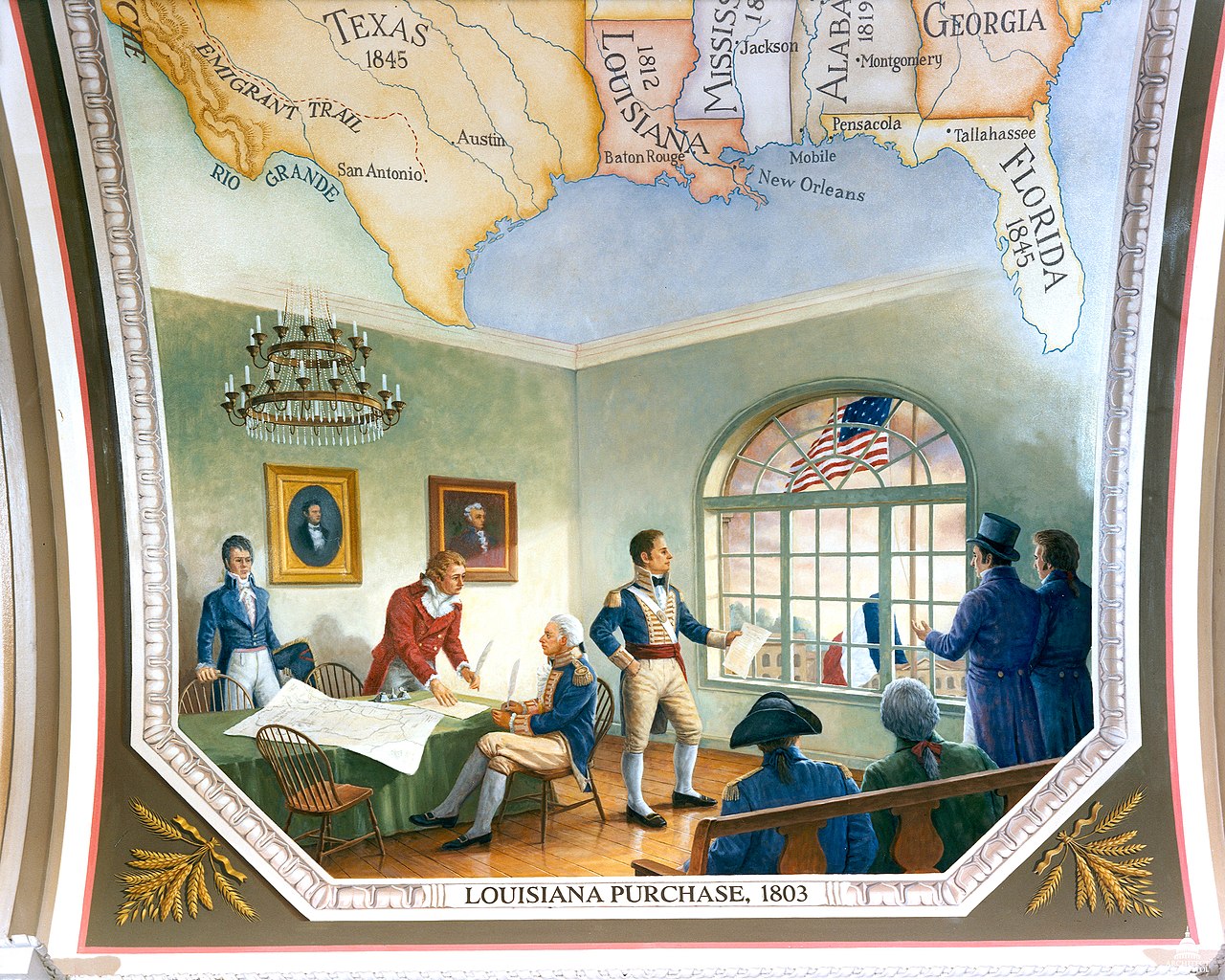
- Louisiana Purchase — The United States concluded an agreement with France to acquire the vast Louisiana territory, a transaction that greatly enlarged American landholdings and altered continental geopolitics.
- Marbury v. Madison — A landmark decision by the U.S. Supreme Court under Chief Justice John Marshall that established the principle that courts may declare laws unconstitutional, a cornerstone of American constitutional law.
- Renewed Anglo–French hostilities — The fragile peace established by the Treaty of Amiens collapsed and Britain and France returned to open war, beginning a long period of naval blockade, maritime conflict, and continental campaigns.
- Haiti and Caribbean upheaval — The struggle for control of French Caribbean possessions continued; the Haitian revolution was nearing its decisive phase and Toussaint Louverture died while imprisoned in France.
- Exploration — Following the territorial acquisition, the United States prepared the Lewis and Clark expedition to explore and map the new lands and their natural resources.
Science, culture and economy
The year also witnessed advances in chemistry and the arts. English chemist William Hyde Wollaston identified a previously unknown metal, palladium, while scientific inquiry into atomic theory and chemical measurement gained momentum. In music and literature, the early Romantic movement continued to develop; notable composers and writers produced work whose influence would grow through the century.
Legacy and significance
Events of 1803 had lasting effects: the Louisiana Purchase set the stage for westward expansion in North America; Marbury v. Madison ensured judicial review as a check on legislative and executive power; and the renewal of the Napoleonic wars reshaped European diplomacy and colonial affairs. Together these developments helped define political boundaries, legal principles, and scientific directions that influenced the 19th century.
Notable facts
While not every development of 1803 can be listed here, the year is often remembered for the intersection of imperial rivalry, nascent American nation-building, and scientific discovery—an intersection that helped make it a turning point in modern history.
Questions and answers
Q: What is the significance of the year 1803?
A: The text simply states the year 1803 without providing further context, so we cannot provide a specific answer.
Q: Can you provide any historical events that occurred in 1803?
A: Yes, some notable events that occurred in 1803 include the Louisiana Purchase by the United States from France, the beginning of the Napoleonic Wars, and the establishment of the British Raj in India.
Q: What was the Louisiana Purchase?
A: The Louisiana Purchase was a deal in which the United States purchased approximately 827,000 square miles of land from France for $15 million, doubling the size of the country at the time.
Q: What were the Napoleonic Wars?
A: The Napoleonic Wars were a series of conflicts fought between France and various European powers from 1803 to 1815, characterized by the expansion and eventual decline of Napoleon Bonaparte's empire.
Q: What was the British Raj?
A: The British Raj was the period of British rule in India from 1858 to 1947 that began with the establishment of the British East India Company and ended with India's independence.
Q: What were some technological advancements or discoveries made in 1803?
A: It is difficult to specify any technological advancements or discoveries made in 1803 without additional context, but the steam engine was a major invention that had debuted a few decades earlier and was being refined at the time.
Q: How did the events of 1803 shape modern history?
A: The events of 1803, particularly the Louisiana Purchase and the Napoleonic Wars, had significant geopolitical and economic impacts that shaped the modern world. The Louisiana Purchase, for example, greatly expanded American territory and set the stage for westward expansion and colonialism. The Napoleonic Wars contributed to the downfall of empires and shifted power dynamics in Europe. The British Raj also had a lasting legacy in India and the wider world.
Related articles
Author
AlegsaOnline.com 1803 Leandro Alegsa
URL: https://en.alegsaonline.com/art/111752