
16-cell (hexadecachoron)
A regular four-dimensional convex polytope with 16 tetrahedral cells; dual to the tesseract and a member of the six regular convex 4-polytopes.
The 16-cell, also called the hexadecachoron, is a regular convex polytope that exists in four-dimensional space. It belongs to the family of cross-polytopes and is one of the six regular convex 4-polytopes first classified in the 19th century. Its regularity means all cells, faces, edges and vertex figures are congruent and arranged with full symmetry.
Image gallery
10 Images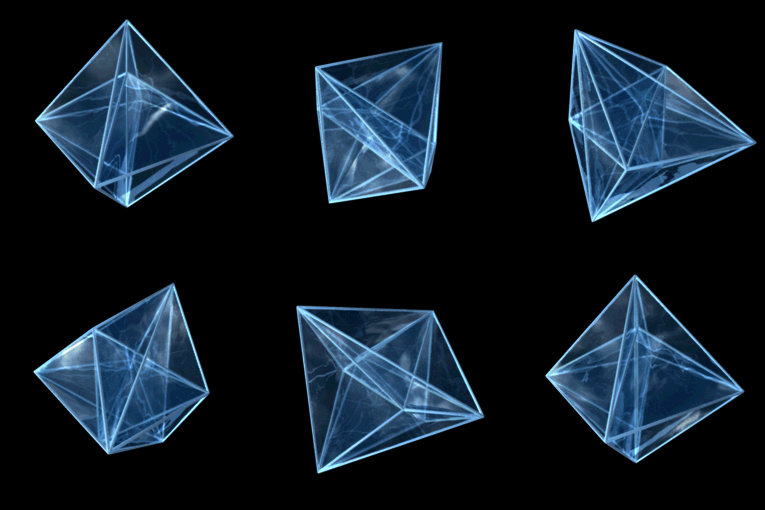


Basic description and structure
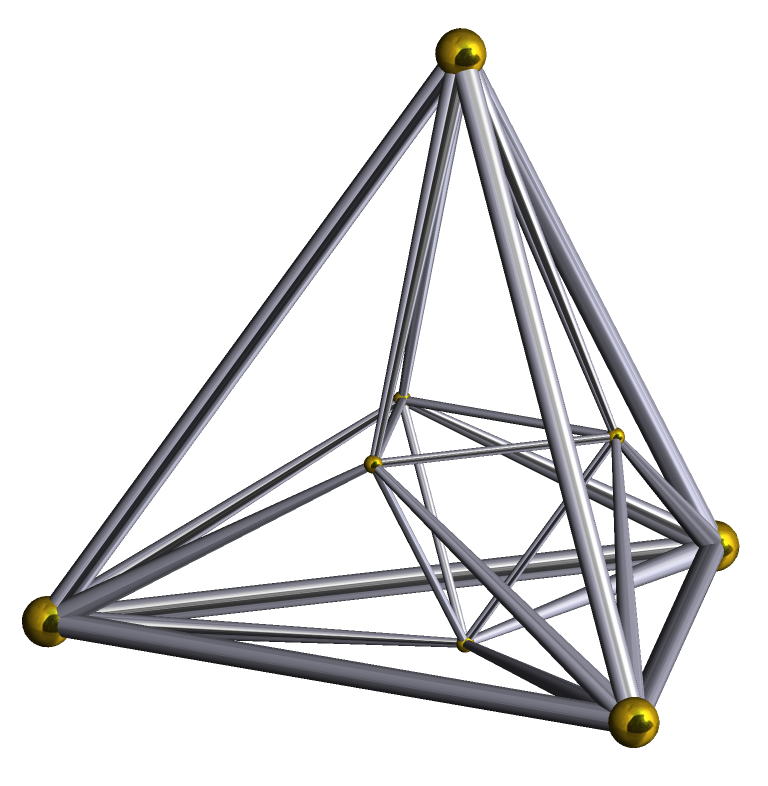
Topologically the 16-cell has 16 tetrahedral cells, 32 triangular faces, 24 edges and 8 vertices. Its Schläfli symbol is {3,3,4}, which encodes the way triangles, tetrahedra and four-dimensional arrangement meet. The vertex figure at each vertex is a regular octahedron, reflecting how six edges and eight triangular faces meet around a single vertex.
Coordinates and symmetry
A simple Cartesian model places the 8 vertices at the coordinate permutations of (±1,0,0,0) in four-dimensional Euclidean space. The 16-cell is the 4D cross-polytope: the convex hull of the unit coordinate axes. It is the dual polytope of the tesseract (8-cell), so vertices of one correspond to cells of the other. The 16-cell has a high degree of symmetry, belonging to the same symmetry family discussed in texts on four-dimensional geometry and polytopes.
History and terminology
The regular 4-polytopes were studied systematically by Ludwig Schläfli in the 1800s. Later writers and geometers adopted various names: John Conway and others describe this shape as an orthoplex, a member of the cross-polytope class; Conway's nomenclature and broader discussion of higher-dimensional regular figures appear in contemporary expositions on polytope families (Conway).
Uses, visualization and related concepts
Although four-dimensional objects cannot be observed directly, the 16-cell is useful as a conceptual and combinatorial model. It appears in studies of symmetry, topology, and tilings in higher dimensions, and provides simple examples for projections and stereographic maps from 4D to 3D or 2D. Common visualization techniques include orthographic and perspective projections that reveal arrangements of cells and the dual relationship with the tesseract.
Notable facts
- It is one of the six regular convex 4-polytopes (the 4D analogues of Platonic solids).
- Cells are regular tetrahedra; the 16-cell can be constructed by joining the centers of the cubic cells of a tesseract.
- Its vertex set can be written compactly as all 4D unit coordinate vectors with one nonzero ±1 coordinate.
The 16-cell remains a central example in four-dimensional geometry because of its simplicity, symmetry and clear dual relationship with the tesseract. For introductory treatments and further diagrams, see standard references on polytopes and four-dimensional geometry (4D geometry overview, polytope introductions, Conway's nomenclature).
Questions and answers
Q: What is a 16-cell?
A: A 16-cell is a regular convex polychoron, or polytope existing in four dimensions.
Q: Who first described the 16-cell?
A: The Swiss mathematician Ludwig Schläfli first described the 16-cell in the mid-19th century.
Q: What is another name for the 16-cell?
A: The 16-cell is also known as the hexadecachoron.
Q: How many regular convex polychora were first described by Ludwig Schläfli?
A: Ludwig Schläfli first described six regular convex polychora, including the 16-cell.
Q: What does Conway call the 16-cell?
A: Conway calls the 16-cell an orthoplex for orthant complex, as well as the entire class of cross-polytopes.
Q: How many dimensions exist in which the 16-cell can exist?
A: The 16-cell can exist in four dimensions.
Q: What is the shape of the 16-cell?
A: The 16-cell is a regular convex polychoron, which means it has a well-defined, symmetric shape with flat faces and straight edges.
Related articles
Author
AlegsaOnline.com 16-cell (hexadecachoron) Leandro Alegsa
URL: https://en.alegsaonline.com/art/111532