
1430 (year and number)
Overview of 1430 as a calendar year and as an integer: historical context, notable events, mathematical properties (including its identity as the 8th Catalan number), and cultural significance.
1430 refers both to a specific year in the 15th century and to the integer 1430. As a year it sits in the late Middle Ages, a period of political conflict and cultural transition across Europe and the Near East. As a number it has several elementary arithmetic and combinatorial properties that give it mathematical interest.
Image gallery
2 Images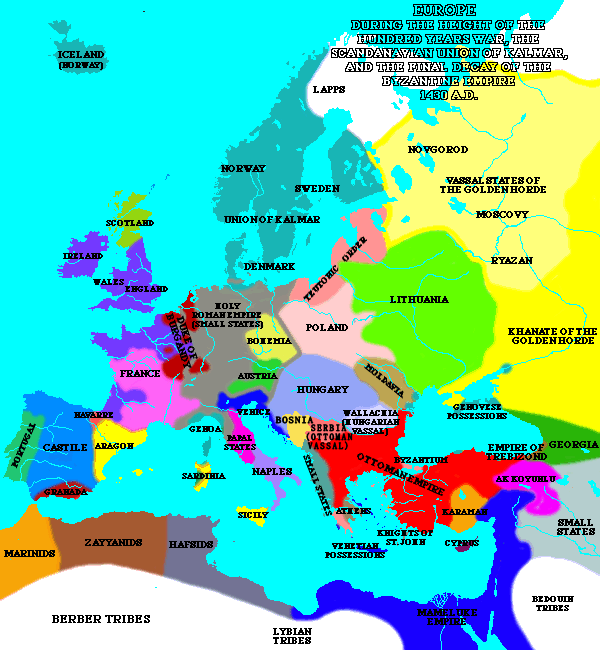

1430 as a year (AD 1430)
The year 1430 falls during the long struggle of the Hundred Years' War between England and France and the wider reshaping of European politics. One of the best-known occurrences around this date is the capture of Joan of Arc at Compiègne in 1430, an event that led to her trial and execution the following year. Across Italy and the Low Countries, early Renaissance artistic and intellectual currents were gaining strength, while in Eastern Europe and the Balkans the Ottoman state continued to extend its influence.
Cultural and technological context
1430 predates the widespread use of movable type in Europe by a decade or more; Johannes Gutenberg's printing experiments would come into public view in the 1440s. Art, architecture, and scholarship in this period show a mix of late medieval and nascent Renaissance styles. City-states, feudal kingdoms and religious institutions remained central actors in political and social life.
Mathematical characteristics of the number 1430
- Factorization: 1430 = 2 × 5 × 11 × 13. It is a composite, even, and divisible by 5.
- Representation: In Roman numerals it is written MCDXXX. In binary it is 10110010110.
- Catalan number: 1430 is the 8th Catalan number (C8). Catalan numbers enumerate many combinatorial structures, for example: the number of correct ways to parenthesize nine factors, the number of full binary trees with nine leaves, and the number of monotonic lattice paths along the edges of a grid that do not cross a diagonal, for a fixed size.
Uses and significance
As a calendar year, 1430 is used to situate events and biographies in the chronology of late medieval Europe. As an integer, 1430 appears naturally in enumerative combinatorics (because of its Catalan identity) and in elementary number-theory exercises illustrating factorization, divisibility rules and representations in different numeral systems.
Notable distinctions
1430 sits at an intersection of medieval and early modern history: it is late enough that Renaissance developments are visible, yet early enough that printing and other hallmark early modern technologies have not yet transformed information circulation. Mathematically, its role as a Catalan number gives it a recurring presence in combinatorial counting problems, making it more than an arbitrary four-digit integer.
Questions and answers
Q: What is the significance of the year 1430?
A: The given text only states the number 1430 and does not provide any additional information to indicate its significance.
Q: Is 1430 a prime number?
A: No, 1430 is not a prime number as it can be factored into the product of two smaller integers - 2 and 715.
Q: What is the Roman numeral representation of 1430?
A: The Roman numeral representation of 1430 is MCDXXX.
Q: What is the sum of the digits in 1430?
A: The sum of the digits in 1430 is 8 (1+4+3+0).
Q: Is 1430 divisible by 6?
A: No, 1430 is not divisible by 6 as it is not an even number and does not have a digit sum that is divisible by 3.
Q: What is the binary representation of 1430?
A: The binary representation of 1430 is 10110001110.
Q: What historical events occurred in or around the year 1430?
A: Some historical events that occurred around the year 1430 include the beginning of the Hussite wars in Bohemia, the start of the reign of King Henry VI of England, and the completion of the Lamia Bazaar mosque in Turkey.
Related articles
Author
AlegsaOnline.com 1430 (year and number) Leandro Alegsa
URL: https://en.alegsaonline.com/art/111348