
1266
Overview of 1266 as a year in the Common Era and as an integer: major events in medieval Europe, numeric properties, historical significance, and notable outcomes of that year.
1266 denotes both a specific year in the 13th century and an integer with simple arithmetic properties. As a calendar year it belongs to the later High Middle Ages, a period of political realignment in western and northern Europe. As a number it is even and composite, with a straightforward factorization and a conventional Roman-numeral form.
Image gallery
1 Image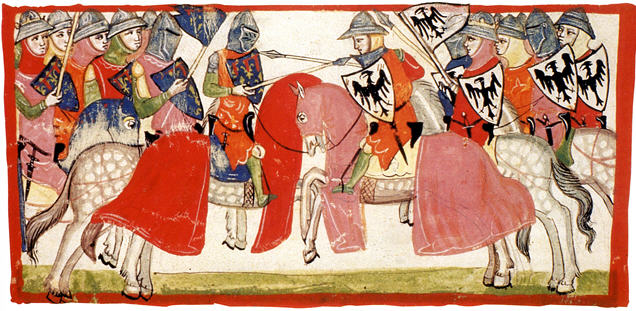
Numeric characteristics
As an integer, 1266 is even and composite. Its prime factorization is 2 × 3 × 211, so its positive divisors are 1, 2, 3, 6, 211, 422, 633 and 1266. In Roman numerals it is written MCCLXVI.
Political and military events
The year 1266 is best known for major political shifts in medieval Europe. In southern Italy a decisive conflict ended the rule of the Hohenstaufen branch in Sicily and southern Italy and established Angevin influence. In England the long aftermath of the Second Barons' War continued to be settled by royal negotiations and legal instruments that restored royal authority while offering terms to former rebels. In the British Isles and northern seas, diplomatic agreements altered sovereignty over island territories between Scotland and Norway, reshaping control of the Hebrides and the Isle of Man.
Context and consequences
These events contributed to several longer trends of the century: the consolidation of royal power in western Europe, the expansion of French Angevin influence into Mediterranean politics, and the gradual absorption of Atlantic island groups into emerging nation-states. Local settlements and royal decrees from this period influenced land tenure, noble obligations and the settlement of rebellion for decades afterward.
Notable figures and outcomes
- Rulers and military leaders who figured in the year included members of the Angevin dynasty and the displaced Hohenstaufen family in southern Italy.
- In the British Isles, the Scottish crown extended its effective control over western island groups previously under Norwegian sway, changing maritime politics in the North Atlantic.
- In England, negotiated settlements reduced open warfare and set precedents for how the crown would reconcile with insurgent nobles.
While 1266 was one single point on a longer medieval timeline, the political rearrangements made that year had a lasting effect on territorial control in western Europe and on the balance between central monarchies and regional powers.
Questions and answers
Q: What is the significance of the number 1266?
A: The text does not provide any additional information on the significance of the number 1266.
Q: Could 1266 be a year?
A: It is possible that 1266 refers to a historical year, but the text does not clarify this.
Q: Is 1266 a prime number?
A: 1266 is not a prime number, as it can be divided by 2, 3, 6, 211, 422, and 633.
Q: What is the sum of the digits in 1266?
A: The sum of the digits in 1266 is 1+2+6+6 = 15.
Q: In what part of the world is 1266 considered lucky?
A: The text does not provide any information on where 1266 is considered lucky.
Q: Can 1266 be written in Roman numerals?
A: Yes, 1266 can be written in Roman numerals as MCCLXVI.
Q: Is there any famous event that happened in 1266?
A: There are several historical events that occurred in 1266, including the establishment of the University of Montpellier in France and the coronation of Conradin as King of Sicily. However, the text does not specify any particular event.
Related articles
Author
AlegsaOnline.com 1266 Leandro Alegsa
URL: https://en.alegsaonline.com/art/111188