
1240 (year)
Year 1240 (Julian calendar leap year) in the 13th century; notable for Mongol campaigns in Eastern Europe and Alexander Nevsky's victory at the Neva, within the broader medieval political and cultural context.
1240 was a leap year of the Julian calendar and falls in the middle of the 13th century, a period marked by the expansion of empires, active crusading movements, and significant political change in Europe and Eurasia. The year is particularly notable for events in Eastern Europe, where Mongol pressure and regional responses reshaped states and alliances.
Image gallery
1 Image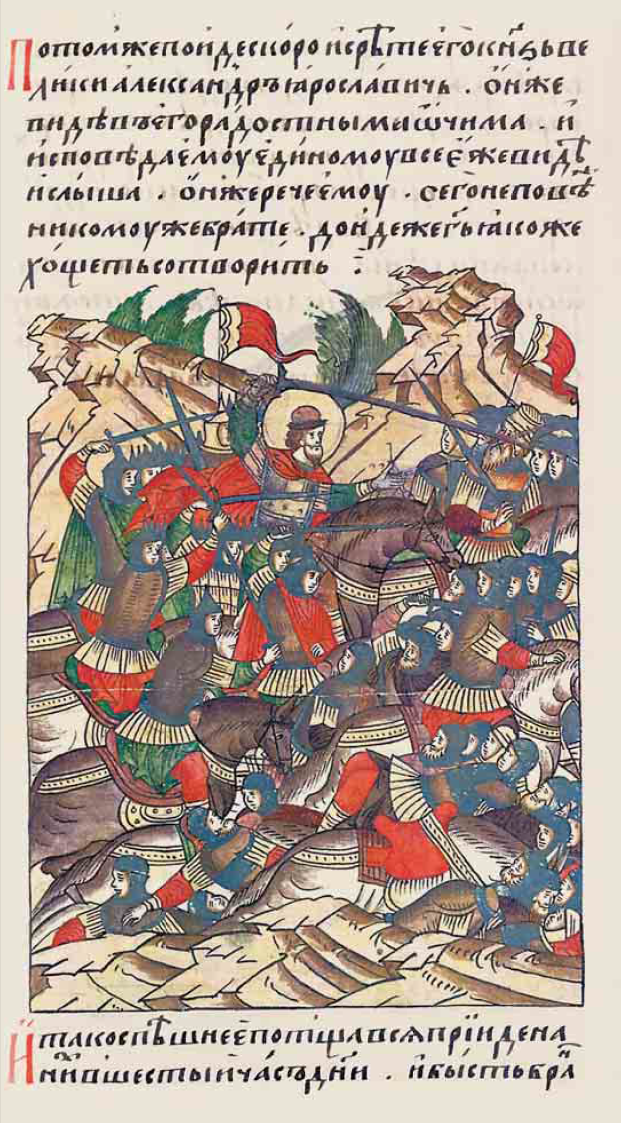
Political and military highlights
One of the most consequential developments around 1240 was the advance of Mongol forces into the principalities of Kievan Rus'. Mongol commanders under Batu Khan and his lieutenants pressed westward, culminating in the siege and capture of Kyiv (Kiev) in late 1240. The sack of Kyiv accelerated the decline of the Kievan Rus' federation and helped bring many East Slavic principalities under the influence or direct control of what would become the Golden Horde.
In the same year northern Russia saw the rise of local military leadership. The Battle of the Neva, fought in 1240, brought fame to Prince Alexander of Novgorod (later called Alexander Nevsky) after he repulsed a Swedish naval expedition. That victory enhanced Novgorod's security and Alexander's reputation as a defender against western incursions.
Cultural and broader context
Across Western and Central Europe, 1240 sat within an era of growing towns, cathedral building in the Gothic style, and the intellectual activity of scholasticism. The crusading movement and rivalries between secular rulers and the papacy continued to shape diplomacy and warfare. Maritime trade and urban charters were expanding, linking regional economies more closely than in earlier centuries.
Consequences and significance
- The Mongol capture of Kyiv marked a turning point for East Slavic political structures and opened the region to prolonged Mongol influence.
- Alexander Nevsky’s victory at the Neva contributed to his later standing as a principal regional leader and symbol of resistance to incursions from the north and west.
- 1240 illustrates larger 13th-century trends: the mobility of steppe armies, the fracturing and reorganization of medieval polities, and the cultural growth of European urban centers.
While not every corner of the medieval world saw major recorded events in 1240, the developments that did occur had lasting effects on the political map of Eastern Europe and on the careers of figures who became important in subsequent decades.
Questions and answers
Q: What is the significance of the year 1240?
A: The significance of the year 1240 is that it was a leap year.
Q: What is a leap year?
A: A leap year is a year that has 366 days instead of the usual 365 days.
Q: Why do we have leap years?
A: We have leap years to keep our calendar year synchronized with the astronomical year, which is approximately 365.24 days long.
Q: How often do we have leap years?
A: We have a leap year every 4 years, with exceptions for years that are evenly divisible by 100 but not by 400.
Q: When was the last leap year?
A: The last leap year was 2020.
Q: When will the next leap year occur?
A: The next leap year will occur in 2024.
Q: How many days longer is a leap year than a regular year?
A: A leap year is one day longer than a regular year. It has 366 days instead of 365 days.
Related articles
Author
AlegsaOnline.com 1240 (year) Leandro Alegsa
URL: https://en.alegsaonline.com/art/111164