
ZIP code (U.S. postal code system)
The ZIP code is the United States Postal Service system of numeric postal codes (five-digit and ZIP+4) used to speed, sort, and route mail and to group geographic and administrative areas.
Overview
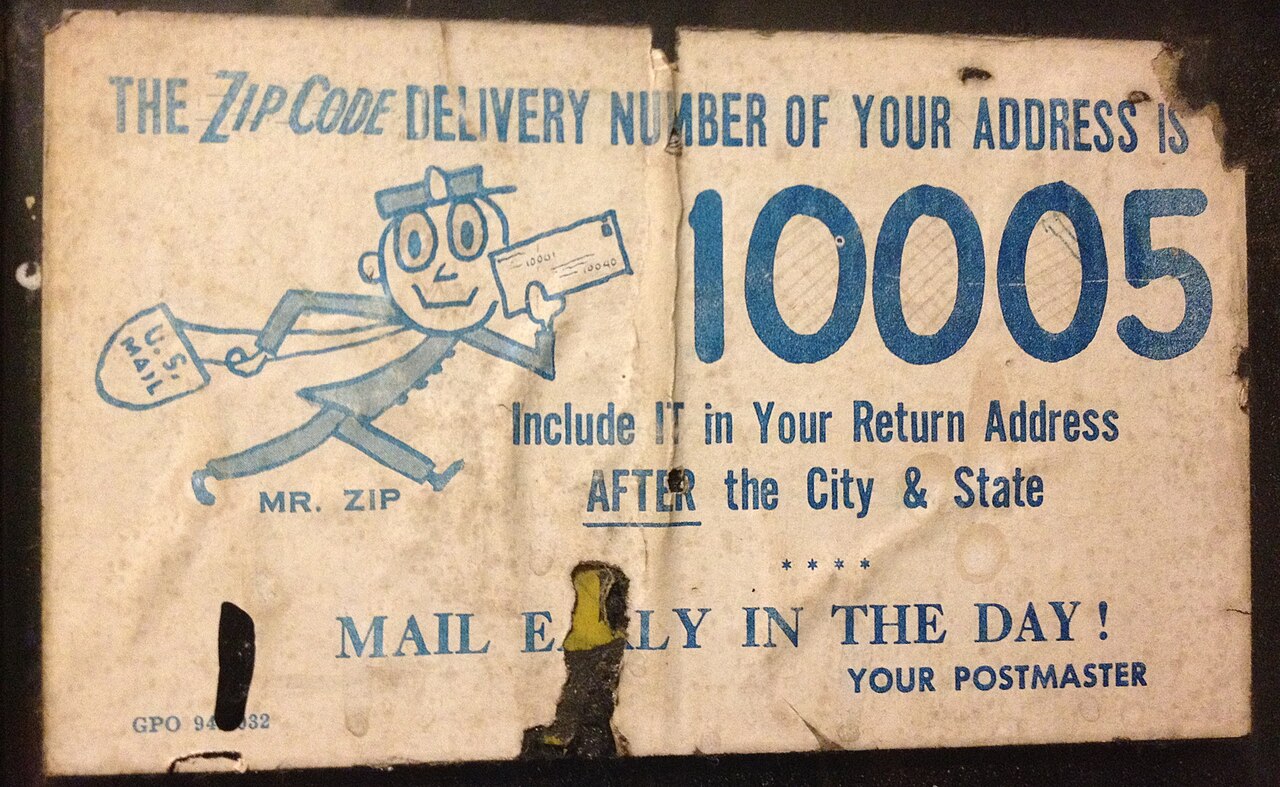
The ZIP code is the system of postal codes used by the United States Postal Service to organize and route mail. ZIP stands for Zone Improvement Plan, a name chosen to convey faster, more efficient delivery. The basic form of the code consists of five digits (the five-number ZIP), and an extended form known as ZIP+4 adds four additional digits after a hyphen to identify a more precise delivery segment of an address.
Image gallery
5 Images


Structure and characteristics
In practice the five-digit ZIP is arranged so that the first digit represents a broad geographic area of the United States, the next two digits generally denote a regional or sectional center, and the final two digits narrow the destination to a delivery area, city, or town. The optional ZIP+4 extension permits more specific sorting — for example, a single city block, a group of apartments, or a specific high-volume receiver within a building.
History and development
The Postal Service introduced ZIP codes to improve the speed and accuracy of mail processing and to support increasing automation of sorting equipment. Over time the system has been refined and remains the foundational addressing scheme for domestic mail in the U.S. Although the term "ZIP Code" was once registered as a trademark by the Postal Service, its registration has lapsed and the designation is now a commonly used generic term.
Uses and practical importance
Beyond routing letters and packages, ZIP codes are widely used for nonpostal purposes: demographic analysis, market research, routing deliveries for e-commerce, emergency planning, assigning tax or insurance zones, and driving location-based services. Because ZIP codes were created for mail routing rather than to match political boundaries, they often cross city, county, and even state lines; entities using them for analysis should be aware of this limitation.
Examples, variations, and special cases
- Standard: 12345 — the five-digit ZIP used on most addresses.
- ZIP+4: 12345-6789 — the five-digit ZIP followed by four digits identifying a precise segment for more efficient processing.
- P.O. Boxes and military mail use dedicated ZIP ranges to direct deliveries to postal facilities or overseas processing centers.
- Some large organizations or high-volume recipients receive unique ZIP+4 assignments to speed internal handling.
When people refer to postal zones or coding systems more broadly, they sometimes use the generic term postal codes. The ZIP system remains central to American mail operations and also functions as a practical geographic shorthand in many commercial and administrative systems. For discussion of mailing procedures and addressing standards see guidance on addressing and mail handling; for technical or historical details consult official Postal Service resources (USPS) or topical references on the structure and evolution of ZIP coding (five-number, hyphen, trademark notes).
Questions and answers
Q: What is a ZIP code?
A: A ZIP code is a system of postal codes used by the United States Postal Service (USPS).
Q: What does the term 'ZIP' stand for?
A: The term 'ZIP' is an acronym for Zone Improvement Plan.
Q: Why was the word 'ZIP' chosen for the postal code system?
A: The word 'ZIP' was chosen to suggest that the mail travels more efficiently and quickly when senders use it.
Q: How should the letters in ZIP code be written?
A: The letters in ZIP code should be written properly in capital letters.
Q: How many numbers does the basic ZIP code consist of?
A: The basic ZIP code consists of five numbers.
Q: What does an extended ZIP + 4 code include?
A: An extended ZIP + 4 code includes the five digits of the ZIP code, a hyphen, and then four more digits.
Q: Was ZIP Code a trademark of the U.S. Postal Service?
A: Yes, ZIP Code was a trademark of the U.S. Postal Service, but its registration has since ended.
Related articles
Author
AlegsaOnline.com ZIP code (U.S. postal code system) Leandro Alegsa
URL: https://en.alegsaonline.com/art/110644
Sources
- glossary.ippaper.com : "ZIP Code,"
- tarr.uspto.gov : Trademark status information