
Zeno's paradoxes
Ancient philosophical puzzles by Zeno of Elea challenging the coherence of motion, plurality, space and time; influential in philosophy, mathematics and physics and foundational for concepts of limit and continuity.
Overview: Zeno's paradoxes are a collection of argumentative puzzles attributed to Zeno of Elea that date to the mid‑5th century BC. They were devised to defend the metaphysical views of Parmenides and to show apparent contradictions in common-sense assumptions about motion, plurality, space and time. Their force lies not in empirical claims but in logical structure: each paradox invites reflection about how an infinite number of parts or moments can relate to a single event.
Image gallery
4 Images

Main paradoxes and examples
Several of Zeno's puzzles are well known through later reports; traditionally nine are attributed to him. The most famous include:
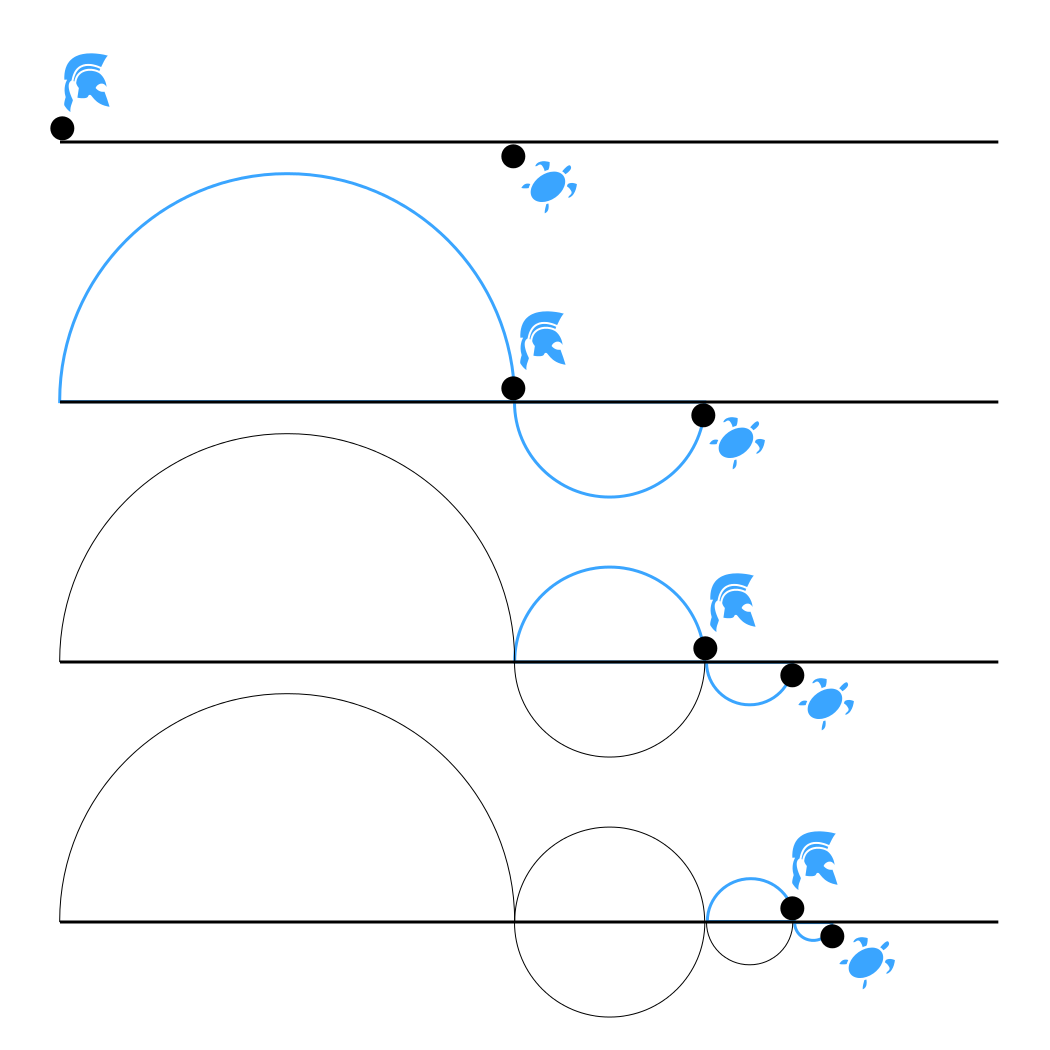
- Achilles and the Tortoise: a fast runner gives a slow tortoise a head start; by the time Achilles reaches the tortoise's previous position, the tortoise has moved forward, and so on, suggesting Achilles never overtakes the tortoise.
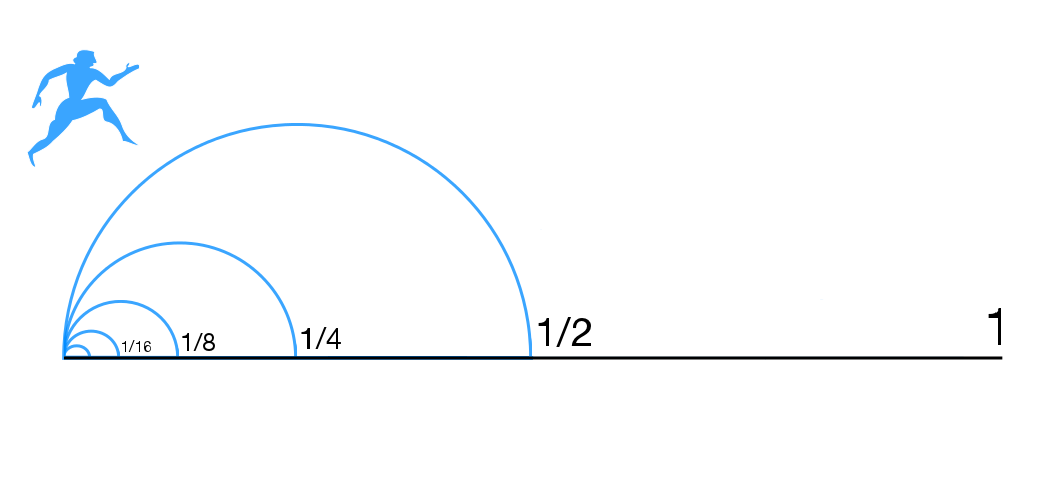
- The Dichotomy (or the Racecourse): before traversing a distance one must first reach its halfway point, and before that a quarter, ad infinitum, implying motion cannot begin because it requires completing infinitely many tasks.
- The Arrow: at any single instant a flying arrow occupies a space equal to itself and so appears motionless; if every instant is motionless, motion is impossible.
- The Stadium: paradoxes about relative motion and the counting of instants when rows of moving objects pass one another.
Philosophical and mathematical responses
Over centuries, thinkers from different traditions—classical atomists, medieval philosophers, modern mathematicians and physicists—have offered diverse replies. Two broad strategies are common: (1) reject a premise (for example, the permissibility of actual infinities or the assumption that instants are complete snapshots), or (2) assimilate the paradox to a mathematical theory that handles infinite processes. The development of calculus and the formal notion of limits showed how an infinite sequence of diminishing distances can sum to a finite value, resolving the numerical tension in Achilles and the Dichotomy while leaving deeper metaphysical questions open.
Historical context and influence
Zeno composed his arguments to support Parmenides' claim that reality is unchanging and that apparent plurality and motion are illusory. The paradoxes became central teaching tools: they stimulated analysis of continuity, discreteness, infinitesimals, and measure. Debates sparked by Zeno contributed, indirectly, to the eventual invention of rigorous methods for infinite series, real analysis, and measure theory.
Importance and modern significance
Today Zeno's paradoxes are studied both as historical artifacts and as living philosophical problems. They highlight the distinction between mathematical resolution and philosophical explanation: a convergent series explains how infinitely many steps yield a finite result, but philosophers still ask what that means for the ontology of time and space. In physics, questions about the structure of spacetime at very small scales (for example in quantum gravity) echo Zeno's concerns about continuity.
For introductions and further reading see general treatments of Zeno's paradoxes, biographical sketches of Zeno, surveys aimed at mathematicians and physicists, and historical studies of Parmenides. These resources help trace how a set of concise ancient arguments shaped centuries of thought about infinity, motion and the foundations of mathematics.
Questions and answers
Q: Who created Zeno's paradoxes and when?
A: Zeno of Elea created Zeno's paradoxes in the mid-5th century BC.
Q: Which fields of study have debated Zeno's paradoxes?
A: Philosophers, physicists, and mathematicians have debated Zeno's paradoxes.
Q: Why did Zeno create these paradoxes?
A: Zeno created these paradoxes to answer those who thought that Parmenides's idea that "all is one and unchanging" was absurd.
Q: How many paradoxes have been attributed to Zeno?
A: Nine paradoxes have been attributed to Zeno.
Q: What do Zeno's paradoxes deal with?
A: Zeno's paradoxes deal with problems of the apparently continuous nature of space and time.
Q: Which of Zeno's paradoxes are the most famous?
A: Three of Zeno's paradoxes are the most famous.
Q: Can Zeno's paradoxes be easily solved?
A: No, Zeno's paradoxes have been debated for 25 centuries and do not have easy solutions.
Tags
Related articles
Author
AlegsaOnline.com Zeno's paradoxes Leandro Alegsa
URL: https://en.alegsaonline.com/art/110511
Sources
- mathforum.org : "Math Forum"
- plato.stanford.edu : "Zeno's Paradoxes: 3.2 Achilles and the Tortoise"
- books.google.com : The history of the calculus and its conceptual development