
Yellow Sky (1948 film)
Yellow Sky (1948) is a black-and-white American Western directed by William A. Wellman, starring Gregory Peck, Anne Baxter and Richard Widmark. It is loosely inspired by Shakespeare's The Tempest.
Overview
Yellow Sky is a 1948 American Western film directed by William A. Wellman and released by 20th Century Fox. The picture is shot in black and white and is often noted for its stark desert imagery, tense atmosphere and the strong performances of its principal cast. The screenplay adapts elements of a classical source, reshaping them into a frontier drama.
Image gallery
1 Image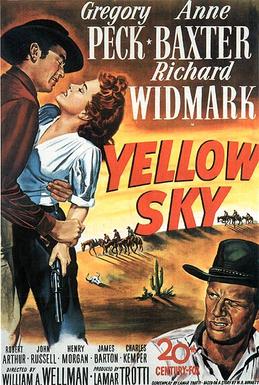
Story and themes
The plot follows a group of outlaws who stumble into an abandoned mining settlement where an elderly prospector and a young woman live in isolation. The discovery of a hidden hoard of gold brings conflicts of loyalty, power and survival to the fore. The film explores themes of greed, authority, and the uneasy encounter between civilized restraint and outlaw lawlessness. Many critics have observed clear parallels with the dynamics in William Shakespeare's The Tempest, particularly the motifs of exile, guardianship and the arrival of disruptive outsiders; the film is therefore often described as a loose, Western-flavored adaptation of that play. Shakespeare's play provides the tonal and structural touchstones rather than a scene-by-scene retelling.
Cast and production
The movie features leading performances by Gregory Peck, Anne Baxter and Richard Widmark, supported by a small ensemble. William A. Wellman, an accomplished director of the era, emphasized location-style photography and strong character interaction over wide-scale spectacle, giving the film a tense, intimate feel despite the open desert setting. The studio release and star billing helped the picture reach a broad audience at the time.
Reception and legacy
Upon release, Yellow Sky received favorable notice for its mood, the moral complexity of its characters and memorable sequences that highlight psychological confrontation rather than purely action-driven spectacle. Over time it has been recognized as a distinctive entry in the postwar Western, one that mixes classical inspiration with genre conventions. Film historians and enthusiasts cite its influence on later Westerns that emphasize atmosphere and moral ambiguity.
Remake and adaptations
The story's core premise proved durable: it was remade in 1967 as The Jackals, a reworking that transposes the basic situation into a different setting and era while retaining the tension between outsiders and the solitary inhabitants of an isolated locale. The original film remains the better-known version and continues to be discussed in studies of literary influences on American cinema.
Notable facts
- Yellow Sky blends classical literary inspiration with the visual and moral vocabulary of the Western.
- Its economical cast and compact storytelling are often praised for concentrating dramatic intensity.
- Performances by the principal actors are commonly singled out in retrospectives and film guides.
Questions and answers
Q: Who directed the American western movie Yellow Sky?
A: William A. Wellman directed the American western movie Yellow Sky.
Q: What is Yellow Sky based on?
A: Yellow Sky is based on William Shakespeare's The Tempest.
Q: When was Yellow Sky released?
A: Yellow Sky was released in 1948.
Q: Who starred in Yellow Sky?
A: Gregory Peck, Anne Baxter, Robert Arthur, Richard Widmark, and Charles Kemper starred in Yellow Sky.
Q: What company distributed Yellow Sky?
A: 20th Century Fox distributed Yellow Sky.
Q: Was Yellow Sky ever remade?
A: Yes, Yellow Sky was remade in 1967 as The Jackals.
Q: What was the name of the movie that remade Yellow Sky?
A: The name of the movie that remade Yellow Sky was The Jackals.
Related articles
Author
AlegsaOnline.com Yellow Sky (1948 film) Leandro Alegsa
URL: https://en.alegsaonline.com/art/109773