
Yaws — a contagious tropical infection caused by Treponema pallidum pertenue
Yaws is a bacterial skin and bone infection of children in tropical regions. It causes ulcers, bone pain and chronic deformity but is treatable and a target of elimination campaigns.
Overview
Yaws is an infectious disease that primarily affects the skin, bones and joints. It is caused by the spirochete bacterium Treponema pallidum pertenue, a close relative of the organism that causes syphilis. The disease is non-sexually transmitted and occurs mainly among children living in poor, rural tropical communities. Yaws typically begins with a local skin lesion and—if untreated—can progress to widespread painful skin and bone lesions and long-term deformity.
Image gallery
10 Images


Causes and transmission
The causative organism is a strain of the treponeme family. Transmission requires direct contact with infectious material from an open lesion; contamination of broken skin during play is the usual route. Yaws is not transmitted by insects or animals in normal conditions and humans are considered the only reservoir. Public-health descriptions often emphasise person-to-person spread in childhood settings such as schools and villages.
Clinical features and stages
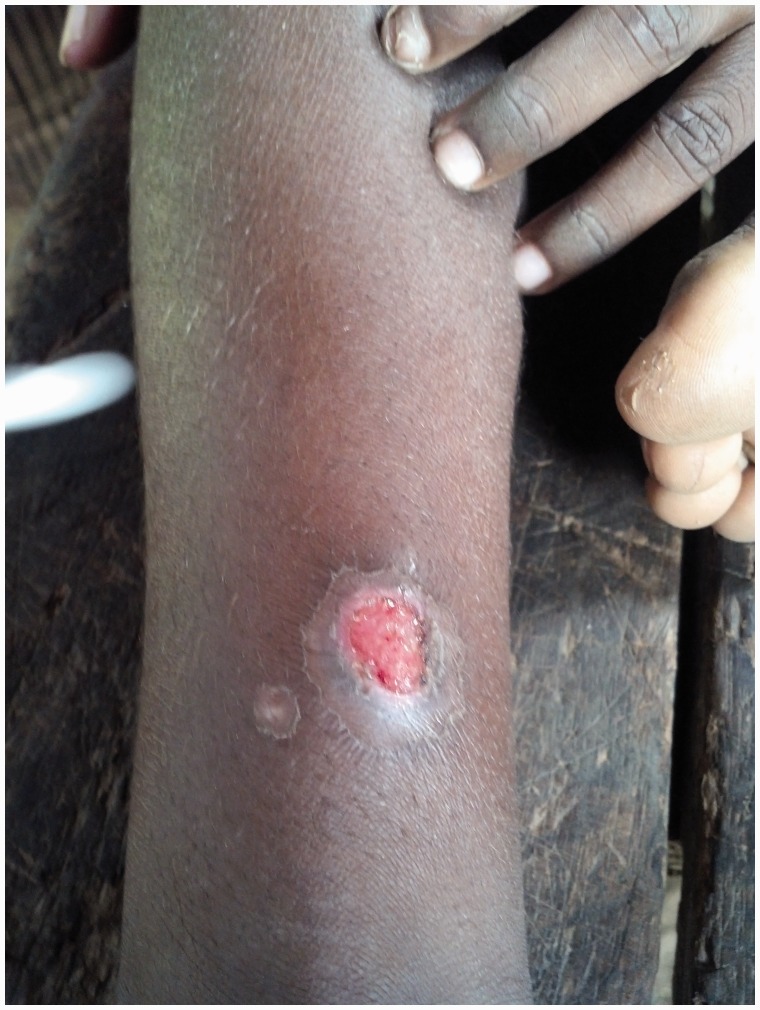
Yaws develops in stages. A typical initial lesion is a single firm papule that enlarges and may break down into a painless or mildly painful ulcer. This primary lesion often heals spontaneously over weeks to months. After a variable interval new skin lesions, bone pain and periostitis can appear. Chronic untreated infection may lead to destructive lesions of skin and bone, producing scarring and deformity—classically of the nose and long bones—and thickened palms and soles.
- Primary stage: papule or ulcer at the infection site.
- Secondary stage: multiple skin sores, sometimes fever, bone pain and lymph node enlargement.
- Tertiary (late) stage: chronic destructive lesions with scarring and disfigurement in a minority of patients.
Diagnosis
Diagnosis is largely clinical in endemic settings because the appearance of characteristic lesions in children is often distinctive. Standard treponemal and non-treponemal serological tests (for example rapid plasma reagin-type or treponemal-specific assays) can support the diagnosis but cannot reliably distinguish yaws from syphilis because they detect antibodies to related treponemes. Direct detection methods such as dark-field microscopy or molecular tests provide more specific confirmation; polymerase chain reaction (PCR) on lesion material is the most accurate laboratory method when available.
Treatment and prevention
Yaws is readily curable with antibiotics. Intramuscular benzathine penicillin has been the traditional first-line therapy; in more recent years a single oral dose of azithromycin has been shown to be highly effective and has been used in mass treatment campaigns because it is easier to deliver. Emerging reports of macrolide (azithromycin) resistance have led to continued monitoring in areas using azithromycin-based programs.
Control measures focus on treating active cases, tracing and treating contacts, and where appropriate using mass drug administration to entire communities to interrupt transmission. Improved hygiene, wound care and health education reduce spread by limiting skin-to-skin transmission and encouraging early treatment.
Epidemiology and public-health efforts
Yaws is found in warm, humid tropical regions of Africa, Asia, the Pacific and parts of South America. Global prevalence dropped dramatically following mid-20th-century campaigns that used mass penicillin treatment; however, pockets of endemic disease persisted and reports increased again in some areas. The World Health Organization has promoted renewed elimination strategies based on single-dose azithromycin and active surveillance. Because humans are the only known reservoir, yaws is considered a candidate for eradication if sustained high-coverage treatment and monitoring are achieved.
History and related conditions
Yaws has been recognized for centuries. Early clinical descriptions date back to the 17th century and paleopathological studies suggest treponemal diseases resembling yaws affected ancient populations. Yaws belongs to a group of endemic treponematoses: other related conditions include endemic syphilis (bejel) and pinta, which are caused by closely related treponemes but differ in geography, clinical features and transmission. Differential diagnosis must also consider tropical ulcers of other causes.
Practical considerations and notable facts
- Because serological tests cross-react with syphilis, clinical context and age are important for interpretation; PCR can provide species-level identification where needed (PCR).
- Treatment of a single patient not only benefits that person but also reduces risk to the community by removing a source of infection.
- Mass treatment campaigns have used different antibiotics and delivery approaches; program choice depends on resources, resistance patterns and local epidemiology.
For concise, practical guides and public-health recommendations, national and international disease-control agencies provide updated protocols and field guidance. Further technical information and historic overviews are available from public-health references and specialist reviews (WHO, general tropical disease resources). Additional reading covers clinical images and case reports (skin manifestations), bone involvement (orthopaedic aspects), bacteriology (spirochete biology, T. pallidum taxonomy), ulcer care (wound management) and the social impact of chronic disease (fatigue and disability). Materials on prevention include hygiene and community strategies (hand and foot care), scar management (long-term scarring), and infection control related to lesion fluid (infectious exudate). For context comparing related treponemal illnesses see resources about syphilis and diagnostic methods such as PCR. Historical and global program details can be found through archived and current global-health documentation (WHO archives).
Questions and answers
Q: What is Yaws?
A: Yaws is a tropical infection of the skin, bones and joints caused by the spirochaete bacterium Treponema pallidum pertenue.
Q: How does it spread?
A: Yaws is spread by touching the fluid from the sores of a person with the disease. It is most commonly spread among children who play together.
Q: What are some symptoms of Yaws?
A: Symptoms include a round, hard swelling of the skin two to five centimeters in diameter that may break open and form an ulcer; painful joints and bones; fatigue; new skin sores; thickening and breaking open of palms and soles; changes in shape of bones (especially nose); large areas of dead skin leaving scars after five years or more.
Q: How can doctors diagnose Yaws?
A: Doctors are able to tell if it is yaws once lesions have appeared, but polymerase chain reaction (PCR) testing is the best method for diagnosis.
Q: How can we stop it spreading?
A: The main way to stop it spreading is by curing those who have it, which stops them passing it on to others. Where the disease is common, treating entire communities has been effective as well as improving cleanliness and sanitation.
Q: Is there any treatment for Yaws?
A: Yes, antibiotics can be used to treat yaws. Without treatment physical deformities occur in 10% of cases.
Q: When was one of first descriptions made about this disease?
A: One of the first descriptions was made in 1679 by Willem Piso.
Related articles
Author
AlegsaOnline.com Yaws — a contagious tropical infection caused by Treponema pallidum pertenue Leandro Alegsa
URL: https://en.alegsaonline.com/art/109707
Sources
- worldcat.org : 62736861
- cid.oxfordjournals.org : "New treatment schemes for yaws: the path toward eradication"
- doi.org : 10.1093/cid/cis444
- pubmed.ncbi.nlm.nih.gov : 22610931
- doi.org : 10.1016/S0140-6736(12)62130-8
- pubmed.ncbi.nlm.nih.gov : 23415015
- who.int : "Yaws Fact sheet N°316"