
Yambol Province (Yambolska oblast) — Southeastern Bulgaria
Yambol Province is an administrative region in southeastern Bulgaria, centered on the city of Yambol. It includes several municipalities, river valleys, agricultural land and cultural heritage sites.
Overview
Yambol Province is an administrative region in southeastern Bulgaria centered on the city of Yambol. It occupies a predominantly rural area characterized by river valleys and lowlands. The province appears on maps with coordinates referenced at these coordinates. As an administrative unit it is often discussed in Bulgarian contexts as part of regional planning and local governance (province).
Image gallery
3 Images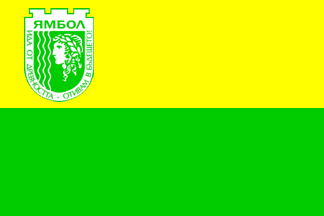


Geography and environment
The landscape is shaped by the Tundzha (Tundja) River, which runs across the province and provides fertile alluvial soils for agriculture. The terrain combines flat plains and rolling hills with patches of forest and wetland along river corridors. Climate is typically temperate continental with warm summers and cool winters, making the area suitable for a range of crops and for pasture.
Municipalities
The province is divided into several municipalities that administer local towns and villages. Major municipalities include:
- Yambol (the provincial capital)
- Tundzha
- Elhovo
- Bolyarovo
- Straldzha
History and culture
Human settlement in the area dates back to antiquity, and the region has seen Thracian, Roman and medieval Bulgarian influences. During the Ottoman period the territory was integrated into imperial administrative systems and later became part of the modern Bulgarian state after the 19th century national liberation movements. Today the province preserves archaeological remains, local museums and folk traditions, and towns host cultural events that reflect both rural and urban heritage.
Economy and transport
Yambol Province's economy is largely agricultural, with arable farming, vineyards and livestock farming playing important roles. There is also food processing, light manufacturing and services concentrated in the city of Yambol and other local centers. Transport links include regional roads and rail connections that serve commerce and link the province with larger Bulgarian cities and neighboring regions.
Points of interest and notable facts
Visitors and residents value the riverine landscapes along the Tundzha, historical town centers, and local cultural institutions. Nature areas near the river and in woodlands offer opportunities for outdoor recreation. The provincial capital functions as the administrative, economic and cultural hub while smaller towns retain distinct local character. For more administrative or geographic details see mapping and official regional pages (coordinates, province overview, national context, city of Yambol).
Questions and answers
Q: Where is Yambol located?
A: Yambol is located in southeastern Bulgaria.
Q: What is the capital city of Yambol province?
A: The capital city of Yambol province is also named Yambol.
Q: What are the other municipalities in Yambol province?
A: The other municipalities in Yambol province are Bolyarovo, Elhovo, Straldzha, and Tundzha.
Q: What river flows through Yambol province?
A: The Tundja River flows through Yambol province.
Q: What are the coordinates of Yambol?
A: The coordinates of Yambol are 42°25′N 26°31′E / 42.417°N 26.517°E / 42.417; 26.517.
Q: Where is Yambol situated in relation to the rest of Bulgaria?
A: Yambol is situated in southeastern Bulgaria.
Q: What are some notable features of Yambol province?
A: The Tundja River flows through Yambol province, and the province includes the municipalities of Bolyarovo, Elhovo, Straldzha, Tundzha, and the capital city of Yambol.
Related articles
Author
AlegsaOnline.com Yambol Province (Yambolska oblast) — Southeastern Bulgaria Leandro Alegsa
URL: https://en.alegsaonline.com/art/109595
Sources
- zei.de : Bulgarian Provinces area and population 1999 — National Center for Regional Development — page 90-91
- nsi.bg : Bulgarian National Statistical Institute - Bulgarian provinces and municipalities in 2009