
Xiphosura: horseshoe crabs and their extinct relatives
Xiphosura is an order of marine chelicerates that includes living horseshoe crabs and many extinct relatives. This article covers their anatomy, fossil record, classification, ecological role, and conservation significance.
Overview
Xiphosura is an order of marine arthropods often recognized by the familiar horseshoe crab body plan. Modern representatives belong to the family Limulidae and comprise only a few surviving species, commonly called horseshoe crabs. The group has an extensive fossil record that documents many extinct lineages and shows remarkable morphological continuity through deep time. For general context see Xiphosura (order) and the broader group of chelicerates.
Image gallery
6 Images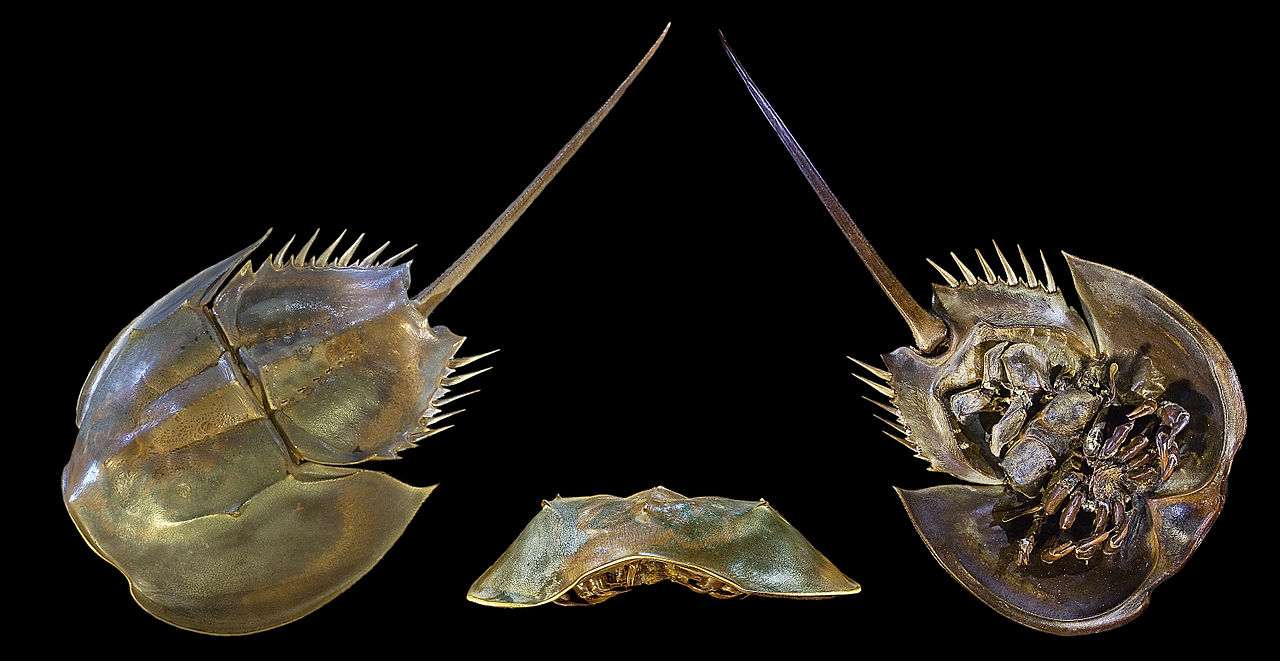


Anatomy and lifestyle
Xiphosurans have a distinctive flattened, shield-like prosoma (head), an articulated opisthosoma (abdomen), and a long rigid tail spine called a telson. They possess simple and compound eyes, a set of chelicerae near the mouth, and numerous walking limbs that also function in feeding. Respiration is accomplished with book gills on the ventral side of the opisthosoma. Most species are benthic scavengers and opportunistic predators that live on soft sediments and come ashore in large numbers to spawn on beaches.
Key characteristics
- Hard dorsal carapace protecting the body
- Book gills used for gas exchange and sometimes limited locomotion
- Opisthosomal segmentation with spines or opercula in some taxa
- Long telson used for righting the body when overturned
Fossil record and evolutionary history
The fossil history of xiphosurans extends back hundreds of millions of years. Numerous extinct genera are known from marine sediments, and some Jurassic fossils (for example Mesolimulus) closely resemble living horseshoe crabs. Because of this apparent morphological stability, modern species are often called living fossils. Molecular and paleontological data indicate that the lineage leading to living xiphosurans diverged early in chelicerate evolution; estimates place the split between xiphosurans and the branch that led to arachnids at roughly 480 million years ago.
Classification and relationships
Xiphosura were traditionally grouped with eurypterids in the class Merostomata, a historical assemblage that emphasized shared primitive traits. Modern systematic work shows that Merostomata as originally conceived is paraphyletic, and the name is used with caution. Current analyses place Xiphosura as a basal lineage relative to a clade containing eurypterids and Arachnida; this changing view reflects the difference between shared ancestral features and derived characters used to infer relationships. For more on taxonomy and terminology see Merostomata and discussions of paraphyly.
Ecological and human significance
Horseshoe crabs play important roles in coastal ecosystems. Their eggs are a critical food source for migrating shorebirds, and adults act as scavengers that help recycle organic material. In medicine, blood from horseshoe crabs has been used to produce Limulus Amebocyte Lysate, a reagent that detects bacterial endotoxins and helps ensure the safety of vaccines and injectable drugs. Conservation concerns include habitat loss, overharvesting for bait and biomedical collection, and impacts from coastal development; these pressures have led to population declines in parts of their range.
Notable distinctions and conservation
- Only a small number of species survive today, concentrated in a few geographic regions and grouped within the family Limulidae (extant species).
- Common name: horseshoe crabs, though the order includes many fossil forms beyond the modern animals.
- Because of their long fossil record and minimal apparent change, xiphosurans are frequently cited in discussions about evolutionary stasis and morphological conservatism.
For further reading on anatomy, fossils, and conservation policy consult specialist summaries and reviews accessible through academic and museum resources (order overview, chelicerate context, common name usage).
Questions and answers
Q: What is Xiphosura?
A: Xiphosura is an order of marine chelicerates.
Q: Which family does Xiphosura include recent species of?
A: Xiphosura includes recent species of the family Limulidae, which include the horseshoe crabs.
Q: Are the modern horseshoe crabs considered to be living fossils?
A: Yes, the modern horseshoe crabs are considered to be living fossils because they look almost identical to prehistoric genera such as the Jurassic Mesolimulus, and the group has hardly changed in millions of years.
Q: What is the traditional classification of Xiphosura?
A: Xiphosura are traditionally placed in the class Merostomata.
Q: Why is the term Merostomata considered to be paraphyletic?
A: The term Merostomata was originally made for the eurypterids, and now with the Xiphosura added, it is known to be paraphyletic.
Q: When did Xiphosura diverge from the Arachnida?
A: It is estimated that the Xiphosura diverged from the Arachnida 480 million years ago.
Q: How are the shared features of the two groups traditionally grouped in the Merostomata thought to be?
A: The shared features of the two groups traditionally grouped in the Merostomata are now thought to be retentions of primitive conditions (symplesiomorphies).
Related articles
Author
AlegsaOnline.com Xiphosura: horseshoe crabs and their extinct relatives Leandro Alegsa
URL: https://en.alegsaonline.com/art/109499
Sources
- helsinki.fi : "Xiphosura - Horseshoe crabs"
- books.google.com : The variety of life: a survey and a celebration of all the creatures that have ever lived
- biomedcentral.com : "The colonization of land by animals: molecular phylogeny and divergence times among arthropods"
- doi.org : 10.1186/1741-7007-2-1
- ncbi.nlm.nih.gov : 333434